Rowan
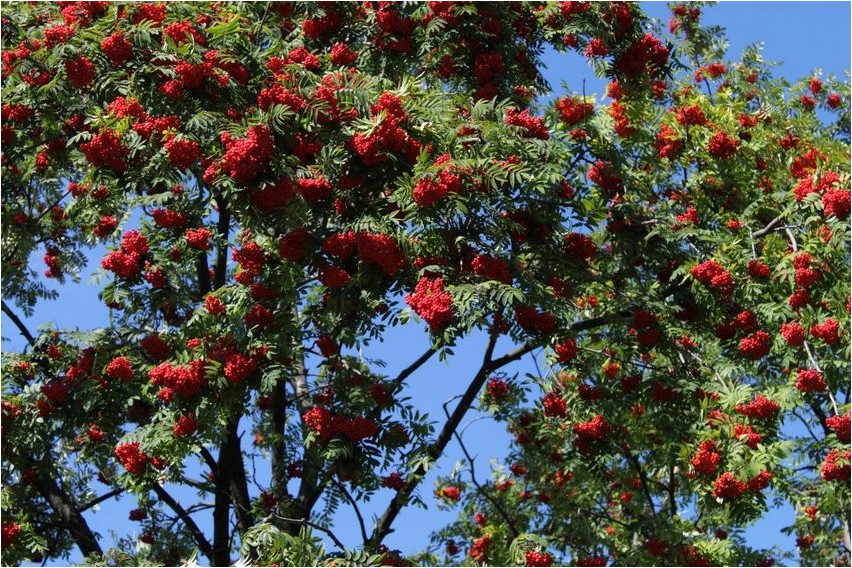
Rowan (lat. Sorbus) is a berry crop; genus of trees or shrubs of the Rosaceae family. Under natural conditions, rowan grows throughout Europe, Asia and North America. Currently there are more than 100 species.
Description
Rowan is a deciduous tree or shrub 2-15 m high, the trunk and branches of which are covered with grayish bark. The crown of the rowan tree is wide. The leaves are quite large, equipped with petioles, imparipinnate, serrated along the edges, alternate, formed from 11-23 elongated leaflets.
The flowers are white, pinkish or cream-colored, with a specific smell, collected in corymbs that reach 6-10 cm in diameter. The calyx is five-petaled, the corolla is white, and is about 15 mm in diameter. Flowering occurs in early May.
The fruits are spherical or oval, up to 15 mm in diameter, and can be bright red or orange-red in color. The fruit is juicy, has a bitter and astringent taste. The fruits ripen in mid-August. The seeds are small, rounded at the edge. The berries remain on the branches for a long time, sometimes remaining until winter. They are readily eaten by birds.
Features of cultivation
Rowan is a light-loving crop, loves well-lit places, and can grow in partial shade. The plant is not demanding on soil, but develops best in light, fertile, moderately moist, well-drained soils with a neutral or slightly acidic pH. Rowan does not accept polluted and smoky areas. It will also not tolerate damp, highly acidic or too poor soils.
Reproduction
Rowan is propagated by seed, cuttings and grafting. The last method is most effective for decorative varieties. The most commonly used rootstocks are chokeberry, apple, pear, hawthorn or Finnish rowan. The grafting is carried out by budding with a sleeping eye in the first ten days of July — the first ten days of August.

Sowing seeds that have previously been subjected to cold stratification is carried out both in early spring and a couple of months before the onset of cold weather in early autumn. In winter, crops are mulched with peat or humus. Young plants are planted in a permanent place in September; a later planting date is not recommended.
When propagated by cuttings, up to 60-65% of the material takes root. This process is simple and can be done even by a novice amateur gardener.
Planting seedlings
The seedlings are planted in pre-prepared holes, the diameter of which should be about 80-100 cm and the depth — 50-60 cm. A substrate consisting of garden soil, humus or compost and fertilized with superphosphate, potassium chloride and wood ash is poured into the bottom of the hole.
The seedling is lowered into the hole, straightening the roots, covered with fertile soil, compacted, watered abundantly (at the rate of 20 liters per plant) and mulched with natural material. Important: the root collar should be located four centimeters above ground level.
Tall varieties of the crop are planted at a distance of 5 m, low-growing ones — 3 m. In two-year-old seedlings, immediately after planting, it is advisable to cut off the skeletal branches by one third and shorten the central shoot.
Care procedures
Crop care involves systematic loosening, weed removal, watering, pruning and disease control. In regions with cold winters, rowan is required in shelter.
Sanitary and formative pruning is carried out in the third ten days of March — early April, but before the start of sap flow. Rowan is formed in two ways. The most common method is cascade. It consists of pruning shoots to 3-4 buds.
Rowan is a plant that is resistant to disease and attack by harmful insects. Rowan is often affected by sawflies, spider mites and cutworm caterpillars, as well as rowan moths. The latter pest is recognized as one of the most dangerous because it causes damage to the crop. The caterpillar of the rowan moth falls inside the berries and devours the seeds. For prevention, it is recommended to treat plants with wormwood infusion.





