Yellow Wood Oxalix
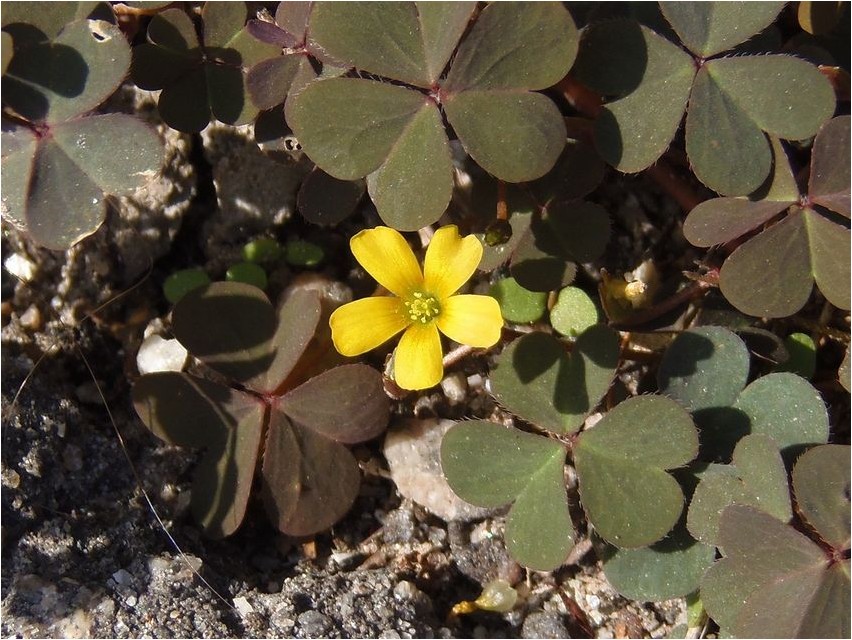
Yellow Wood Oxalix belongs to the family Oxalidaceae, and its Latin name is Xantoxalis corniculata (L.) Small.
As for the family name of yellow wood oxalix, its Latin name is Oxalidaceae R. Br.
Description of Yellow Wood Oxalix
Yellow Wood Oxalix is an annual or biennial herbaceous plant that is pubescent. The plant has a taproot. The stem is developed, reaching a height of between seven and fifty centimeters. This stem is slender and rounded, sometimes with purple hues. Most of the time, this stem is branched, spreading, and has numerous creeping shoots. The leaves of this plant are alternate and trifoliate. The flower stalks are straight and short-segmented at the base. The peduncle is one to one and a half millimeters long, the calyx is four millimeters long, and the corolla is exactly half that length. The corolla is almost bell-shaped, with yellow petals. The corolla is five to eight millimeters long and two millimeters wide. The corolla has a straight claw and a blunt, deflected blade. The capsule is rather pointed, cylindrical in shape, and one and a half to two centimeters long and about two to two and a half centimeters wide. The seeds are ovoid and flat, and can be brown or russet in color.
The yellow wood sorrel blooms from May to July. Remarkably, this plant is not only ornamental but also a valuable honey plant. Description of the medicinal properties of yellow wood sorrel
Yellow wood sorrel has very valuable medicinal properties, and it is recommended to use the herb and roots of this plant for medicinal purposes. The herb includes the flowers, leaves, and stems of this plant.
These valuable medicinal properties are due to the plant’s content of vitamin C and acetic acid. Notably, the herb of this plant contains glucose and the following organic acids: glyoxylic, malic, citric, oxalic, glycolic, and isocitric. The stems of this plant contain malic acid, and the leaves contain citric and tartaric acids.
As for traditional medicine, the plant is used as an antiseptic. Also, remedies based on this plant are used for dyspepsia, rectal prolapse, dysmenorrhea and dysentery. Locally, yellow sorrel carob is used for furunculosis as a wound healing agent. It is noteworthy that the juice of this plant is used for scabies and bites of various poisonous insects.

An infusion of leaves can be used as an antiscorbutic, diuretic, and astringent. This infusion is also used for diseases of the liver and gall bladder, for fevers and dysentery. As a poultice, an infusion of the leaves can be used as an anti-inflammatory, and the fresh juice can remove warts.
Also, preparations based on yellow sorrel carob are quite widely used for Graves’ disease. The plant can be eaten fresh to strengthen the gums. The plant is used as food for soups and salads, and also as sorrel.
For gastritis, which is accompanied by reduced secretion, it is recommended to prepare a remedy based on this plant: for this you need to take three tablespoons of leaves per two glasses of boiling water. The resulting mixture is left to infuse for two hours and then carefully filtered. Take this remedy half a glass three times a day.
Red-leaved oxalis purpurolifolia – weed





