Euphorbia esula
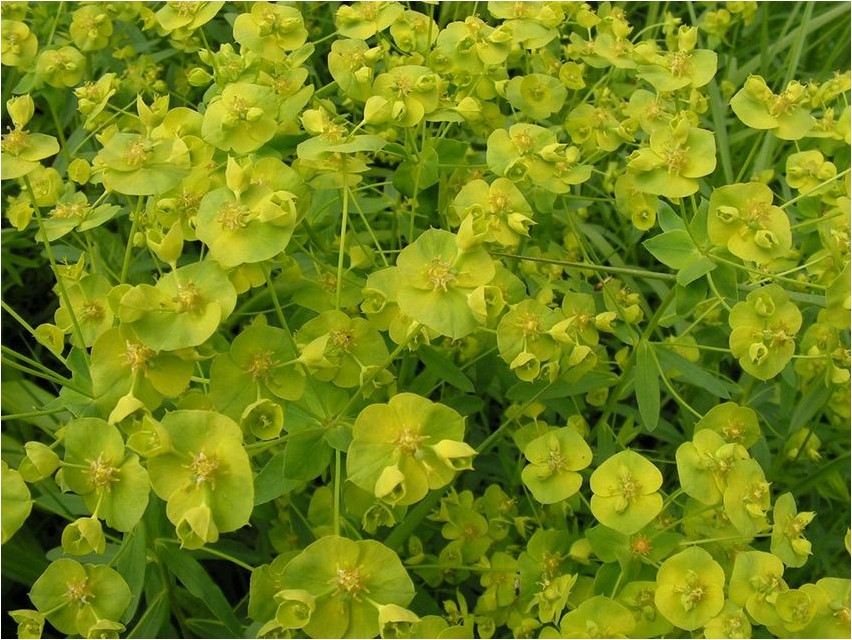
Euphorbia esula is a member of the Euphorbiaceae family. Its Latin name is Euphorbia esula L.
As for the family name itself, the Latin name is Euphorbiaceae Juss.
Description of Euphorbia esula
Euphorbia esula is a perennial herbaceous plant, reaching heights between twenty and seventy centimeters. Its roots are thinly cylindrical and creeping, branched, and endowed with long shoots. The stems of Euphorbia esula are round, glabrous, striped, and erect, bearing one to twenty-three axillary peduncles, which are often curved. The length of such flower stalks will be approximately one and a half to seven and a half centimeters. Below, the stems will be covered with densely foliated, later elongating branches, which in turn are non-flowering. The lower leaves of Euphorbia acuta will be scale-like and dry-filamented, while the cauline leaves can be either barely petiolate or sessile, growing from a gradually tapering base. The leaves of this plant will be serrated at the top, glabrous, soft, and eventually protruding, with a dull green color above and a bluish tint below. These leaves of this plant point upward and are located on non-flowering branches, which are seven to twenty millimeters long and about two to two and a half millimeters wide. The apical peduncles of the Euphorbia acuta are about eight to thirteen pieces, their length is approximately one and a half to six centimeters, like the axillary peduncles, they can be either simple or once or twice bipartite at the very end.
The involucre leaves are oblong-ovate or linear-lanceolate, their length is one to three centimeters, and their width is about one and a half to three and a half centimeters. The cup of Euphorbia acuminatum is bell-shaped, its diameter and length are equal to two to two and a half millimeters, it will be endowed with truncated, short and fringed lobes. The nectaries of this plant can be colored either green or yellow, but later they will turn brown. Such nectaries are short-horned, but they are often almost hornless. The three-flowered milkweed will be ovoid, its length is two and a half to three and a half millimeters, it is glabrous and deeply three-striated. The seed of this plant is ovoid, it is smooth and colored in yellow-brown tones, and is also endowed with a kidney-shaped appendage, also colored in yellow tones.
Acute milkweed blooms from June to August. Under natural conditions, this plant is found in Moldova, Belarus, Ukraine, the European part of Russia, the Caucasus, Central Asia, Western and Eastern Siberia.
Description of the medicinal properties of acute milkweed
Acute spurge is endowed with very valuable healing properties, and for medicinal purposes it is recommended to use the grass, roots and milky juice of this plant. The concept of grass includes flowers, leaves and stems.

The presence of such valuable healing properties should be explained by the content of rubber, alkaloids, milky juice, resins, higher fatty acids, diterpenoids, phenol carbonic gallic acid, resins, higher aliphatic carbohydrates and many other useful substances in this plant.
An ointment based on the herb powder of this plant is used for external tumors. The milky juice of Euphorbia spurge should be used to remove calluses and warts, and mixed with sulfur, this juice is used for scabies and leishmaniasis.





