Grapes
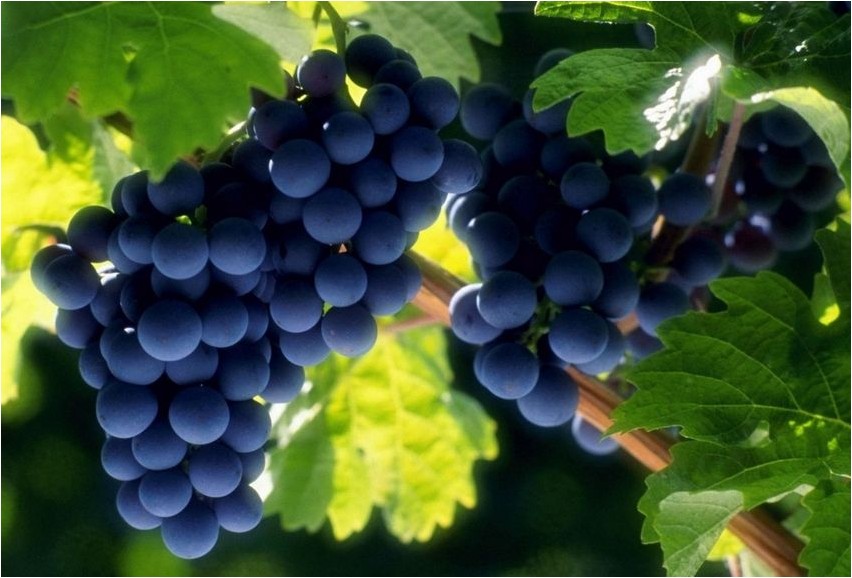
Grapes (Latin: Vitis) are a fruit crop; a genus of perennial vines in the grape family Vitaceae. Various grape species are native to the Mediterranean, North America, Western Europe, and Asia.
Currently, grapes are a highly valued crop, used in the food industry, including winemaking.
Crop Characteristics
Grapes are a perennial vine with elongated, well-developed shoots that stop growing in autumn until they reach a lower bud. The following year, new, vigorous shoots form from this bud, which in turn bear shorter fruit. Young shoots are green; mature shoots are yellowish-brown. Only long shoots flower and bear fruit. The leaves are medium to large, five-lobed, deeply dissected, and usually rounded.
The flowers are small, gathered in paniculate or compound racemose inflorescences. Flowers can be bisexual, female, or male. Flowers of the first type are characteristic of most existing varieties grown for food. The fruits are ovoid or spherical berries, collected in loose or dense clusters of cylindrical or cylindroconical shapes. Fruit color can vary greatly depending on the variety—yellow, green, dark blue, purple, burgundy, black, and others. The flesh is usually fleshy, sweet or slightly tart, sometimes with tart notes.
Growing Conditions
Grapes love the sun, but can also grow in shaded areas in tropical regions. Grapes grown in dense shade often shed their leaves, and the shoots fail to ripen and freeze with the onset of persistent cold weather. Temperature also plays a significant role in growing grapes. For example, in temperate climates, early-ripening varieties are grown, as varieties with a long growing season do not have time to ripen. The temperature threshold for most species is 10°C (50°F). The optimal temperature for active growth and development is 30°C (86°F) for late-ripening varieties, 28°C (82°F) for mid-season varieties, and 25-26°C (77-77°F) for early-ripening varieties. These parameters must be taken into account when choosing a variety for cultivation in a personal garden.
Since some grape roots can penetrate to considerable depth, soil conditions apply not only to the arable layer but also to the subsurface. All grape varieties have their own soil composition requirements, but most prefer light, well-warmed, well-drained, and mineral-rich soils.

Propagation and Planting
Grapes are easy to propagate by cuttings and layering, so there is no need to purchase expensive seedlings. There are other ways to produce new plants, such as by sowing seeds. But this method is used only by breeders and is intended for breeding new varieties. Grapes are also propagated by grafting; this procedure is only possible for experienced gardeners.
Propagation by short cuttings is carried out in the fall. Cuttings containing 1-2 eyes are cut from healthy shoots. They are soaked in warm water for 24 hours, then dried and planted in pots with a diameter of 10 cm filled with a moisture-retaining substrate. The substrate is made up of lowland peat, fertile soil and coarse sand in a ratio of 1:1:1; or from sphagnum peat and sawdust (1:1); or from sawdust, coarse sand and humus (3:1:1). Also, before planting, cuttings can be treated with growth stimulants, this will speed up the rooting process. Important: when planting a cutting in a substrate, its upper eye should be located at the level of the substrate. A plastic film is stretched over the pots, but it should not come into contact with the cuttings. Rooting occurs in 20-30 days, however, subject to regular watering and systematic ventilation. Young plants are planted in open ground next spring, by which time the shoots have formed a well-developed root system and a shoot 30-40 cm long.
Propagating grapes by layering is a rather labor-intensive method, but quite doable. On bushes intended for propagation, the shoots are cut so that 2-3 eyes are preserved on each. The shoots formed from them (25-30 cm long) are hilled to a height of 5-8 cm. For hilling, you should use a soil mixture consisting of fertile soil and coarse sand in a 1:1 ratio. When the shoots reach a length of 50-60 cm, they are hilled to a height of 25-30 cm. Subsequently, the shoots are minted, which involves removing the tops to stop their growth; this agrotechnical technique allows for improved fruit formation. In autumn, the shoots are separated from the mother plant using pruning shears and stored. Seedlings are planted in the ground next spring.
Care
In the spring (usually in April), the grapes are freed from winter shelter, and the bunches are tied to a trellis in an inclined or vertical position, while the fruit shoots are placed on the lower trellis. If a white coating appears from dampness, do not be alarmed; it will disappear over time. Also, after opening, the grapes are treated with the drug “Nitrafen” (at the rate of 200 g per 10 liters of water). This procedure will prevent the further existence of fungi and viruses identified last season. To obtain a good harvest, at the end of April, sanitary and thinning pruning is carried out, along with which basal shoots and excess buds are removed. Fertilizing is carried out in early May; experienced gardeners advise using complex liquid fertilizers. During flowering, excess ovaries will be removed; this is necessary so as not to subsequently overload the bush.
With the onset of summer, periodically pinching the vines is carried out, removing stepsons and leaves that prevent access of sunlight to the developing bunches of berries. In July, the grapes are fed with mullein solution, superphosphate, nitrophoska and wood ash. It is also important to promptly loosen the stem zone, carry out watering, remove weeds and spray the plants with antifungal and antiviral drugs. In the fall, after harvesting, the plants are fed, treated against pests and diseases, old and damaged shoots are removed, bent to the ground and covered with spruce branches.
GRAPES
https://www. youtube. com/watch? v=-o7fApf51mY
Grapes grapes