Cetraria icelandica
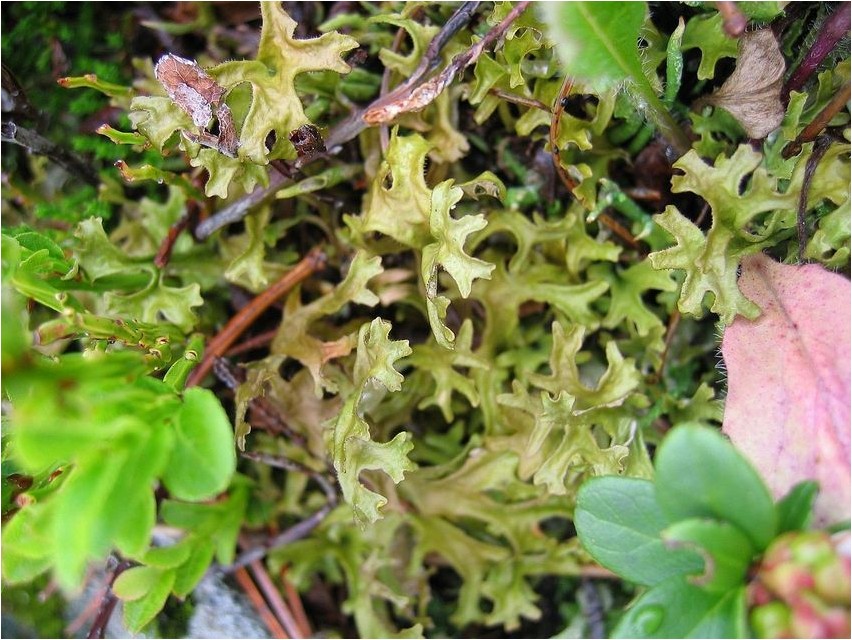
Icelandic Cetraria is one of the plants of the family called Parmeliaceae; in Latin the name of this plant will be as follows: Cetraria islandica.
As for the name of the Icelandic Cetraria family itself, it will be: Parmeliaceae Juss.
Description of Icelandic Cetraria
Icelandic Cetraria is a plant that is also called Icelandic moss. However, in fact, this plant should be classified as a lichen. Such a perennial leafy-bushy thallus will be colored in greenish-brown or greenish-gray tones. This plant will be cut into ribbon-like pieces, the length of which will be about ten centimeters and the width will be equal to two centimeters. The plant is endowed with rather short darkish outgrowths along the edges. The thallus will attach to the soil or to trees by means of hairs called rhizoids. At the edges of the blades of such a plant, fruiting bodies develop in the form of dark brown thin formations in which microscopic spores will be fixed. In wet weather, such a thallus of Icelandic cetraria will be soft-skinned, but in dry weather it is hard, and the color of this thallus will be brown-gray. Reproduction of this plant occurs through spores or vegetatively.
Under natural conditions, this plant is found in all regions of the former USSR, which will be located north of the steppe zone, as well as in the Caucasus and Crimea. Icelandic cetraria can grow either singly or in large groups on dunes, in pine forests, in high-mountain and alpine meadows, on sandy heaths, in coniferous-deciduous forests, as well as on the soil and bark of old stumps. It is noteworthy that the plant is an indicator of air purity in the atmosphere, which is due to the fact that the plant grows in conditions that will be completely free from any atmospheric pollution.
Description of the medicinal properties of Icelandic cetraria
Icelandic cetraria is endowed with very valuable healing properties, and it is recommended to use the dried thallus of this plant for medicinal purposes. The presence of such valuable healing properties in the plant is due to the content of carbohydrates, which will be close in chemical nature to cellulose. The content of such carbohydrates will fluctuate between thirty and eighty percent.
Preparations created on the basis of this plant are endowed with antimicrobial, anti-inflammatory, choleretic, wound healing and laxative effects. It should be noted that this plant has been used in folk medicine in various countries since ancient times, and the plant also served as a food product in especially lean years. Consumption of Icelandic cetraria will also help activate the body’s immune system.

A decoction of this plant is a very valuable nutrient, which should be associated with the fact that the carbohydrates of this plant will be well absorbed by the body, and at the same time there will also be an improvement in appetite and normalization of digestion. For this reason, a decoction of this plant can also be used as a general tonic during the recovery period after serious illnesses. A decoction of this plant, among other things, is also endowed with a soothing, enveloping and wound-healing effect. This decoction is recommended for use for gastritis with reduced secretion of gastric juice, chronic constipation, diarrhea, digestive disorders, whooping cough, bronchial asthma, pulmonary tuberculosis and various respiratory diseases. Lotions made from a decoction of this plant are effective for burns, boils, ulcers and wounds.





