Medium plantain
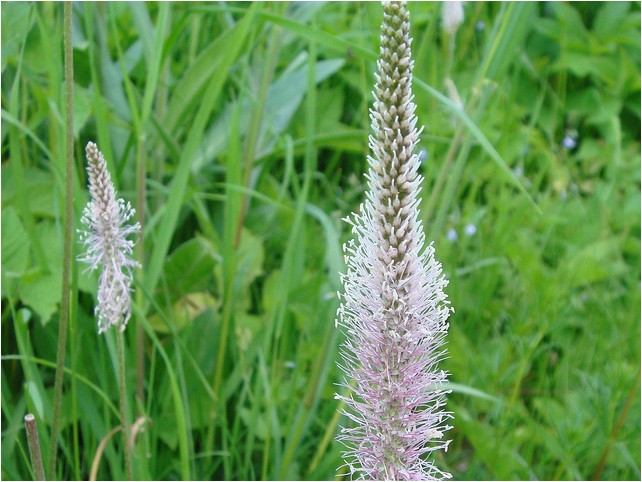
The middle plantain is one of the plants of the family called plantains; in Latin the name of this plant will be as follows: Plantago media L.
As for the name of the middle plantain family itself, in Latin it will be: Plantaginaceae Juss.
Description of plantain
The middle plantain is known by many popular names: babka, rzhanik, arzhenik, triputnik, Petrovy batogi, husarchik, putiki, wenge tongue and uzik. Medium plantain is a perennial herbaceous plant with a woody rhizome. The leaves of this plant can be either elliptical or ovate or even ovate-lanceolate. Such leaves of the middle plantain taper into a short wide petiole or are almost sessile with the absence of grooves on the flower arrow. Also, such leaves of this plant are endowed with a four-lobed calyx and an ovoid capsule, which will bear an average of three to four seeds. The seeds of the middle plantain are endowed with a light ridge; they will be oval in shape and flat-convex. This plant blooms from June to the autumn months.
Under natural conditions, the common plantain is found in Ukraine, the European part of Russia, Kazakhstan, Belarus, Western Transcaucasia, Western and Eastern Siberia, as well as the Okhotsk region and the Kuril Islands in the Far East. For growth, this plant prefers places near roads, sparse forests, floodplain, upland and high-mountain meadows, as well as forest glades.
Description of the medicinal properties of plantain
The average plantain is endowed with very valuable healing properties, and it is recommended to use the seeds, roots and leaves of this plant for medicinal purposes. The presence of such healing properties is recommended to be explained by the content of higher fatty linoleic acid and steroids in the roots of this plant, while the leaves will contain phenol carrboxylic acids, carbohydrates and related compounds. The seeds of plantain contain beta-sitosterol, triglycerides of linoleic and oleic acid, iridoid aucubin, as well as fatty oil, which in turn contains elaidic acid.
Medium plantain is endowed with very valuable wound-healing, anti-inflammatory, expectorant, analgesic and antiseptic effects, and will also improve metabolism and enhance the secretory activity of the stomach. An infusion prepared from the leaves of this plant helps to more effectively dilute sputum when coughing: for this reason, this infusion is used for a variety of diseases of the respiratory organs, which will be accompanied by a large secretion of mucous sputum: including whooping cough, bronchitis and pulmonary tuberculosis.

As for traditional medicine, this plant is very widespread here. A decoction prepared from the leaves of the common plantain is recommended for use in pleurisy, pulmonary tuberculosis, stomach and duodenal ulcers. A decoction based on the roots of this plant is used externally for toothache, while poultices made with milk are used for abscesses. An infusion based on plantain leaves should be used for hepatitis, pulmonary tuberculosis, as well as stomach and duodenal ulcers.
The powder and seeds of this plant can be used as a laxative, and also as an anti-inflammatory agent for stomach and duodenal ulcers, as well as for colitis. If used correctly, such a healing remedy will be very effective.





