Eyebright
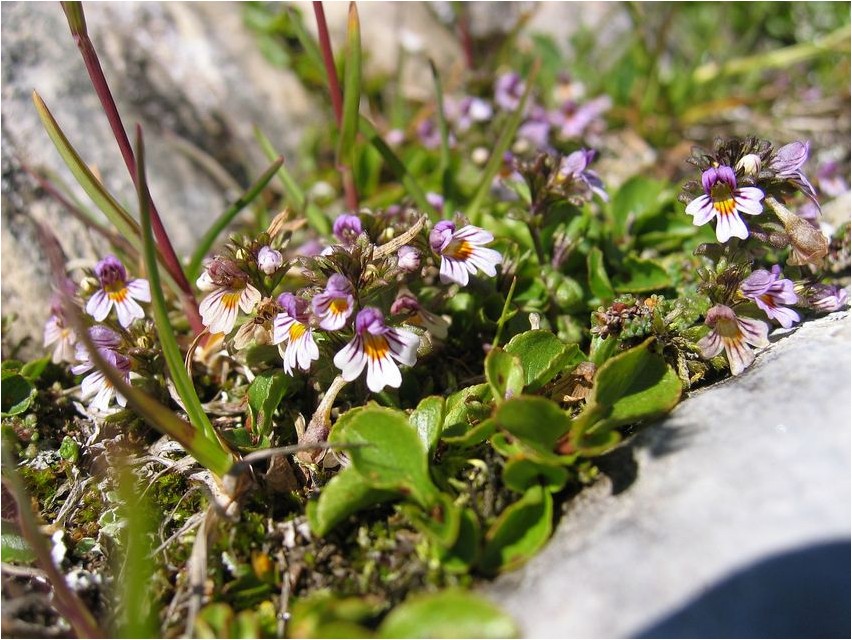
Eybright is a member of the Scrophulariaceae family. Its Latin name is:
Euphrasia rostkoviana Hayne (E. officinalis L., p. p et auct. mult. s str., E. officinalis L., var. pratensis (Tries.) Koch). The Latin name of the eyebright family is: Scrophulariaceae Juss.
Description of Eyebright
Eybright, also known as common eyebright, is an annual herbaceous plant, reaching a height of between ten and fifteen centimeters. This plant is semi-parasitic. The stem of eyebright is erect, often branching in the lower part. The stem of this plant is covered with brownish hairs and is colored either green, brownish, or reddish. The inflorescence is initially compressed, later becoming elongated. The flowers of the Euphrasia rostovii are nearly sessile, with a fairly large corolla, initially about nine to eleven millimeters long, reaching eleven to fourteen millimeters by the end of flowering. This corolla has a two-lobed upper lip and notched lobes that are also recurved. The upper lip of the Euphrasia rostovii is three-lobed, and the lower lip has a yellow spot and purple stripes. Interestingly, both lips of this plant can sometimes be white.
Eybright rostovii blooms from June until October. In the wild, this plant is found in Belarus, the Dnieper region, and the Carpathian Mountains of Ukraine, as well as in the following regions of European Russia: the Ladoga-Ilmen, Volga-Kama, Volga-Don, Upper Volga, and Baltic regions. Eyebright grows in meadows, forest clearings, and deciduous forests. It is worth noting that this plant is a highly valuable honey plant.
Description of the medicinal properties of Eyebright
Rostkovius eyebright is endowed with very valuable healing properties, and it is recommended to use the entire above-ground part of this plant for medicinal purposes. The presence of such valuable healing properties should be explained by the content of iridoids and flavonoids in the composition of this plant, in turn, the composition of the aerial part of Rostkovius eyebright will contain organic acid, carbohydrates, related compounds minnit, essential oil, higher aliphatic carbohydrates, alcohols, phenolcarboxylic acid cinnamic and caffeic, as well as the following higher fatty acids: linolenic, oleic, linoleic and stearic.
It should be noted that the essence of this plant is quite widespread in homeopathy. Externally, this healing agent is recommended for use for compresses and rinsing for blepharitis, glaucoma, acute and chronic conjunctivitis, weak vision, stye on the eyelid, inflammation of the lacrimal sacs and bronchitis. In addition, this plant is also used: the crushed fresh aerial part of Rostovius eyebright is used for rhinitis, dermatitis and eczema.

As for traditional medicine, here this plant is used in the form of an aqueous infusion for rhinitis and eye diseases. It is noteworthy that the effectiveness of such a healing agent has been confirmed experimentally. In addition, this remedy is used for sore throat, colitis, bronchopneumonia, various respiratory infections, hypertension, sclerosis, scrofulosis, hysteria, headache, anorexia, bronchial asthma, warts, dermatoses, memory disorders and as an astringent.





