Ragwort falsewort
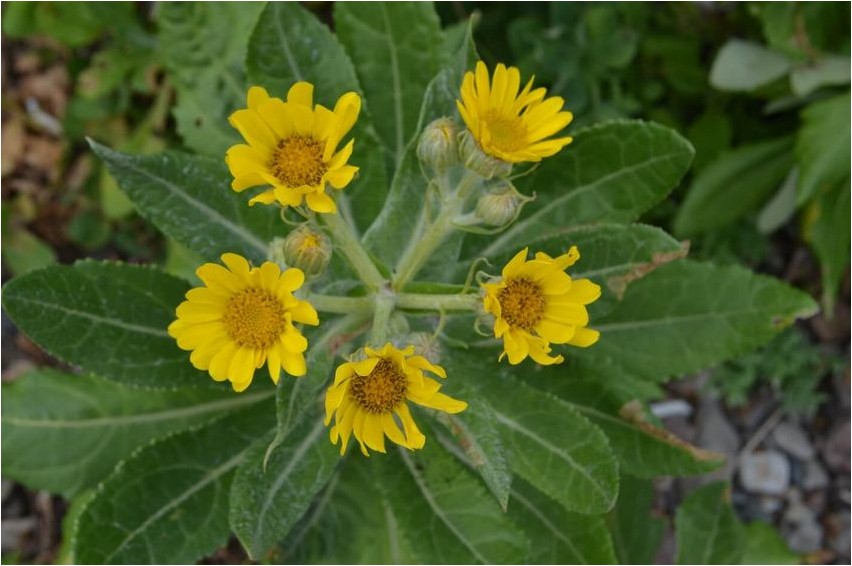
The pseudoarnica plant is one of the plants of the family called Asteraceae or Asteraceae; in Latin the name of this plant will be as follows: Senecio pseudoarnica Less.
As for the name of the ragwort family itself, in Latin it will be like this: Asteraceae Dumort.
Description of the false ragwort
False ragwort is a perennial herbaceous plant whose height will vary between fifteen and seventy centimeters. The rhizome of this plant is shortened, it will be covered with numerous and rather long roots. The stem of the plant is straight and simple, and inside it will be hollow. The basal and lower stem leaves will wilt early, while the middle and upper leaves will be oblong and ovate in shape. The length of the leaves of the false ragwort is about eight to twenty-five centimeters, and the width will be approximately two and a half to nine centimeters. Baskets, numbering two to fifteen pieces, are located at the very top of the stem of this plant. Such baskets will form a loose corymbose inflorescence, which will be located on almost bare or cobwebby-pubescent peduncles. The reed flowers are colored yellow, there are about fifteen of them, the length of such flowers will be about fifteen millimeters, and the width will not exceed three to four millimeters. The achenes of the pseudoarnicula will be bare, ribbed and shiny, they are painted in light brown tones, their length is seven millimeters, and their thickness will be about one millimeter.
Flowering of the false ragwort occurs in the period from July to September. Under natural conditions, this plant is found in the Far East and the Eastern Arctic. For growth, the plant prefers pebbles and seaside sands.
Description of the medicinal properties of ragwort
The ragwort is endowed with very valuable healing properties, and it is recommended to use the herb of this plant for medicinal purposes. The presence of such valuable healing properties should be explained by the content of alkaloids in this plant.
As for traditional medicine, here this plant has received quite wide use. Ragwort is used to treat dermatoses. Infusion and decoction of this plant are recommended for use in ascites, and also as a very effective diuretic and hemostatic agent. Externally, the infusion and decoction are used as an antiseptic for acne and boils. It is noteworthy that the stems of the false ragwort can be eaten boiled.

For ascites, it is recommended to use the following very effective remedy based on ragwort: to prepare such a remedy you will need to take ten grams of crushed dry grass of this plant per two hundred milliliters of water. The resulting healing mixture should be infused in a warm place for about two hours, after which it is recommended to strain this mixture based on ragwort very carefully. Take this remedy three times a day, one or two tablespoons. It is noteworthy that the same infusion of ragwort can also be used externally in the form of lotions and compresses for acne and boils. It should be remembered that to ensure the greatest effectiveness when taking such a remedy, it is important to strictly follow not only all the standards for the preparation of such a remedy, but also all the rules for its administration.





