Tatarian honeysuckle
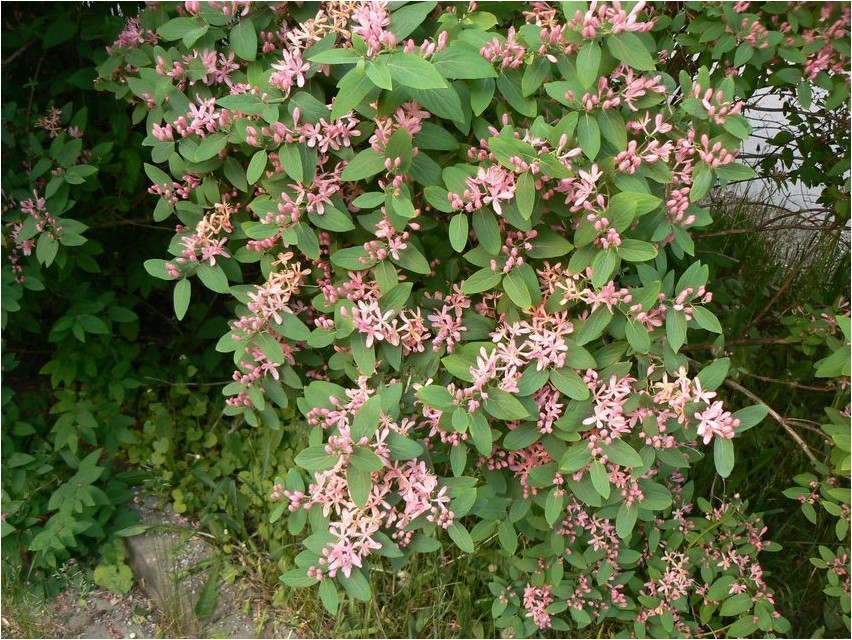
Tatarian honeysuckle is one of the plants called honeysuckle; in Latin the name of this plant will be as follows: Lonicera tatarica L.
As for the name of the Tatarian honeysuckle family itself, in Latin it will be: Caprifoliaceae Juss.
Description of Tatarian honeysuckle
Tatarian honeysuckle is a shrub whose height will vary between one and a half and two and a half meters. The leaves of this plant are on short bare petioles, and in shape they will be oblong-ovate. The length of such leaves is two and a half to eight centimeters, and the width varies between one and a half and four centimeters. The length of the corolla is twelve to twenty-four centimeters, while the fruits will be naked on the outside, they are pink in color: from pale pink to brick red. The fruits are six to eight millimeters long, they are spherical in shape, with a brightly colored corolla they will be bright red, but with a pale corolla they can be either yellow or orange.
Flowering of Tatarian honeysuckle occurs from the end of May to June, with fruiting occurring in July-September. Under natural conditions, this plant can be found in Central Asia, Western Siberia, as well as in the following regions of the European part of Russia: in the Zavolzhsky, in the north of the Volga-Don and in the Volga-Kama region. For growth, Tatarian honeysuckle prefers forest edges, places along river valleys and in hollows, as well as hillsides, among bushes and in the undergrowth of floodplain forests. The plant can grow either singly or in groups, or in large thickets. The plant is not only decorative, but also a rather valuable honey plant.
Description of the medicinal properties of Tatarian honeysuckle
Tatarian honeysuckle is endowed with quite valuable healing properties, and it is recommended to use the bark of this plant for medicinal purposes.
The presence of such valuable healing properties is explained by the content of alkaloids, triterpene saponins, tannins, flavonoids, higher aliphatic carbohydrates and coumarins in this plant. The flowers of this plant will contain glucose, sucrose and fructose, while the fruits of Tatarian honeysuckle contain higher aliphatic hydrocarbons.

It should be noted that this plant exhibits antibacterial activity. A water-alcohol tincture of leaves and branches of Tatarian honeysuckle exhibits very effective anti-Trichomonas activity. A decoction of the bark of this plant, both internally and externally in the form of lotions, can be used for goiter. Volatile and water-soluble substances in the experiment became inhibitors for numerous field weeds, as well as activators for poplar and oak.
It is noteworthy that Tatarian honeysuckle is a poisonous plant, which especially applies to the fruits of this plant. There were also known cases of poisoning of children.
For goiter, it is recommended to use a fairly effective remedy based on Tatarian honeysuckle: to prepare such a remedy you will need to take one teaspoon of crushed bark per glass of water. The resulting mixture should be boiled over a fire for five minutes, then this mixture is infused for one hour, after which it is filtered very carefully. Take the resulting product based on Tatarian honeysuckle, one tablespoon three times a day. It should be noted that in order to achieve the greatest effectiveness when using this product, it is important to follow not only all the preparation rules, but also all the norms for taking such a product.





