Arctic princess
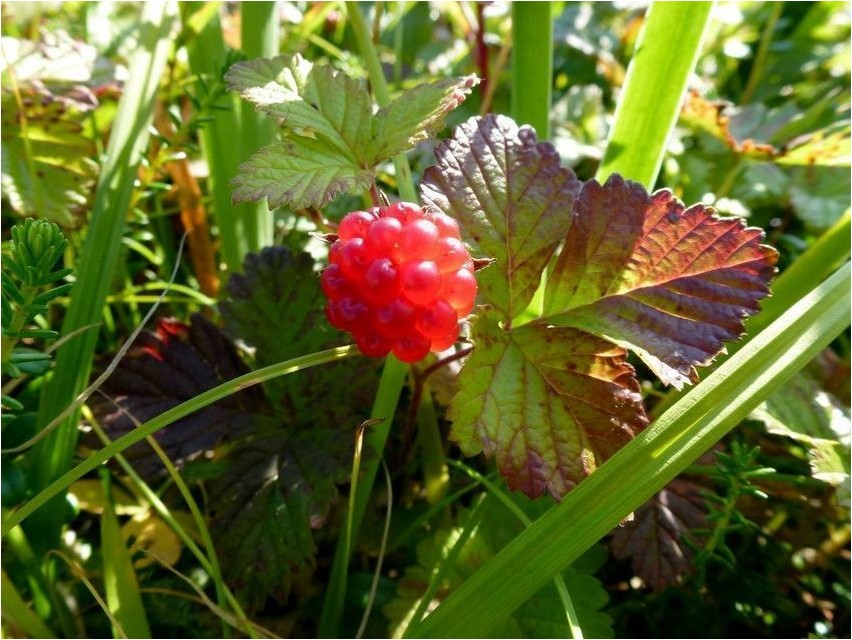
Arctic princess is one of the plants of the family called Rosaceae; in Latin the name of this plant will be as follows: Rubus arcticus L.
As for the name of the arctic princess family itself, in Latin it will be: Rosaceae Juss.
Description of the Arctic princess
The Arctic princess is also known under other popular names: paletiga, zharovikha, princess, red princess, princess, princess, princess, red princess, earthen raspberry, raspberry, midday, kumarichnik, polynitsa, Khokhlyanka, Khokhlusha, Khokhlynitsa, mamura, mamurovka, northern raspberry, red cloudberry, paw powder. Arctic princess is a perennial herbaceous plant, endowed with a long and creeping rhizome, the height of which will be about ten to thirty centimeters.
The stems of this plant are simple and bluntly triangular; at the base, such leaves will be endowed with scales. The leaves of the arctic princess are endowed with rather large stipules, they are trifoliate and are located on rather long pubescent petioles. The terminal leaf is on a short petiole, and the lateral leaves are practically sessile. The flower of this plant is apical and solitary; it is quite large, six to ten-membered and bisexual. It should be noted that sometimes Arctic princess flowers can be unisexual: in this case, such a plant will be dioecious. The sepals are hairy and lanceolate, and when flowering they become splayed. The petals of the arctic princess will be obovate, and their color will be dark pink. It should be noted that the stamens of this plant are numerous. There are about twenty pistils of Arctic princess and they are much shorter than the stamens. The fruit of this plant is a red, aromatic drupe.
The Arctic princess blooms from June to July. Under natural conditions, this plant is found in the Far East, the European Arctic, as well as Western and Eastern Siberia. For growth, this plant prefers tundra, swamps, damp and swampy forests.
Description of the medicinal properties of arctic princess
Arctic princess is endowed with very valuable healing properties, and it is recommended to use the fruits and leaves of this plant for medicinal purposes. Arctic princess berries are recommended to be harvested in the month of August, and the leaves are harvested from June to July.

The presence of such valuable healing properties should be explained by the content of flavonoids and traces of saponins in the composition of the herb of this plant. The fruits of Arctic princess contain anthocyanins, ascorbic acids, sugars, citric and malic acid. It is noteworthy that during the flowering period of this plant, a fairly large amount of tannins will be present in the leaves.
Arctic princess berries are endowed with anti-inflammatory, antiscorbutic and antipyretic effects. An aqueous infusion of the berries of this plant is used as a valuable antipyretic for febrile diseases, and also as a vitamin remedy for the treatment and prevention of scurvy. A water infusion of berries is also used to quench the berries. In addition, the berries of this plant have a diuretic effect and are recommended for use in cases of gout and urolithiasis. An infusion prepared from the fruits of this plant should be used as a gargle for various inflammatory diseases of the mucous membrane of the mouth and throat.





