Cnidium monnier
Cnidium monnieri is one of the plants of the family called Umbellaceae; in Latin the name of this plant will be as follows: Cnidium monnieri (L.) Cuss ex Juss.
As for the name of the cnidium monnieri family itself, in Latin it will be: Apiaceae Lindl.
Description of Cnidium Monnier
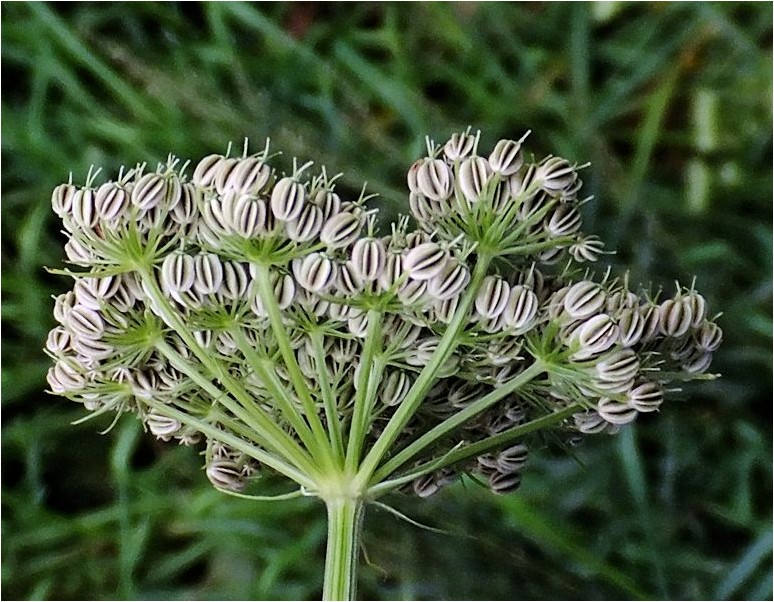
Cnidium monnieri is an annual herbaceous plant whose height can vary between thirty and one hundred centimeters. The root of this plant is vertical and spindle-shaped; the stems can be either several or single. Such stems of Cnidium Monnier are straight, at the top they will be bare, and at the bottom they will be short and rough pubescent. Only just before flowering do such stems become white-pubescent, branched, hollow and ribbed inside. In general, the leaves of this plant are ovoid; they can be either double-pinnate or triple-pinnate. The basal and lower stem leaves of Cnidium monnieri are on petioles that are equal to the plate; at the base, such leaves are expanded into a sheath covering the stem, painted in whitish tones. The length of the inflorescences in the form of umbrellas will be about two to five centimeters in diameter, it is endowed with fifteen to thirty rough rays along the upper side. The multileaf involucre consists of pointed and linear-subulate leaflets, which are approximately three times shorter than the rays of the umbrella themselves. The umbrellas will be small, their length in diameter will be about five to ten millimeters and they will be endowed with bare rays. The number of involucre leaves will be about five to nine pieces; they can be either linear-lanceolate or linear-subulate in shape. Along the edge, such leaves will be finely ciliated, and in length they will be equal to the pedicels themselves.
The fruit of this plant is broadly ovoid, its length is about two and a half millimeters, and its width is one and a half millimeters. This fruit is endowed with five wide winged ribs. Cnidium monnieri blooms from June to July. Under natural conditions, this plant is found in the Far East and Eastern Siberia. For growth, Cnidium monnieri prefers fallow lands, places along roadsides, as well as mixed-grass floodplain meadows.
Description of the medicinal properties of Cnidium monnieri
Cnidium monnieri is endowed with very valuable healing properties, and it is recommended to use both the herb and the fruits of this plant for medicinal purposes. The concept of grass includes the leaves, flowers and stems of this plant. The presence of such valuable healing properties should be explained by the content of coumarins in the composition of this plant, which are found in the roots and grass of this plant. The fruits contain essential oil and fatty oil, which contains petroselinic acid.
A decoction prepared from the herb of this plant is recommended for use as a fairly effective diuretic and antirheumatic agent. A decoction of Cnidium monnieri seeds or crushed seeds should be used for itching of the genitals, impotence and leucorrhoea, and also as a very effective antihypertensive agent. As for local use, it is possible for purulent wounds, leprosy and itching. A decoction prepared from the seeds of Cnidium monnieri should be used as a diuretic, and also as a remedy that has the ability to regulate menstruation. It is noteworthy that such products are always characterized by a fairly high degree of effectiveness when used.

It should be noted that the fruits of Cnidium monnieri are also used as a spice both in cooking and in canning.