Meadowsweet
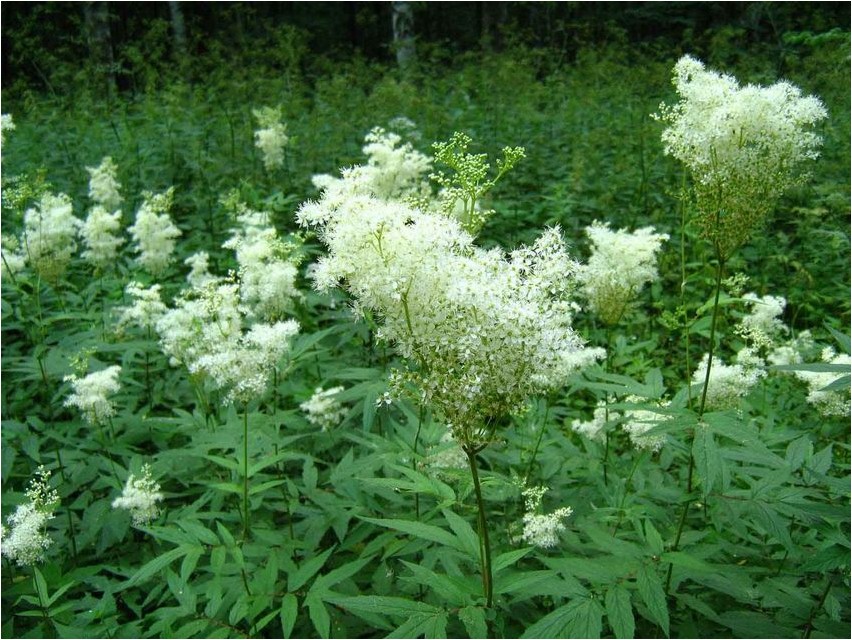
Meadowsweet (lat. Filipendula) is a perennial plant of the Rosaceae family. Another name is Meadowsweet. Under natural conditions, meadowsweet grows in the temperate climate zone of the Northern Hemisphere.
Currently there are about 13 species. The paucity of species is compensated by decorative diversity.
Characteristics of culture
Meadowsweet is a herbaceous rhizomatous plant with an erect stem up to 3 m high. The leaves are pinnate or pinnately divided. The flowers are numerous, small, collected in dense pyramidal, corymbose and paniculate inflorescences of yellowish-white, pink or red. The calyx has five or six petals; there are also terry forms. Double perianth.
The fruit is a multi-nut, and does not set in double varieties and hybrids. The root of meadowsweet is thickened, branching horizontally and forming buds from which flowering shoots are formed. Meadowsweet blooms in the first half of summer, that is, June – early July. The flowering period of the crop is about 20-25 days.
Very often, meadowsweet is confused with spirea. Some time ago, both plants were included in one genus. The updated botanical classification includes several species in the genus Spiraea: pink meadowsweet, Japanese meadowsweet, Bumald’s meadowsweet, Van Gutta’s meadowsweet, willow meadowsweet, the plant form of which is a shrub.

Growing conditions
Meadowsweet is an unpretentious crop. It grows well in intensely lit areas, protected from strong and piercing winds. The preferred soil for growing meadowsweet is light, rich in nutrients, aerated, loamy with a neutral pH. Acidic soils are not suitable for meadowsweet. Most types of crops are moisture-loving, but do not tolerate stagnation and excess moisture.
Reproduction and planting
Meadowsweet is propagated by seeds and division of the rhizome. Seed collection is carried out in the fall. Only ripened fruits that are easily separated from the receptacle are considered suitable for propagation of the crop. Seeds are sown in open ground immediately after collection. If sowing was postponed to spring, the seeds are stored in a cool room, after which they are stratified and scarified with sandpaper. Before sowing, the soil is dug up and fertilized. The seed placement depth is no more than 2 cm.
When propagating plants by dividing the rhizomes, planting material is collected from meadowsweet roots dug up in the fall. Each division should be about 5-7 cm. The divisions are planted immediately in a permanent place or stored in damp sand or sawdust in a cool room until spring.
Care
Caring for meadowsweet consists of timely watering, clearing the soil near the stem zone from weeds, fertilizing and controlling pests and diseases. Abundant watering is carried out in the summer, especially during long droughts; in the fall, watering is reduced. The soil should not be over-moistened. Fertilizing is carried out twice during the season: the first – with nitrophos and organic fertilizers in early spring, the second – with liquid complex fertilizers after flowering. Plants do not need shelter for the winter, with the exception of young specimens.
Application
Meadowsweet is a beautifully flowering and highly decorative plant, widely used in landscape design, which largely depends on the type and variety of the plant. Lush inflorescences and lacy foliage are an excellent decoration for various plant compositions. Meadowsweet is used as a planting in single and solitary plantings, especially for Kamchatka meadowsweet and red meadowsweet. Low and medium-sized forms will add a special decorative effect to mixborders. Moisture-loving species, such as meadowsweet, purple meadowsweet and Korean meadowsweet, are suitable for landscaping marshy areas, pond banks and lowlands.
In addition to its expressive aroma and catchy appearance, meadowsweet is famous for its medicinal properties. The plant has been used in folk medicine for several hundred years; it is said that in the Middle Ages, an infusion of meadowsweet was used to treat the plague. Today, meadowsweet is used in the treatment of coughs, colds, infertility, herpes, psoriasis, hepatitis, edema, tachycardia, diabetes and other diseases. Scientists claim that meadowsweet contains salicylates, which are similar in action to the aspirin we are used to. The plant is also used in cooking and brewing; in addition, meadowsweet with its aroma repels mosquitoes, horseflies and flies.





