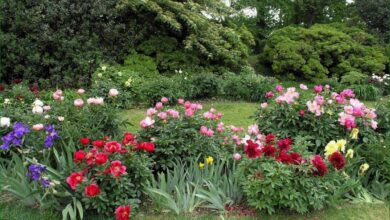
Castor bean
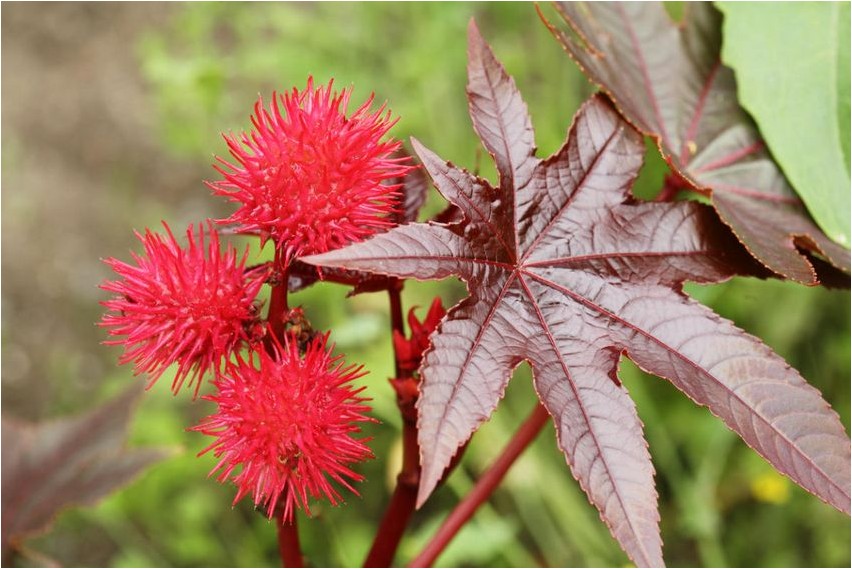
Castor bean (lat. Ricinus) is an ornamental foliage plant from the Euphorbiaceae family. Such an interesting name of the plant is due to the fact that its seeds are very similar in shape to the oriental tick.
Description
Castor bean is a very large and tall annual — the height of its bushes can reach two to three meters, but most often it still does not go beyond two meters. The stems of this plant are branched and erect, and inside they are usually hollow and colored red, pink, purple or even almost black. The large, palmately divided leaves of castor bean have five to ten lobes, and their length can vary from twenty to sixty centimeters.
The castor bean flowers are very small and rather inconspicuous, with a characteristic reddish, white or creamy tint. They gather in fairly dense inflorescences, which are characterized by a racemose shape. And castor bean fruits look like spherical boxes, which can be either prickly or bare. Such boxes quite often reach three centimeters in diameter.
Ripe oval seeds are usually flat on the ventral side, more convex on the dorsal side, and in the middle there is a tiny longitudinal seam on each seed.
Where does it grow
Distant Africa is considered to be the birthplace of castor beans. And now it will not be difficult to see it in India, Iran, China, Argentina, Brazil, as well as in a number of African countries. Moreover, this plant has been successfully cultivated in Egypt for more than four thousand years!
Usage
In landscape design, castor beans are planted either as single plants on lawns (in this case it serves as an excellent accent plant) or in small, loose clumps. Located between the leaves of the castor bean, its bizarre fruits give the shrubs an extremely decorative appearance!

In cultivation, castor bean is grown on an industrial scale mainly because its seeds produce a fairly useful oil — the seeds of this plant contain from forty to sixty percent very fatty oil. Moreover, this oil can be used both for medical purposes (well-known castor oil), for example, as a laxative, and for technical purposes — the scope of its application will depend on the method of squeezing. And quite durable burlap and ropes are made from castor bean stem fibers.
And it”s important to remember that every part of the castor oil plant, without exception, contains dangerously toxic compounds! This means this plant is poisonous not only to animals but also to humans!
Cultivation and Care
It”s recommended to plant castor oil plants in fairly moist, warm, and sunny areas with nutritious soil (ideally, either black soil or well-fertilized sandy loam soil).
In hot weather, castor oil plants need to be watered generously, and just before the graceful inflorescences begin to form, you can feed this vigorous plant with a good nitrogen fertilizer.
Castor oil plants do not tolerate prolonged cold spells and frosts, so this fact should not be ignored.
Castor oil plants are propagated primarily by seeds—they are sown in greenhouses in early March, placing two or three seeds in each pot. The seedlings are transplanted individually into pots and also placed in greenhouses. It makes sense to plant castor oil plants in open ground when the danger of even slight frost has completely passed, and when planting seedlings, it is essential to maintain a distance of 1–1. 2 meters!