Tladianta
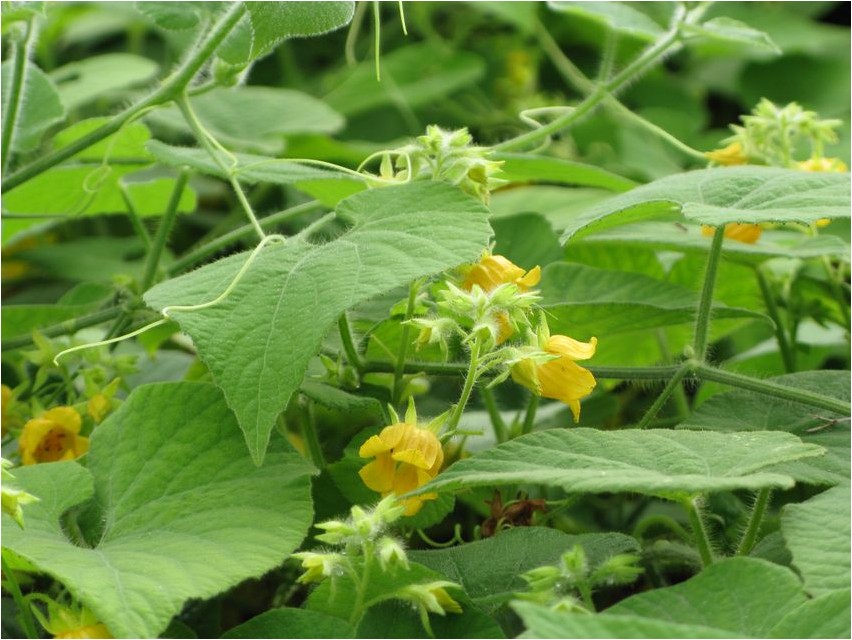
Tladiantha (lat. Thladiantha) is a dioecious liana plant belonging to the Pumpkin family and popularly called a red cucumber.
Description
Tladianta is a climbing herbaceous perennial vine, endowed with bizarre protruding hairy stems. And the entire heart-shaped leaves of this crop look from the outside as if they were covered with felt.
On each underground shoot, as well as on all branches hanging low above the soil surface, funny chains of useful tubers are regularly formed. With the onset of next spring, each tuber produces new shoots, which greatly contributes to the fairly rapid spread of red cucumber throughout the area.
Young tladiant fruits, colored in juicy green shades, have an external resemblance to the well-known ordinary cucumbers. As a rule, their diameter does not exceed two centimeters and their length is six centimeters. In addition, each Tladianta fruit is covered with a pleasant fluff, which disappears after some time. And closer to the very moment of ripening, these vegetables noticeably soften, turn red and acquire a characteristic sweet taste.
Inside each red cucumber there is a huge number of tiny seeds. And the tubers of this crop are somewhat reminiscent of potatoes.
Where does it grow
The Far East is the historical homeland of the bizarre Tladianta. True, in this region the red cucumber is used exclusively as an ornamental plant — tladianta looks especially great on fences. This crop is also actively cultivated in a number of countries in Southeast Asia, as well as in America and some European countries.

Application
In cooking, fruits that have not yet fully ripened (that is, green) are mainly used. It is quite acceptable to eat them raw, or they can be subjected to tladiant and heat treatment. With the addition of red cucumber, amazing appetizers, hearty side dishes and wonderful salads are prepared. And the high sugar content in fruits allows them to be used for making rich jam or jam, as well as sweet jams. And finally, this vegetable is often added to preserves and pickles (similar to ordinary cucumbers).
Thladiantha is an indispensable aid in speeding recovery from a wide variety of gastrointestinal ailments. It is most often used in Eastern medicine—a decoction of the seeds and tubers is not only an excellent diuretic and choleretic, but also an excellent remedy with antiscorbutic, astringent, and expectorant properties.
Furthermore, red cucumber can quickly relieve headaches and even manage a hypertension attack. Eastern healers strongly recommend drinking an infusion of the flowers of this graceful plant during flu epidemics.
The potato-like tubers of Thladiantha also boast healing properties—they are most often used to treat osteochondrosis and radiculitis. This is done very simply: crush the tubers into a paste and apply them to the affected areas as a compress. Thladiantha is also widely used for ornamental purposes—this delightful vine has long been a magnificent decoration for many garden plots.
Contraindications
Individual intolerance is perhaps the only contraindication to consuming thladiantha. Diabetics should also limit their consumption of red cucumbers, as they are very high in sugar.
Exotic Red Cucumber How to Grow Thladiantha





