Eschynanthus

Aeschynanthus (lat. Aeschynanthus) is a beautifully flowering and decorative foliage plant of the Gesneriaceae family. Under natural conditions it grows in the tropical forests of Southeast and South Asia, as well as on the islands of the Malay Archipelago.
The plant received its name for the unusual shape of the flower: from the ancient Greek language “aischyneia” is translated as distorted, and “anthos” means flower. Currently there are about 190 species.
Characteristics of culture
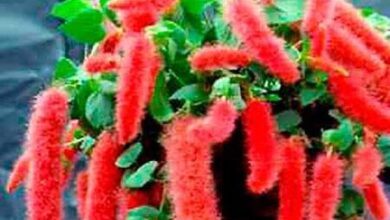
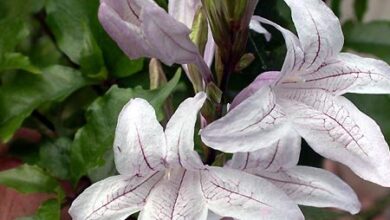
Aeschynanthus is an epiphytic or polyepiphytic plant with drooping shoots, naturally growing on snags, trees and mossy stones. The leaves are leathery, fleshy, bright green, 3-10 cm long, arranged oppositely on short petioles. The flowers are orange or bright red, irregular, tubular, collected in corymbose inflorescences of 5-12 pieces, formed in the axils of the leaves or at the tips of the shoots. The corolla has a curved tube and a bilabial limb, often green-yellow or brown.
Conditions of detention
Aeschynanthus is a light-loving plant, prefers rooms with good lighting, does not tolerate direct sunlight. The culture grows and develops well on windows of any orientation, but in the summer at midday it needs shading. The optimal temperature is 20-25C in summer, 15-18C in winter. If the optimal temperature is maintained during the dormant period of aeschynanthus, buds are laid already in February-March.

The plant does not respond well to drafts, so placing it near open windows and vents is not recommended. Eschinanthus are demanding of high air humidity. It is advisable to spray the plants several times a day or humidify the air in other ways. The substrate for growing the crop should consist of light leaf soil, peat, humus and sand (2: 1: 1: 1). Often a little crushed charcoal or chopped sphagnum moss is added to the substrate.
Reproduction and transplantation
Transplantation of aeschynanthus is carried out once every 2-3 years in the spring. Since the plant begins to shed its leaves over time and, as a result, loses its decorative effect, the aeschynanthus is renewed using cuttings. The pot for growing the crop is chosen to be several centimeters larger than the previous one (literally 2-3 cm), and a thick layer of drainage in the form of pebbles or crushed stone is placed on its bottom.
Aeschynanthus is propagated by seeds and cuttings. The seeds are very small; they are sprinkled on a sheet of white paper and, tapping the paper, sown in seedling trays filled with moistened substrate. Do not cover the seeds with soil. Cover the seedlings with plastic film or glass until germination. Water through the tray. Prick out the seedlings 1-1. 5 months after sowing, planting 4-5 per pot. Young aeschynanthus bloom the following year.
Cuttings are taken from long, healthy shoots using a sharp knife. Each cutting should have 4-5 nodes. To accelerate rooting, treat the cuttings with a phytohormonal powder solution. The cuttings are planted in a loose substrate consisting of peat and sand (or perlite expanded clay). The cuttings are planted 2 cm deep, watered, and covered with a glass container or plastic wrap. The room temperature should be around 26-28°C. To stimulate branching, pinch the tips of the cuttings.
Care
Aeschynanthus is a moisture-loving plant and requires regular watering. Water as the soil dries out; never allow it to dry out completely, nor should it be overwatered. Use warm, settled water for irrigation. Fertilize twice a month with liquid mineral fertilizers during the active growth period, from March to September. Pest Control
Aeschynanthus are most often attacked by spider mites, aphids, and mealybugs. When attacked by aphids, the plant’s leaves turn pale, buds fail to open, and shoots become severely distorted. To combat these pests, it is recommended to wash the plant with a soap or alcohol solution or spray with Actellic.
Spider mites appear on plants when humidity is low; their colonies settle on the undersides of leaves, causing them to discolor and fall off. To get rid of this pest, use Decis or Actellic.
ESCHINANTHUS: Growing Instructions. Family: Gesneriaceae.