Cuckoo color
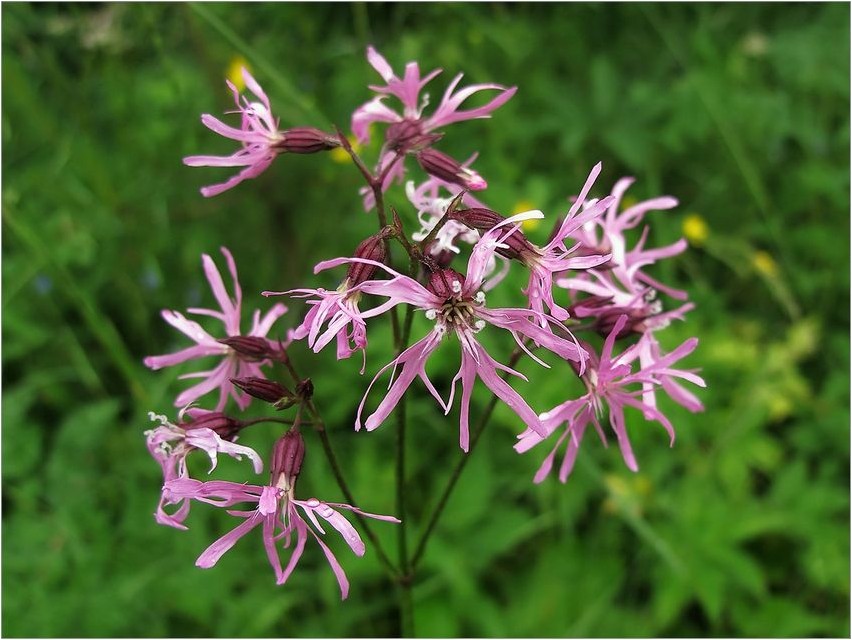
Cuckoo flower is one of the plants of the family called carnation; in Latin the name of this plant will be as follows: Coronaria flos-cuculi (L.) A. Bg.
As for the name of the cuckoo-colored family itself, in Latin it will be: Caryophyllaceae Juss.
Description of cuckoo color
Cuckoo flower is a perennial herbaceous plant whose height will vary between thirty and eighty centimeters. Such a plant will form loose turf. The cuckoo’s stem is simple and straight and will be covered with short hairs that point downward. The lower basal leaves of this plant will be oblong-palmated and petiolate in shape, while the upper leaves are sessile and sharp, the width of such leaves is about three to ten millimeters, and the length will be equal to ten centimeters. The cuckoo-colored inflorescence will be corymbose-paniculate, it is endowed with opposite branches and is quite rare. The peduncles of this plant can be longer or sometimes shorter than the calyx itself. The calyx of this plant is thin-skinned and bell-shaped, its length is six to eight millimeters, and it is colored purple. Such a cup will be endowed with ten protruding veins, painted in dark green tones. In addition, the calyx of this plant will have triangular sharp teeth, which are ciliated along the edge. Cuckoo-colored petals are white in color and are rarely white, and such petals are twice as long as the calyx. The petals will be endowed with a deeply quadripartite limb, and at the base there will be two sharp and elongated appendages. The cuckoo-colored fruit is a broadly ovoid capsule that will not be endowed with a stem.
The seeds of this plant are small in shape and endowed with small spines. Under natural conditions, this plant is found in the Crimea, the Caucasus, Western Siberia, Belarus and all regions of the European part of Russia. For growth, this plant will prefer places near the edges of swamps and damp floodplain meadows, and sometimes cuckoo flower can form thickets.
Description of the medicinal properties of cuckoo blossom
Cuckoo’s flower is endowed with highly valuable medicinal properties, and its herb is recommended for medicinal purposes. The herb includes the flowers, stems, and leaves of this plant. It is recommended to harvest this raw material throughout the flowering period. These valuable medicinal properties are attributed to the triterpene saponins and sucrose galactosides found in cuckoo’s flower roots.
The aboveground portion of this plant contains traces of alkaloids, triterpene saponins, carbohydrates, the related compound D-pinitol, coumarins, phenolic carboxylic acids and their depsinoids, unidentified gypsogenin derivatives, and the following flavonoids: saponaretin, vitexin, isosaponarin, and saponaretin 6-0-galactopyranoside.

Infusions and decoctions of cuckoo’s flower herb are recommended as a highly effective diuretic and diaphoretic. In addition, such remedies should also be used to treat lung diseases and jaundice. As for external use, crushed fresh cuckoo flower herb is used for scabies and furunculosis, and is also a very valuable wound-healing agent. It is noteworthy that in England, such remedies are used against thyroid tumors. It is important to remember that an extract from this plant will have antibacterial activity. For pneumonia, it is recommended to take three tablespoons of crushed dried herb per 400 milliliters of boiling water, steep for two hours, and strain. Take this remedy three times daily, one-third of a glass at a time.
Adonis cuckoo or cuckoo flower
https://www. youtube. com/watch? v=znVbcUw5m6Y





