Bignay
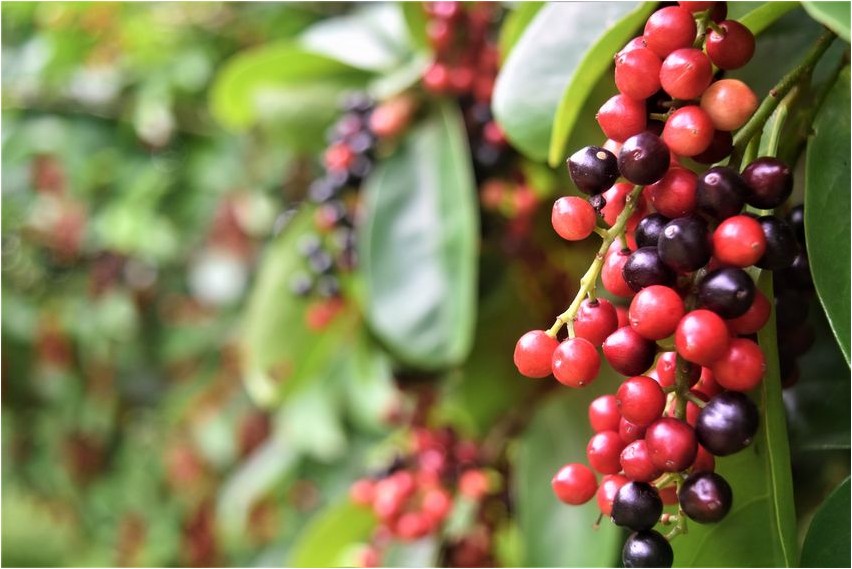
Bignay (lat. Antidesma bunius) is a fruit crop belonging to the Euphorbiaceae family and is often called a salamander tree.
Description
Bignay is a fairly tall tree — its height ranges from fifteen to thirty meters. The crowns of the trees are always very dense, and the glossy and oblong dark green leaves of bignay are attached to the shoots with the help of short petioles. They usually grow from ten to twenty-two and a half centimeters in length, and from five to seven and a half centimeters in width.
Bignay blooms with miniature reddish flowers, the diameter of which is about 2 mm. All flowers are collected in spectacular racemose inflorescences, which can be located both in the leaf axils and at the tips of the branches.
Bignaia fruits are round drupes collected in clusters, the diameter of which does not exceed 8 mm. These brushes are somewhat reminiscent of bunches of grapes. And the incredibly impressive appearance of these clusters is due to the variety of colors of the berries collected in them — the fact is that the berries of this crop are characterized by uneven ripening, and on one cluster you can often see both just set or almost ripe berries, as well as ripe and even overripe fruits. That is, on one brush there are often yellowish-greenish, light red and rich red, as well as dark blue berries!
All fruits are very juicy and covered with a fairly thin, but at the same time very tough skin. And the bright red juice secreted by this skin cannot be washed off from clothes even with state-of-the-art detergents. However, washing it off the skin of your hands can also be very difficult. As for the pulp, it is always white, with colorless juice. Inside each berry you can find one large seed.
Where does it grow
The bignay is native to Asia and Australia. Both cultivated and wild, this plant can be found in Malaysia, Northern Australia, India, the Philippines, North America and Indonesia, as well as in a number of countries in Indochina. Moreover, in North America (in particular, in Florida), bignay fruiting occurs in the fall, in Vietnam — in the summer, and near the equator in Southeast Asia — in February-March.

Application
Ripe bignay fruits are often eaten fresh, but unripe specimens have a very sour taste. These unique berries make not only very good jams and jellies, but also excellent wine, exported to expensive restaurants around the world. And local people love to enjoy rice with bignay.
Bignay is very rich in a wide variety of fruit acids — succinic, as well as malic and citric. It also contains a lot of vitamins, anthocyanins and beneficial pectin substances.
One of the main healing properties of these fruits, which is highly valued by the natives of Australia and Southeast Asia, is their ability to reduce blood pressure. That is, most often these berries act as an antihypertensive agent.
The high content of iron and calcium makes it possible to recommend bignay for heavy menstruation, anemia, or as a general tonic. And the potassium and phosphorus contained in it have a beneficial effect on the kidneys and on the activity of the cardiovascular system, help quickly restore strength after active physical activity and perfectly strengthen the musculoskeletal system.
Bignaia bark is also used for medicinal purposes, in particular to lower blood pressure. But if you want to use it, it is important not to forget that it is poisonous, that is, in this case it is necessary not only to know the exact dosage, but also to strictly adhere to it.
Contraindications
Hypotensive people should eat bignay with caution — these berries are endowed with the ability to lower blood pressure. And the high content of organic acids makes them an unsuitable delicacy for people suffering from duodenal or stomach ulcers. Allergic reactions cannot be completely ruled out.