Passion flower
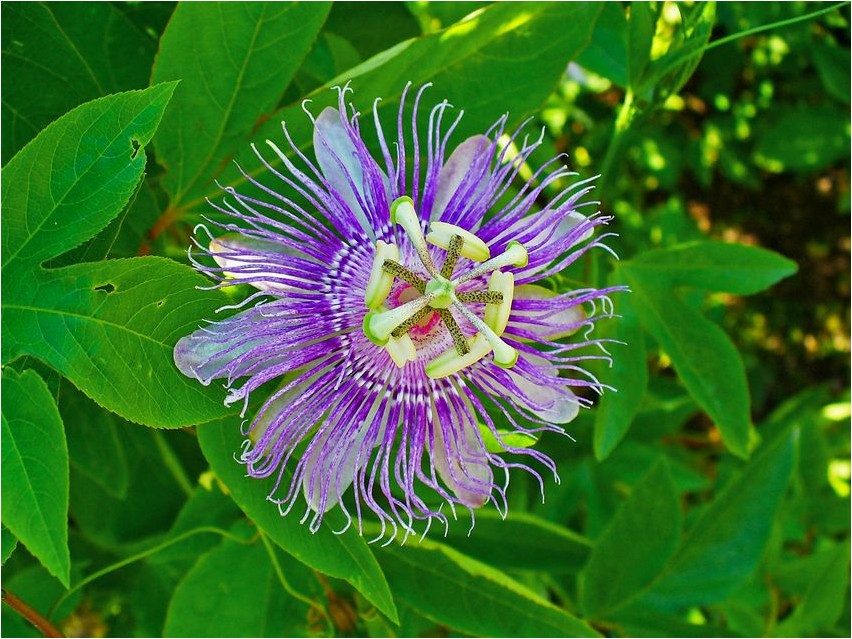
Passion flower, or Passiflora (lat. Passiflora) is a genus of beautifully flowering herbaceous plants or climbing shrubs of the Passionflower family.
The genus includes 400 species, according to other sources – 500 species. In nature, passion flowers are found in the Mediterranean, Brazil, Peru, Australia, the island of Madagascar and tropical Asian countries. In Russia, the crop is cultivated mainly in regions with a subtropical climate, in particular in Transcaucasia and the Krasnodar Territory.
Characteristics of culture
Passion flower is an ornamental climbing shrub or herbaceous plant with simple, lobed or entire leaves. The flowers are large, brightly colored, axillary, fragrant, up to 10 cm in diameter, sitting on long peduncles. The calyx is five-petalled, each petal is equipped with a small process on the midrib. The bracts are large. Between the stamens and the perianth, during the growth process, a series of scales or threads of rich color are formed, which form a “crown”.
The leaves and petioles of the plant are equipped with glands filled with a special liquid that, when secreted, attracts ants, which protect the passion flower from the negative effects of heliconia butterfly caterpillars. For each species, the location and shape of the glands is unique; some of them, in the process of evolution, began to form egg-shaped outgrowths that repel butterflies.
Subtleties of cultivation and reproduction
The most important requirement for cultivating passionflowers is sufficient illumination. The optimal temperature for growth and development is 18-24C; at elevated temperatures, the leaves of the plant become yellowish in color, and subsequently dry out and fall off. The number of developing buds is significantly reduced, as a result the plant loses its decorative appearance and dies.
Passion flowers are propagated mainly by seeds. Seeds are sown in seedling containers in late February – early March. The first shoots appear after 2-2. 5 weeks. It is important to provide the crops with optimal temperature and air humidity. To speed up germination, scarification is performed, which softens the seed coat, and soaking in warm water for 24 hours.

Sowing is carried out in separate pots filled with soil consisting of peat, humus and leaf soil and sand, taken in equal proportions. Before sowing, the soil mixture is disinfected. Containers with crops are covered with film and placed in a warm room. Crops are systematically ventilated and watered. With the emergence of seedlings, the seedling containers are transferred to window sills or other well-lit places without drafts.
Propagation of passionflower by cuttings is not prohibited. This procedure is carried out in the summer. Cuttings containing two nodes and leaves are cut from lignified shoots. Germinate the cuttings in water. The cuttings take root in about 1. 5-2 months. The water in the container cannot be changed; a small piece of charcoal is added to it.
Care
Passion flower is moisture-loving and needs frequent and abundant watering. Overmoistening should not be allowed. Spraying is also welcome, especially for indoor specimens grown in rooms with low air humidity. This procedure is carried out late in the evening; direct sunlight should not fall on micro-drops of moisture, otherwise burns and other troubles cannot be avoided.
Fertilizers for the crop are required. During the season it is necessary to carry out at least 4-5 fertilizing with complex mineral fertilizers. Shrub species require special support, onto which the strongest shoots are secured.
Pruning is advisable. Secondary shoots are shortened by 1/3 annually. Pruning is done from the second year of life. For the winter, garden specimens are dug up, transplanted into containers and brought into a room with a temperature of 13-16C. In the southern regions of Russia, passionflower overwinters directly in the ground, but only under cover in the form of straw or fallen leaves.
Application
For Russian gardeners, stratoflower is a real exotic, which is associated with the unusual structure of the flowers. The culture is used most often for decorative purposes; some species are edible. Passion flowers are grown not only on personal plots, but also as a houseplant. Cultivation of the plant in Russia is somewhat difficult, since it puts forward special requirements for growing conditions, although the cultivation of some species, for example, Stinking Passionflower and Meat-red Passionflower, is possible even for inexperienced gardeners.
Most of the species of herbaceous representatives of the genus are used in folk medicine. They are useful for eye diseases and problems with the nervous system. The plant is also used as a laxative. Shrub species are widely used in ornamental gardening; they look great under the crowns of openwork trees, along whose trunks they climb with their climbing shoots.