Watermelon
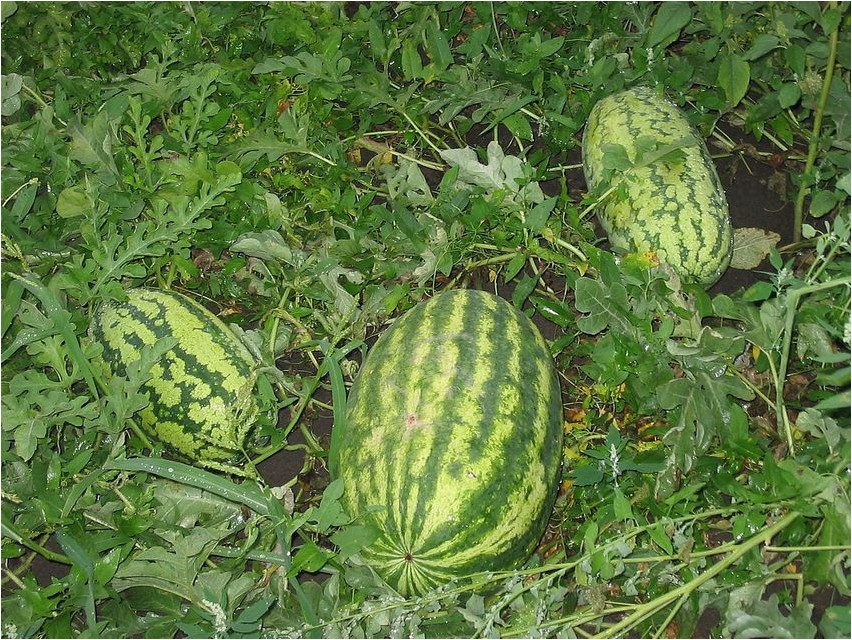
Watermelon (lat. Citrullus) is a popular melon crop; annual herbaceous plant of the Cucurbitaceae family. The birthplace of the culture is South Africa, where to this day the plant grows in natural conditions.
Characteristics of culture
Watermelon is a plant with thin, flexible, branched, creeping or climbing stems up to 4 m long. Young stems are covered with small and soft hairs. The leaves are rough, rough, pinnately divided or pinnately dissected, triangular-ovate, heart-shaped at the base, 8-22 cm long, 5-18 cm wide, located on long petioles.
Flowers with boat-shaped bracts reach 2-2. 5 cm in diameter. The receptacle is bell-shaped, slightly pubescent. Sepals subulate, filiform or narrowly lanceolate. The corolla is funnel-shaped, green on the outside, with oblong-ovate lobes.
The fruit is a multi-seeded pumpkin, oval, spherical or cylindrical; the color of the bark can be very diverse: from white and light yellow to dark green with patterns in the form of stripes or spots. The pulp of the fruit is red, pink, crimson or white, and has a pleasant sweet taste and aroma. The seeds are white, brown or black, flat, with a ridge.
Growing conditions
Watermelon belongs to the category of heat-loving plants, the optimal daytime temperature is 28-30C, night temperature is 18-20C. The culture prefers well-lit areas. Soils are desirable: light, permeable, nutritious, sandy, neutral. Damp and heavy soils are not suitable for growing watermelon.
Watermelon has a positive relationship with soils with a rich mineral composition. Legumes and grains are considered the best predecessors of the plant. It is not recommended to plant crops after representatives of the Solanaceae family.

Landing
The area for cultivating watermelons is prepared in the fall, the soil is plowed, the plowing depth is at least 30 cm. After plowing, organic matter and mineral fertilizers are added to the soil. With the onset of spring, the area is loosened. Watermelons are grown in two ways — by sowing seeds and through seedlings. The seedling method is the most effective; it produces a harvest 20-25 days earlier than when sowing seeds in open ground. The crop yield with such planting increases exponentially, moreover, the plants are less likely to be affected by various pests and diseases
Sowing watermelon seeds to obtain seedlings is carried out in special cassettes or low pots filled with soil substrate. The seeds are planted to a depth of 1. 5-2 cm. Until the seedlings appear, the temperature in the room is maintained at 25-30C, then for 7-9 days the temperature is lowered to 16-18C, after which it is raised to 20-25C. Seedlings are transplanted into open ground as soon as the seedlings have three leaves.
Before planting seedlings, they are hardened and treated with the Zircon preparation. Seedlings are planted in holes 10-15 cm deep only when the threat of night frosts has passed, otherwise the death of young plants cannot be avoided. A day after planting, watermelons are sprayed with biostimulants, and a week later the procedure is repeated again.
When growing watermelons by sowing seeds in the ground, the seeds are first pickled in a weak solution of potassium permanganate and then dipped in warm water until the sprouts hatch. Seeds are sown in 2-3 pieces, then the crops are thinned, leaving the strongest specimens.
Care
Watermelons need fertilizing with mineral fertilizers; they are especially demanding on the presence of nitrogen, phosphorus, potassium and magnesium in the soil. A sufficient amount of minerals increases yield by 40%. Fresh organic fertilizers cannot be applied to the crop; they can delay ripening and worsen their taste.
The crop is also demanding on loosening; it requires at least a couple of loosenings per season. The depth of loosening is no more than 10 cm. The plant responds favorably to watering, especially at the time of active growth of stems, mass flowering and fruit formation. It is recommended to carry out 10-15 waterings per season. Before harvesting the fruits, watering should be stopped. In order to stimulate the formation of new shoots and further growth of fruits, it is necessary to carry out two pinchings.
Harvest
Harvesting is done when the fruits ripen. Maturity can be determined by shrunken whiskers and stalks. Also, if you lightly click the fruit with your fingers, a dull sound will be heard.





