Common Gill Gill
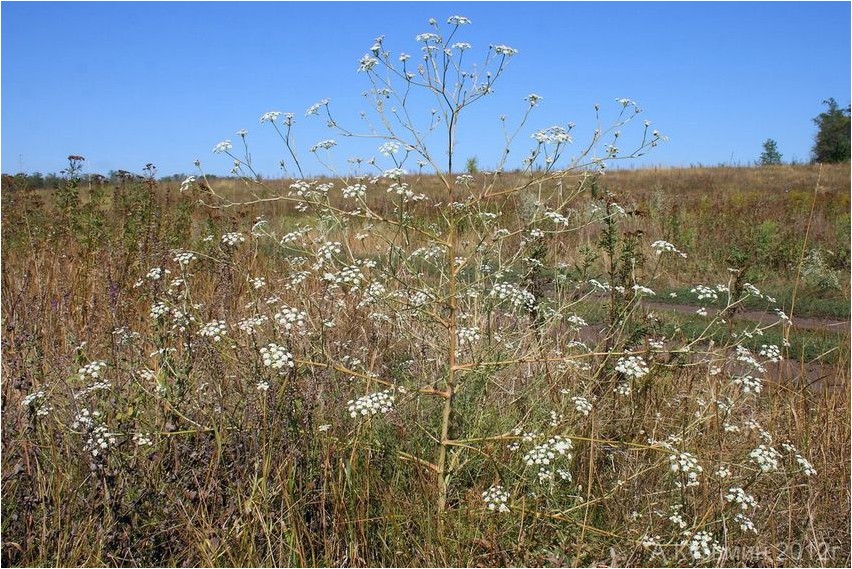
The tortuous tortuosum is one of the plants of the family called Umbellaceae; in Latin the name of this plant will be as follows: Seseli tortuosum L.
As for the name of the tortuous gilly family itself, in Latin it will be: Apiaceae Lindl.
Description of the tortuous gill
The tortuous gilly is a perennial herbaceous plant, the height of which can vary between forty and one hundred and fifty centimeters. The root of this plant is quite thick, its thickness will not exceed one and a half centimeters. Most often, such a root is straight, and the stem will be finely ribbed; it can be colored in both green and purple tones. Numerous umbels of this plant are located at the top of the branches and stem; the umbels will have seven to fifteen rays. The diameter of the umbrellas reaches five to eight millimeters, the fruits will be ovoid, their length is three millimeters, and the width will be about one to two millimeters. Such fruits are endowed with thick ribs and are densely hairy.
Flowering of the tortuous gill occurs in the period from June to August. Under natural conditions, this plant is found in all regions of the European part of Russia, with the exception of the Karelo-Murmansk region, as well as everywhere in Western Siberia, in the Angara-Sayan region of Eastern Siberia, in Belarus, Moldova, Ukraine and Central Asia. For growth, the plant prefers dry, flooded, subalpine meadows, as well as thickets, shrubs, meadow steppes, fallow lands, places along roads, pine and deciduous forests.
Description of the medicinal properties of the tortuous gill
The tortuous frog is endowed with very valuable healing properties, and the grass and fruits of this plant should be used for medicinal purposes. The concept of grass includes the flowers, leaves and stems of this plant. The presence of such valuable properties is due to the content of coumarins in the plant, and the herb of this plant contains carbohydrates, coumarins and mannitol. The leaves of the tortuous gill contain diosmin, and the flowers contain coumarins.
Infusion and decoction prepared from the leaves of this plant are recommended for use as a detoxifying agent, and are also taken for flatulence. An infusion of the leaves of this plant is used for ascites and angina. The experiment proved that the extract of leaves of the tortuous gilly has a pronounced antiarrhythmic, cardiotonic and anticoagulant effect, and can also increase diuresis.

A decoction of the fruits of this plant is used as an anthelmintic and diuretic, and also for dysmenorrhea, flatulence and numerous heart diseases.
As a diuretic, you should use the following remedy based on the tortuous gill: to prepare such a remedy, it is recommended to take two tablespoons of dry crushed leaves of this plant per three hundred milliliters of water. The resulting mixture should be boiled for three to four minutes over fairly low heat, and then left to infuse for one to two hours, after which this mixture is filtered very carefully. Take the resulting product one third of a glass three to four times a day.
For angina pectoris, you should take the following remedy: to prepare it, it is recommended to take one tablespoon of dry crushed leaves of this plant per glass of boiling water. The resulting mixture should be infused for two hours in a sealed container, and then this mixture should be carefully filtered. Take this remedy based on the tortuous gill, one-third of a glass three to four times a day.





