Biriba
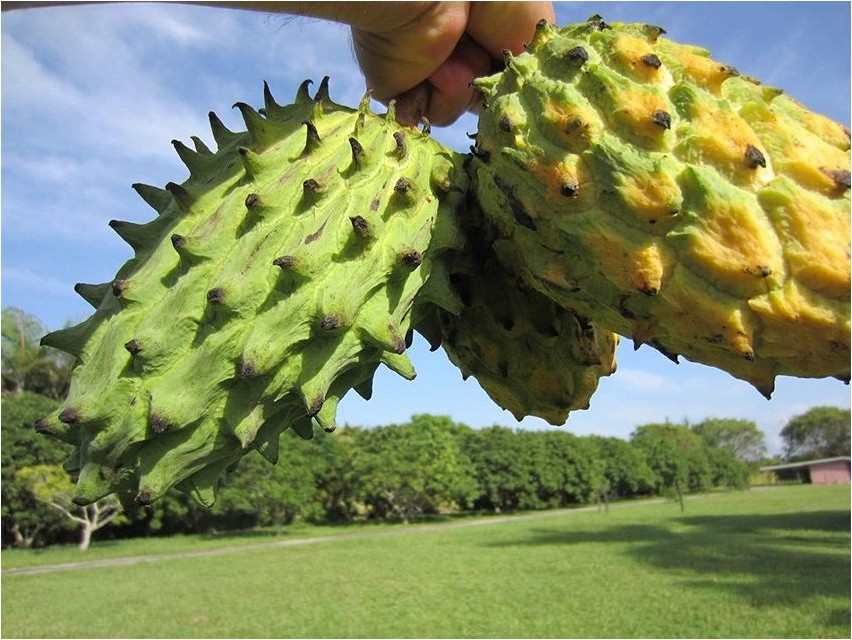
Biriba (lat. Rollinia mucosa) is a fruit tree from the large Annonaceae family. In Western Amazonia, biriba is one of the favorite fruits.
Description
Biriba is a very spectacular fast-growing tree, the height of which can reach one and a half tens of meters, but most often the height of biriba is five to eight meters. The leathery leaves of this crop are distinguished by an oval-oblong shape and grow in length from ten to twenty-five centimeters. And the undersides of all leaves are characterized by an amazing velvety texture.
Biriba”s bisexual flowers are endowed with hairy sepals and soft petals, and its conical-heart-shaped fruits are slightly larger in size than oranges. True, there are also varieties whose fruits weigh as much as four kilograms. All the fruits are incredibly cute: their yellow bark looks like growths consisting of conical hexagonal segments, and each segment in turn is equipped with a wart-like protrusion. The pulp of biriba is slightly slimy, white, transparent and very juicy. Also inside the fruits you can find black-brown seeds, reaching a length of two centimeters.
As for the taste of the fruit, it is very reminiscent of a mixture of apples and lemons, only, unlike these two fruits, biriba is very sweet.
Where does it grow
In its wild form, biriba can be admired throughout almost all of South America (in Venezuela or Colombia, Paraguay or Peru, as well as in colorful Brazil and northern Argentina). It is found a little less frequently in the Antilles and southern Mexico. And in cultivation it is grown mainly in Brazil and Peru. By the way, since the beginning of the last century, biriba began to be cultivated in the Philippines.
Application
Biriba is almost always eaten fresh. It also makes wonderful wine!

Biriba is an extremely nutritious fruit: if it is constantly present in the diet, then it is quite acceptable to give up meat even for a long time. Biriba fruits are especially useful for people whose work involves significant psycho-emotional or physical stress. But those who want to lose weight should not abuse this fruit: the fruits of biriba are very high in calories.
Due to the high content of vitamin C, as well as B vitamins, biriba boasts not only an antiscorbutic, but also a tonic effect. It also contains a lot of calcium, as well as phosphorus and iron — these valuable elements help maintain healthy teeth and bones and proper hemoglobin levels.
In the countries of South and Central America, biriba is widely used in folk medicine — dried seeds ground into powder are actively used to quickly get rid of enterocolitis. In addition, biriba has pronounced immunostimulating and antipyretic properties.
Unfortunately, these healthy fruits cannot boast of the ability to be stored for a long time — within a couple of days after picking, the biriba spoils and turns black. In this regard, it is cultivated on an industrial scale only near large cities.
And one more important nuance — it is important for everyone who wants to try biriba to know that it can easily provoke allergic reactions.