Arracacha
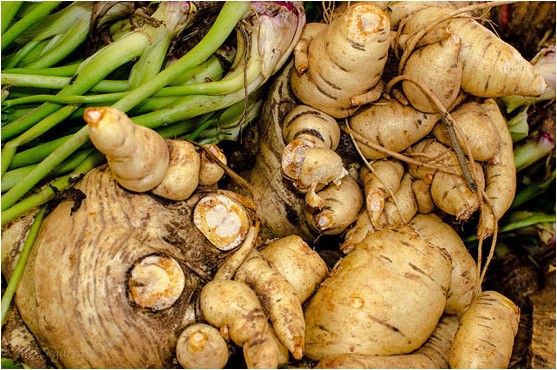
Arracacia (lat. Arracacia xanthorrhiza) is an angiosperm from the large Apiaceae family. Arracachi root vegetables, which are similar in appearance to carrots, are considered relatives of potatoes.
Description
Arracacha is an angiosperm and very interesting dicotyledonous plant with a short stem that has a cylindrical shape. The diameter of the stems is about ten millimeters, and their height can reach ten centimeters. The upper parts of the stems are densely dotted with countless buds, and each bud has one leaf with a small petiole. And the leaves of arracachi are painted in bronze or greenish tones (their color depends entirely on the variety).
Arracachi roots extending from the stems are of two types: some roots are tuberous in shape and quite thick, while others are long and very thin. The diameter of the first variety of roots often reaches eight centimeters, and their length ranges from five to twenty-five centimeters.
Tiny arracachi flowers collected in fancy umbrella inflorescences are characterized by a pleasant dark purple color.
Where does it grow
Arracachi grows most in its homeland — in South America (where this crop can be found in the foothills of the Andes). This product is popular in Ecuador, as well as in Peru and Brazil and Venezuela. In all of the above states, this useful crop ranks second in terms of cultivation volumes after potatoes.
And not so long ago, arracacha began to be grown in Sri Lanka, the Antilles, as well as in Africa and in a number of countries in distant Central America.

Application
Arracachi root vegetables are widely consumed as food. By the way, they are a cross between carrots and celery. Arracacha is stewed, boiled and fried, as well as excellent side dishes and even purees. If you store root vegetables for several months, they will gradually acquire a sweet taste (during this time the starch they contain has time to break down into simple sugars).
Arracachi leaves are also used in cooking — their taste is very similar to the taste of celery. And in terms of starch content, these root vegetables are very close to potatoes (10 — 25%).
Arracachi tops are often fed to livestock — they are rich in mineral salts, starch and protein.
It is also useful to use arracacha for diseases of the kidneys, cardiovascular system and various digestive organs. It will also serve well against lupus erythematosus and a number of skin ailments. Fungal infections, eczema, erysipelas, carbuncles and boils — all can be treated with healing arracace. And the high potassium content in root vegetables helps remove excess water from the body, which in turn allows you to quickly get rid of edema.
Contraindications
It is better to avoid eating arracachi root vegetables in case of exacerbation of inflammatory intestinal diseases, as well as flatulence, increased sexual excitability and urolithiasis.
Growing
The main disadvantage of arracachi is its truly incredible demands on fairly high soil moisture. 600 mm per year is approximately the minimum amount of precipitation required for the full growth of this crop, and it will grow best at 1000 — 1200 mm. Arracacha is also picky about temperatures — its normal growth can only be observed at temperatures from fourteen to twenty-one degrees. If the thermometer drops below, the processes of leaf growth and root maturation will slow down significantly, but if the temperature exceeds the recommended values, then the root crops will be very small.