Artichoke
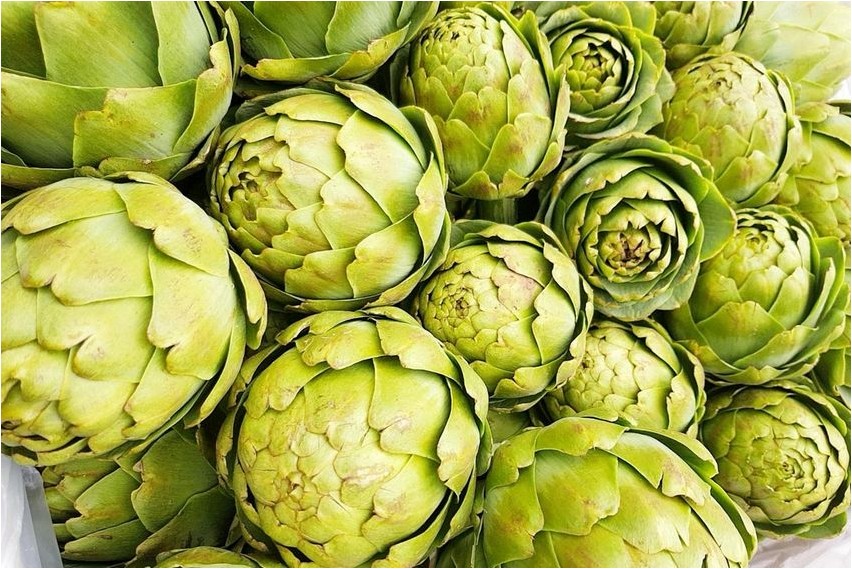
Artichoke (lat. Cynara) belongs to the category of perennial plants of the Compositae, or Asteraceae, family. In the wild, the plant in question grows in the Mediterranean. Nowadays, the artichoke is widely cultivated in many European countries, less often in Russia.
Description
Artichoke is represented by herbaceous plants that reach a height of up to two meters. They bear large pinnately dissected foliage, green or gray-green in color, pubescent on the inside, and may have small spines. The artichoke has a strong root system.
The inflorescence is in the form of a basket, consisting of tubular flowers of yellowish color and marginal flowers of blue color. The artichoke is considered a heat- and light-loving plant, therefore, in the Russian Federation (especially in the middle zone) it is grown exclusively as an annual. The crop is sensitive to spring frosts and can withstand frosts down t o-1 C.
Location
The artichoke thrives best in nutritious, well-cultivated, loose, water- and breathable soils with a neutral pH. Sandy loam soils are the best option for cultivating the crop in question. It is undesirable to grow artichokes on waterlogged soils, as this threatens rotting of the roots, and subsequently the death of the plant.
Features of cultivation
Artichokes are propagated by seed and vegetatively (by layering and root suckers). When growing a crop by seed, the seeds need pre-treatment, more precisely, germination for a week. They are placed in a damp cloth and placed in a container filled with well-moistened sand. The optimal temperature for germination i s-20-25C. As soon as the seeds hatch, they are removed to a cold place.
Then the seeds are sown in containers with a soil mixture made up of nutrient soil, humus and washed river sand, taken in equal proportions, and kept at a temperature not lower than 17C. With the appearance of the first true leaf, the seedlings are planted in pots. Artichoke seedlings are transferred to open ground in the third ten days of May — the first ten days of June. Sowing in a greenhouse or greenhouse is not prohibited.

Vegetative propagation of artichokes is a simpler, but no less effective method. Cutting the offspring is carried out from the mother plant using a sharp knife, previously disinfected. Each offspring should have a small part of the rhizome. Before planting, sections of material are treated with wood ash and planted in a greenhouse for growing. Between the artichoke crops you can plant lettuce, parsley, onions, etc.
Care
Among the care techniques, moderate watering, fertilizing with organic matter and complex mineral fertilizers are required. Fertilize once every 2-3 weeks until the end of July. Many gardeners advise leaving no more than 3-5 baskets on plants; the rest should be removed. This approach will allow you to get larger baskets. Artichoke baskets are harvested when they begin to open at the very top. It is not recommended to wait for flowering. The artichoke can be stored in the refrigerator.
With the onset of autumn, the entire above-ground part is cut off, leaving small stumps, which are covered with a thick layer of fallen leaves or other material. In Russia this is not required, because the plants will not tolerate severe frosts. For winter, plants should be dug up, all foliage trimmed and placed in the cellar. In the third ten days of February — the first ten days of March, the overwintered material is divided and planted in pots. In the first ten days of June they are transferred to open ground.
Artichoke. How to clean artichokes. Proper cleaning. Lifehack.
https://www. youtube. com/watch? v=qWW1ikQrj2Q





