calyx flower
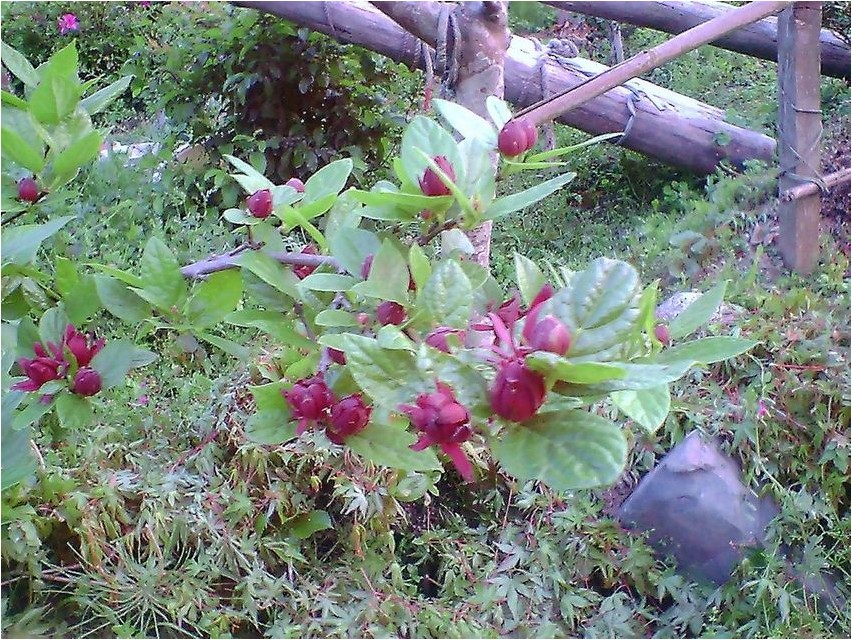
Chameleon (lat. Calycanthus) is a light-loving woody plant belonging to the Calicantaceae family.
Description
Chameleon is a medium-sized deciduous shrub (on average its height varies from one to three meters) with a fairly persistent and pleasant aroma of leaves and shoots. The leaves of this plant are entire and opposite, and its perianths are formed by a huge number of narrow, uniform leaves that have a reddish-brownish color.
The diameter of chalyx flowers ranges from three and a half to seven centimeters. All these flowers are located on short axillary shoots, are painted in rather pleasant reddish-brown tones and boast a complete absence of petals (instead, the flowers are formed by petal-shaped sepals). However, sometimes you can see cream flowers.
The fruits of this plant look like boxes up to seven centimeters in size. And inside these boxes you can find a huge number of miniature fruit-nuts. The seeds of the chapal flower are brown, and these seeds have no endosperm at all, and almost their entire area is occupied by the embryo.
In general, this genus has only four species.
Where does it grow
The chalyx flower came to us from North America. However, it can be seen quite often in a number of Central Asian states, as well as in Transcaucasia and on the Black Sea coast of the Caucasus.

Usage
The calyx flower attracts primarily for its impressive stability in cultivation and surprisingly strong aroma. For decorative purposes, the flowering chapal flower, which exudes an incomparable strawberry aroma, is most often grown. It will look especially great in group plantings — in this case, a distance of one and a half to two meters should be maintained between the bushes (only in this case will they be able to fully develop!).
Growing and care
It is recommended to plant chalyx flowers in sunny areas that can boast reliable protection from cold winds. By the way, in the regions located south of Voronezh, it is quite acceptable to grow this beauty in partial shade. This plant prefers moist and fertile soils.
When the heat sets in, the plant should be provided with regular watering, and with the onset of spring, it is advisable to feed it with complete mineral fertilizers (the consumption for each bush should be approximately twenty to thirty grams).
In winter, selyflowers growing in temperate climates can freeze, so it is recommended to cover them well in advance.
Selyflowers are propagated by division or layering, both in the fall and spring. Under favorable conditions, young specimens should bloom as early as their fourth or fifth year. However, if desired, selyflowers can also be grown from seeds, but the most important thing is to try to obtain these seeds, as selyflowers almost never bear fruit in temperate climates. It is also important to remember that the seeds of this plant must be scarified.
To ensure better rooting of the green cuttings, it is recommended to first dust their lower parts with Kornevin and then soak them in a 0. 5% Heteroauxin solution for sixteen hours. Only then can the cuttings be planted in a fertile and relatively light substrate, slanted and spaced three to five centimeters apart. Cuttings usually show the best rooting results in greenhouses with limited shade and temperatures ranging from sixteen to twenty degrees Celsius.





