Momordica
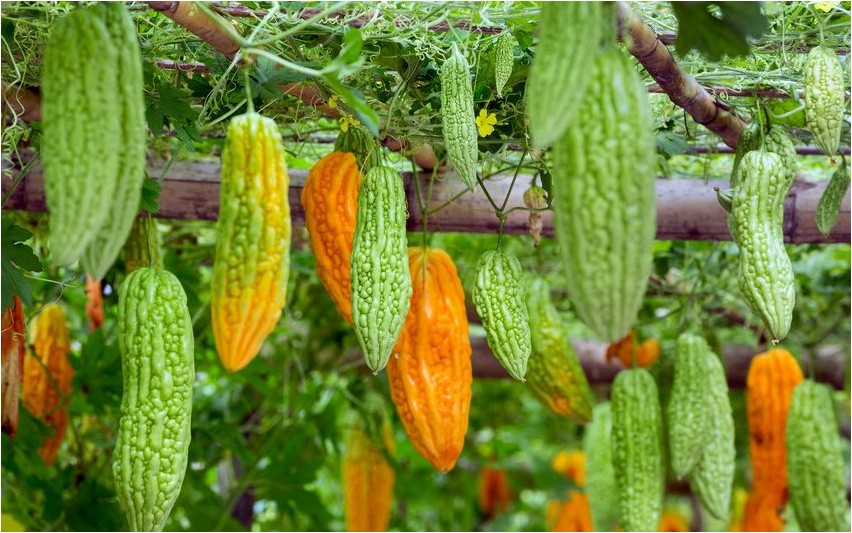
Momordica (lat. Momordica) is a genus of annual or perennial climbing plants of the Pumpkin family (Cucurbitaceae). The genus includes about 20 species.
The natural range is tropical and subtropical regions of Africa, Asia and Australia, some wild species are found in North America. Currently, only two species are cultivated — Momordica cochin and Momordica charantia. Cultivate momordica in the garden, on the balcony and indoors. The scope is wide.
Characteristics of culture
Momordica is a herbaceous plant 2 m or more in height. The leaves are green, five or seven lobed. The flowers are unisexual, yellow in color, very fragrant, equipped with a five-toothed corolla. The aroma of momordica is similar to the aroma of gardenia, but differs in intensity. The fruits are elongated, round or oval berries, covered with tubercles over the entire surface, although today varieties have been bred that produce fruits with a smooth surface. Unripe fruits are dark green, mature ones are orange-yellow, white or yellow.
As the seeds ripen, the fruits burst into three parts, revealing the bright orange insides. The seeds are large, red, of unusual shape, with a rim around the edge and a tuberculate surface. One fruit usually contains about 15-20 seeds. The taste of momordica fruits is practically no different from pumpkin, however, the tubercles or papillae protruding on their surface are slightly bitter, for this reason the general taste sensations acquire a bitterish tint. But this characteristic does not affect the taste of delicacies prepared from momordica.
Growing conditions

In general, momordica agricultural technology has much in common with the technology of growing cucumbers, pumpkins and zucchini. The crop is demanding on soil fertility and needs a large amount of organic and mineral substances. It does not accept acidic soils; such areas must be pre-limed. Momordica is grown mainly on vertical trellises, the lower crossbars of which are located 70 cm above the soil surface.
The plant appreciates well-lit areas; in the shade, the ovaries may shed and the fruits may become smaller. Momordica has a negative attitude towards thickening. Good predecessors are legumes, potatoes and tomatoes. It is unacceptable to plant a plant after representatives of the Pumpkin family. When growing crops in greenhouses or greenhouses, manual pollination is required.
Soil preparation and sowing
The area for momordica is prepared in advance: the soil is dug up, organic matter (up to 10 kg per 1 sq. m.) and mineral fertilizers are added (ammonium nitrate — 20 g per 1 sq. m., superphosphate — 35 g per 1 sq. m., potassium chloride — 20 g per 1 sq. m.). Momordica seeds do not need pre-sowing preparation, although soaking them in a weak solution of potassium permanganate is not prohibited. Momordica is sown in special peat-humus pots edgewise to a depth of 1-1. 5 cm. Immediately after sowing, watering is carried out using warm, settled water. The next watering is carried out after 3-4 days. If we talk about sowing dates, it is advisable to give preference to the first ten days of April.
Some gardeners and gardeners advise germinating seeds before sowing. In this case, the ends of the seed are sanded with sandpaper and wrapped in damp gauze and placed in damp sawdust. As soon as the seeds hatch, they are sown in the ground. Momordica shoots appear in two weeks. Seedlings should be protected from temperature changes and drafts. Over time, the seedlings are planted in larger pots and fed. Momordiki seedlings are transplanted into open ground at the end of May. Seedlings are planted together with a clod of earth, since the crop has a negative attitude towards exposing the roots, which is associated with an underdeveloped root system. At first, the plantings are shaded and covered with film at night.
Care
Caring for momordica mainly involves regular and moderate watering. The soil in the stem zone should be constantly moist, but not waterlogged. Particular attention should be paid to plants during fruiting, including watering. The crop responds positively to fertilizing; it is very important to systematically apply organic matter and mineral fertilizers at least 3-4 times per season. Liquid mullein can be fed every 10-12 days.