Alocasia
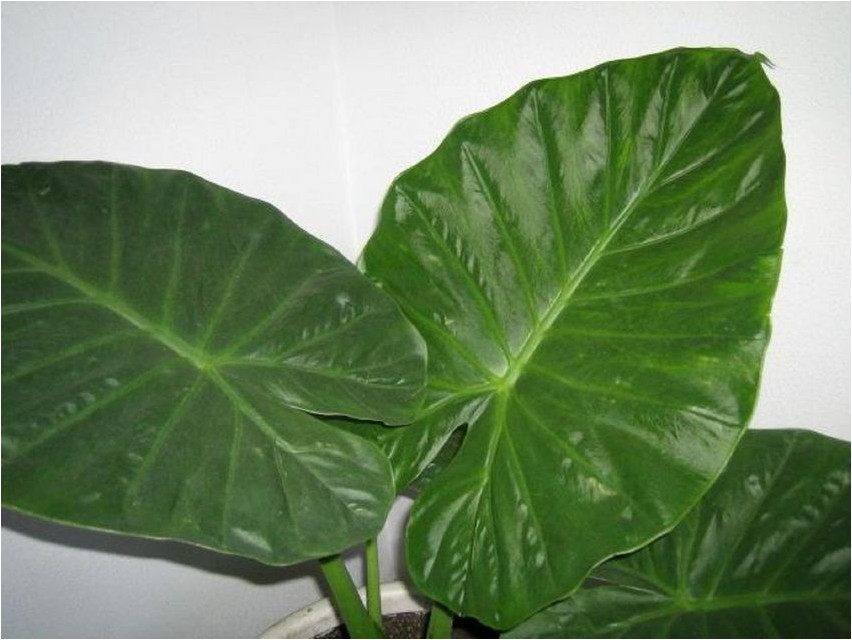
Alocasia (lat. Alocasia) is a genus of tropical plants, distinguished by the virtuosity of large, beautiful leaves, for which they are grown in greenhouse conditions where summer alternates with frosty winters.
Although milky juice flows through the plant arteries of Alocasia, in a number of East Asian countries people use the leaves in their national dishes.
Description
In the ranks of the Alocasia genus, there are seven dozen species of plants that live exclusively in the humid tropics, agreeing to live in other climatic conditions only under the protection of indoor walls.
Alocasia has a short but powerful rhizome, capable of extracting nutrients from the soil for its large, sometimes simply gigantic, leaves. A couple of such leaves are enough to build a roof over a modest hut. Under the Alocasia bush you can arrange a place for tea, where it will be cozy and comfortable at any time of the day.
Passionate fans of Alocasia who grow the plant indoors rarely have the opportunity to admire its flowers, much less its fruits. This does not upset flower growers at all, since the stunning beauty of the leaves fully repays all their troubles.
Large leaves growing in the natural conditions of the warm tropics are associated with everyone. These are pterodactyls, extinct in the Jurassic period, rhythmically flapping their sharp-angled powerful wings, on which bones are clearly drawn – light veins on the surface of dark green leaves; and huge elephants, or rather elephant ears, enjoying the sounds and rustling of mighty tropical plants.

An inflorescence of small monoecious flowers resembles an ear of corn, the grains of which, as they ripen, turn, as a rule, into red hemispherical berries that hide the seeds inside.
Varieties
* Alocasia macrorrhizjs (lat. Alocasia macrorrhizjs) – a powerful rhizome gives birth to powerful leaves. Prefers to grow closer to human habitation, betraying its love for tropical thickets.
* Alocasia cucullata (lat. Alocasia cucullata) – on almost half-meter petioles, holding on to a thick stem, there are heart-shaped leaves of the same length as the petioles, the green surface of which shines glossy in the sun.
* Indian alocasia (lat. Alocasia indica) – triangular-arrow-shaped meter-long leaves sit on erect, strong petioles, the bases of which form a special type of decorative stem, called “caudex” by botanists.
* Alocasia sanderiana (Latin: Alocasia sanderiana) – the surface of its dark green, picturesque, irregularly shaped leaves, whose wavy edges are highlighted by a white stripe, are additionally decorated with white veins and have a metallic sheen. The reverse side of the leaf boasts a silvery-purple hue.
* Alocasia lowii (Latin: Alocasia lowii) – stands out from its tall relatives in the genus, growing only 60 cm in height. Leathery leaves with an olive-colored surface have taken on a triangular shape.
Cultivation
The difficulty of growing a tropical plant indoors is that maintaining humidity of up to 85 percent in a living space is unrealistic. The only options are to locate this exotic beauty in the bathroom, or to acquire a modern grow box equipped with special devices that can create any conditions the plant requires. Lower humidity not only hinders plant growth but also encourages spider mites, which can create even greater problems.
The plant’s survival temperature is above 17°C (65°F).
The soil should be fertile, loose, and moist.
Alocasia is propagated by sowing seeds, separating offshoots, and dividing the growing rhizome.