Volzhanka
Volzhanka (lat. Aruncus) is a shade-tolerant, moisture-loving perennial from the Rosaceae family.
Description
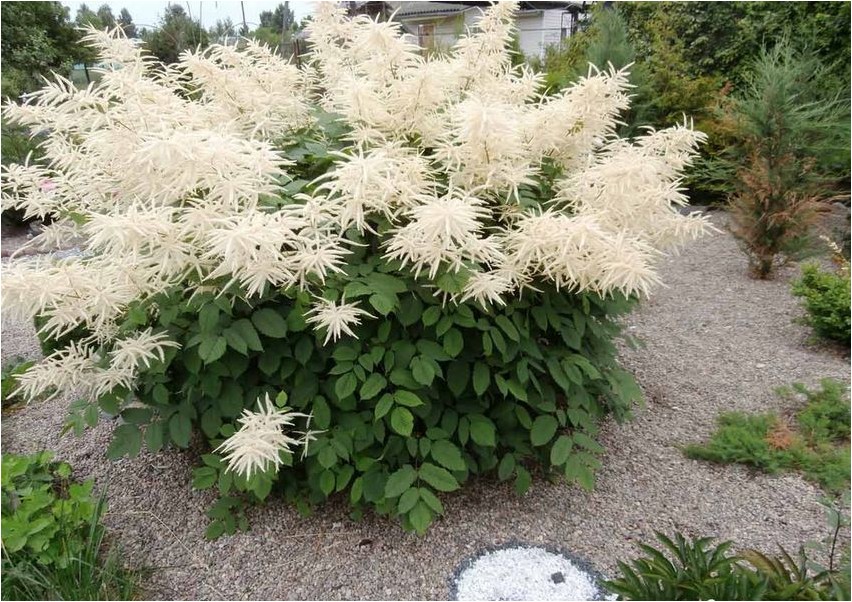
Volzhanka is a perennial whose height ranges from one to one and a half meters. Its leafy, erect stems form spectacular spreading bushes, reaching one hundred and twenty centimeters in diameter. The openwork complex leaves of Volzhanka can be either double or triple pinnate, and they all sit on very strong and fairly long petioles.
The spreading paniculate inflorescences of Volzhanka reach half a meter in length, while the inflorescences formed by staminate (male) flowers will always be much denser than the inflorescences consisting of only female flowers — the latter are usually openwork and more sparse.
The diameter of small Volzhanka flowers usually does not exceed 0. 3 cm, and their color is almost always white, although slightly greenish or yellowish flowers can be seen a little less often. Flowering of this plant usually starts in June-July and lasts from thirty to thirty-five days. And the fruits of Volzhanka look like very fancy leaflets. As for the ripening of small seeds, it usually occurs in mid-September.
In total, the Volzhanka genus includes about twelve independent species.
Where does it grow
Volzhanka is quite widespread in the European part of Russia (mainly in the western regions), as well as in Central Europe and the Caucasus. It grows mainly in mixed or broad-leaved forests.

Usage
Volzhanka has been known in culture for a very long time — since 1623! And this beautiful plant has proven itself well in ornamental gardening! Volzhanka looks especially cool in flower beds located in shady areas. This beauty will look wonderful both in group and single plantings, in addition, it can be safely planted in the background in mixed flower beds — it goes well with many other perennials. Astilbe, which begins flowering a little later, will look very beautiful against the backdrop of the lush openwork greenery of the beautiful Volzhanka. In addition, Volzhanka is perfect for decorating the banks of various reservoirs, as well as for planting in rockeries.
As for cutting, Volzhanka will not last long in the form of bouquets — already on the second or third day, the cut inflorescences will begin to slowly fade.
Growing and care
To ensure the Volzhanka boasts impressive ornamental qualities, it is recommended to plant it in semi-shaded areas with well-drained, fertile soil.
During dry periods, Volzhanka requires regular and fairly generous watering, and a good organic fertilizer should be applied about once a year.
Overall, Volzhanka is quite low-maintenance—it grows magnificently and quickly, and boasts excellent resistance to all kinds of weeds. When its panicles have finished flowering and turned brown, it is recommended to cut them back, but this is completely unnecessary—some gardeners even consider the fruiting shoots very beautiful and decorative. Furthermore, allowing the seeds to develop allows Volzhanka to propagate by self-seeding, which is undoubtedly the most convenient way to obtain new plants! However, Volzhanka is often propagated by seed or division (usually done towards the end of summer or in spring). It”s important to keep in mind that the seedlings will bloom for the first time only in the third or even fourth year.