Pyrethrum corymboses
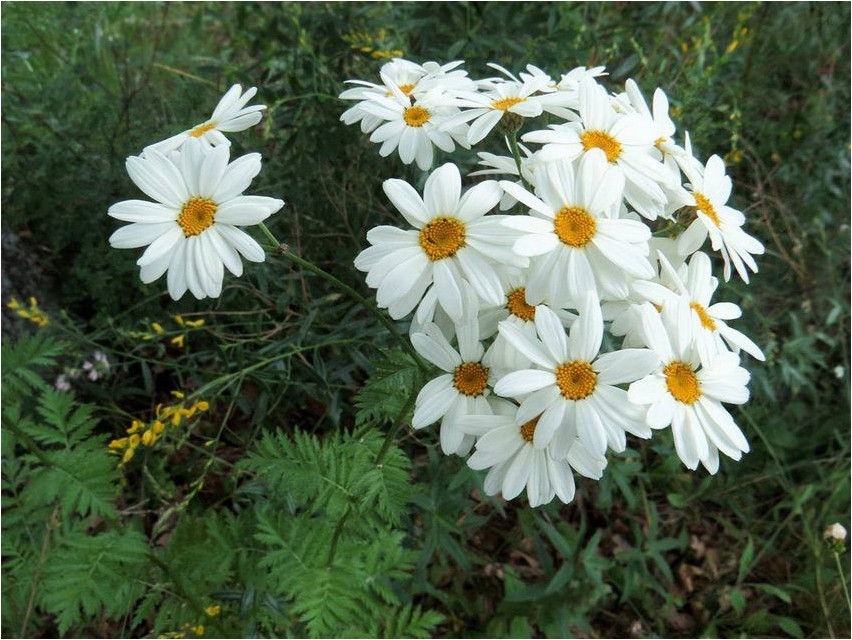
Pyrethrum corymbosum is one of the plants of the family called Asteraceae or Asteraceae; in Latin the name of this plant will be as follows: Pyrethnim corymbosum (L.) Scop. (Tanacetum corymbosmn (L.)).
As for the name of the pyrethrum corymbose family itself, in Latin it will be like this: Asteraceae Dumort. (Compositae Giseke).
Description of pyrethrum corymboses
Pyrethrum corymboses is a perennial herbaceous plant, the height of which will fluctuate between thirty and one hundred and twenty centimeters. The stems of this plant are solitary, weakly leafy and angularly grooved. The length of the petiole leaves of pyrethrum corymboses will be about ten to thirty centimeters, they are pinnately dissected and oblong. The baskets of this plant are on rather long stalks, of which there are only three to ten pieces, they will be endowed with a corymbose inflorescence. The marginal false-ligulate flowers will be painted white.
Pyrethrum corymboses bloom in the summer. Under natural conditions, this plant is found in Belarus, Ukraine, Western Siberia, Central Asia, the Caucasus and in all regions of the European part of Russia, with the exception of only the Baltic, Karelo-Murmansk and Dvina-Pechora regions. For growth, this plant prefers forest glades, deciduous forests, places among bushes up to the mid-mountain zone. It is noteworthy that pyrethrum corymboses is an insecticide and acaricide, as well as a very ornamental plant.
Description of the medicinal properties of pyrethrum corymboses
Pyrethrum corymboses is endowed with very valuable healing properties, and it is recommended to use the herb of this plant for medicinal purposes. The term grass includes leaves, flowers and stems. The presence of such valuable healing properties is recommended to be explained by the content of heterocyclic oxygen, polyacetylene compounds, sulfur-containing compounds, sesquiterpenoids, parthenolide, tanacetin, as well as the following phenolcarboxylic acids and their derivatives in this plant: caffeic and chlorogenic acids.
An infusion prepared from the herb pyrethrum coliculosa is recommended for use for gastritis. It is noteworthy that experimental studies have shown that extracts based on flowers and leaves will be endowed with very effective antibacterial and protistocidal effects. The inflorescences of this plant are used as an insecticide in a manner similar to the so-called “Persian powder.”

For gastritis, it is recommended to use the following very effective remedy based on this plant: to prepare such a healing remedy, you will need to take one teaspoon of dry crushed pyrethrum corymboses herb per glass of boiling water. The resulting healing mixture should be infused for about one hour, after which the mixture should be filtered very carefully. Take the resulting healing remedy based on this plant two to three times a day after meals, one tablespoon.
The following very effective remedy based on this plant should be used as an insecticide: to prepare such a healing remedy, take five tablespoons of crushed dry herb pyrethrum corymboses per liter of boiling water. This healing mixture should be infused for about one to two hours, after which this remedy is completely ready for use. It should be noted that this medicine is very effective when used correctly and properly prepared.
Pyrethrum maiden – growing from seeds
https://www. youtube. com/watch? v=0GQmrXIKAFc





