Moldavian snakehead
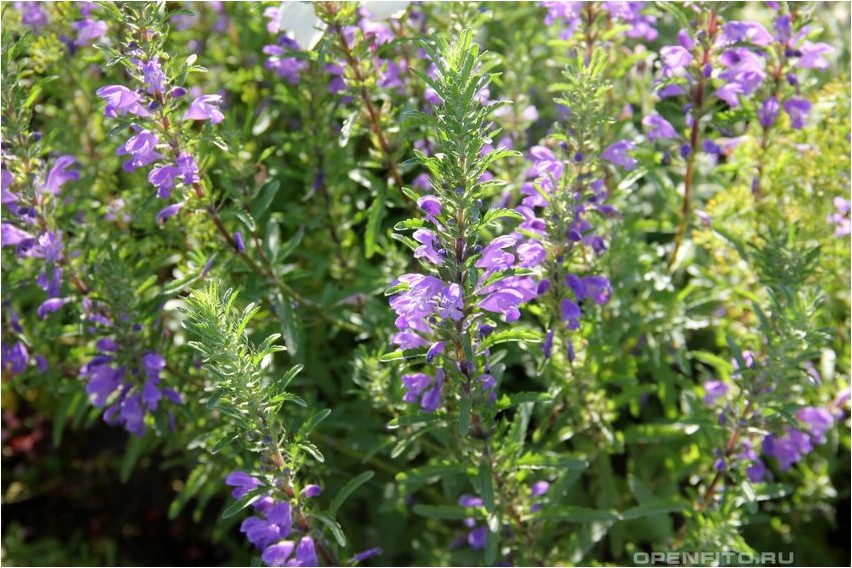
The Moldavian snakehead is one of the plants of the family called Lamiaceae; in Latin the name of this plant will be as follows: Dracocephalum moldavica L.
As for the name of the Moldovan snakehead family itself, in Latin it will be like this: Lamiaceae Lindl.
Description of the Moldavian snakehead
Moldavian snakehead is an annual herbaceous plant endowed with a thin tap root. The stem of this plant is erect, branched and tetrahedral, and the height of such a stem will be about fifty to seventy centimeters. The leaves of the Moldavian snakehead are short-petiolate and opposite; they can be either oblong-ovate or oblong-lanceolate. Such leaves will be jagged along the edges, they are colored in dark green tones, while the apical leaves are lanceolate. The flowers of this plant are collected in racemes, they are colored in pale purple tones. The fruits of the Moldavian snakehead are triangular oblong nuts, the length of which does not exceed three millimeters, and the width does not reach two millimeters. The fruits of this plant are dark brown in color.
Flowering of the Moldavian snakehead occurs in July, while fruiting will take place from August to September. Under natural conditions, this plant is found in Primorye in the Far East, in the Crimea, in the Irtysh region of Western Siberia, in the Daursky region of Eastern Siberia, as well as in the following regions of the Caucasus: the South Caucasus, Western Caucasus and Ciscaucasia. The plant is also found in the following areas of the European part of Russia: Lower Don, Ladoga-Ilmen, Lower Volga and Volga-Don, as well as in the Tien Shan and Pamir-Altai regions of Central Asia.
Description of the medicinal properties of the Moldavian snakehead
The Moldavian snakehead is endowed with very valuable healing properties, and it is recommended to use the herb of this plant for medicinal purposes. The concept of grass includes the leaves, flowers and stems of this plant.
The presence of such valuable healing properties is explained by the content of tannins, essential oil, coumarins and the flavonoid moldavoside in the plant. The leaves and flowers of the Moldovan dragonhead contain vitamin C and essential oil, and the inflorescences also contain essential oil.

As for the decoction of this plant’s herb, clinical trials have shown positive results in children with pyelonephritis. In the experiment, a tincture of this plant increased intestinal tone and contraction amplitude, as well as increased blood flow and dilated mesenteric vessels. Notably, the herb extract has antibacterial properties.
Traditional medicine uses an aqueous infusion of this plant’s herb as an analgesic, sedative, anti-inflammatory, wound-healing, antispasmodic, and anticonvulsant. These remedies are also effective for gastrointestinal disorders, numerous gynecological diseases, headaches, cold-related aches and pains, palpitations, migraines, and neuralgia, and also as an appetite stimulant.
A decoction prepared from the seeds of this plant is recommended as an astringent and sedative. Fresh crushed leaves of Moldavian dragonhead have been proven to significantly accelerate the healing of purulent wounds: compresses made from the herbal mixture are recommended for use on sore spots for bruises and rheumatism.





