Field crooked flower
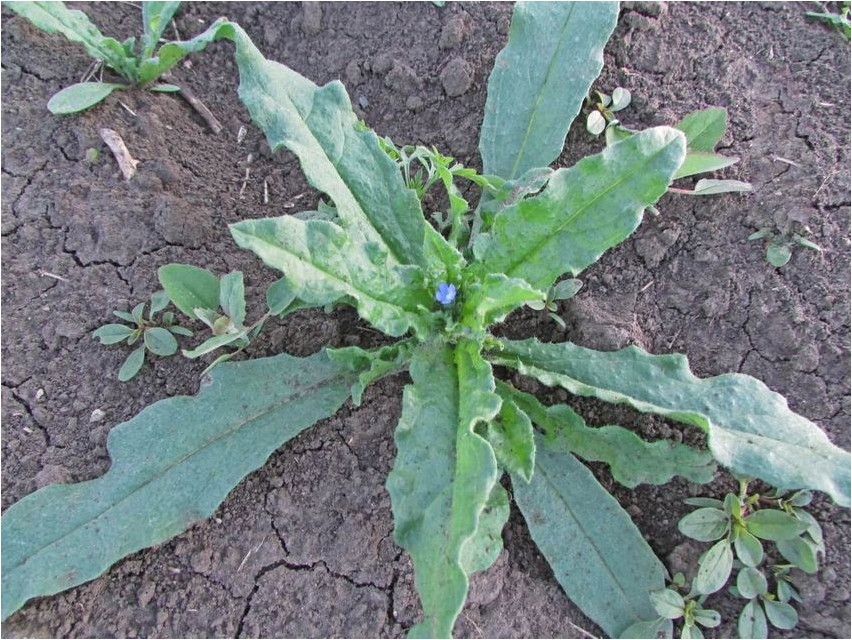
The field flower is one of the plants of the family called borage; in Latin the name of this plant will be as follows: Lycopsis arvensis L.
As for the name of the wildflower family itself, in Latin it will be like this: Boraginaceae Juss.
Description of wildflower
Field flower is an annual herbaceous plant, the height of which varies between ten and fifty centimeters. The stem of this plant is very strong, erect and sparsely hairy. The leaves of the wildflower will be lanceolate, all edges are angular-toothed and will often be wavy. On average, the length of the leaves of this plant will be about three to seven centimeters, and the width will be approximately four to fifteen millimeters. The curls are dense at first and will be in pairs or may be single at the end of both the branches and the stem. It is noteworthy that such leaves will not form a separate panicle, they are few-flowered, and when bearing fruit they are quite dense. Also, such leaves will be slightly elongated. The corolla of the field crooked flower is painted in purple tones, its tube will be approximately equal to the calyx, the limb in diameter will be about four to six millimeters, and the corolla of this plant will be bell-shaped. The nuts of the wildflower are moderately bent and oblique, its length will be about three millimeters. The nuts are colored gray and are net-wrinkled.
Flowering of wildflower occurs during the period from May to June. Under natural conditions, this plant is found in the European part of Russia, Belarus and Ukraine. For growth, this plant prefers places along roads, fields and garbage areas.
Description of the medicinal properties of wildflower
The wildflower is endowed with very valuable healing properties. The presence of such medicinal properties should be explained by the content of cyclitol a-bornesite. A decoction prepared from this plant is recommended for use for tumors of various types. It is noteworthy that the above-ground part of this plant can be used similarly to borage, the name of which in Latin will be as follows: Borago officinalis L.
It should be noted that the roots of the wildflower will produce a red color. For coughs, cardioneurosis, gout, neurosis, cystitis, rheumatic pain, gout, pleurisy and stomach pain, it is recommended to use the following remedy based on this plant: to prepare such a remedy, you will need to take one tablespoon of crushed dry grass of the wildflower per one glass of boiling water. The resulting mixture based on this plant should be infused for about thirty to forty minutes, after which such a healing mixture should be filtered very carefully. Take the resulting remedy four times a day, one-fourth of a glass, for all of the above diseases.

As a diuretic, it is recommended to use the following remedy based on this plant: to prepare such a remedy based on wildflower, it is recommended to take one tablespoon of a mixture of horsetail herbs, common knotweed and wildflower itself, taken in equal quantities, per one glass of boiling water. The resulting mixture based on this plant should be infused for about thirty to forty minutes, after which this healing mixture is filtered very carefully. Take this healing remedy based on wildflower three to four times a day, one-third of a glass.





