Mencisia
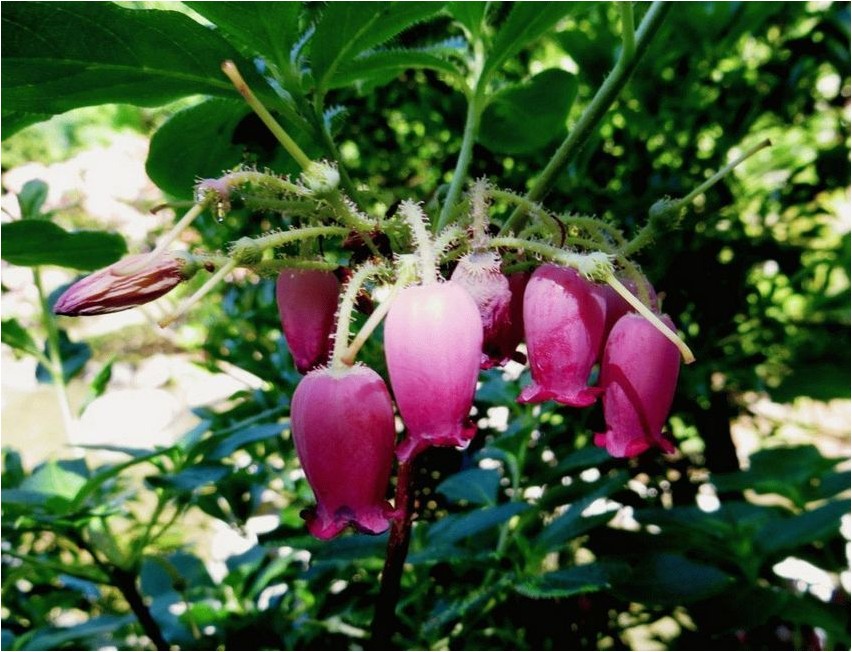
Mencisia (lat. Menziesia) is a genus of deciduous shrubs of the Heather family. The genus includes seven species, native primarily to East Asia and North America. The genus got its name in honor of the English naturalist and physician Archibald Mencies.
Characteristics of culture
Mencisia is a fast-growing deciduous shrub or small tree up to 2. 5 m high. Annual growth is 5-9 cm. The leaves are alternate, short-petiolate. The shoots are bristly and pubescent. The flowers are five-membered, bisexual, the color ranges from light pink to dark red. The calyx is fused-leaved, the corolla is slightly zygomorphic or regular. Mencisia blooms regularly, but not always profusely; flowering lasts 14-27 days. The fruit is a thin-walled four or five-lobed capsule. The fruits are set annually and often do not have time to ripen. Young plants do not differ in winter hardiness, adults are able to withstand frosts down t o-30C. Mencisia is a close relative of the azalea. The crop is rarely used in landscaping, which is due to insufficient cultivation data.
Five-stamen mencisia (lat. Menziesia pentandra) is one of the most popular representatives of the genus. It is a low shrub or tree with shoots covered with long glandular hairs and leaves clustered into a rosette. The leaves are oblong-elliptical or elliptical, pubescent, up to 5 cm long. The flowers are small, red or white, sit on long bristly stalks, collected in apical umbellate inflorescences of 2-5 pieces. The fruit is a spherical-ovoid capsule with scattered bristly pubescence. Mencisia pentastamen blooms in June, the fruits ripen in August. The species is distributed on the Kuril Islands and Sakhalin, as well as in Japan.
Growing conditions
Mencisia develops well and blooms profusely in areas whose composition is as close as possible to natural ones. Soils are preferably moderately moist, acidic, light, air- and water-permeable, without excess nitrogen fertilizers. The location is sunny with light shade.
Propagation by cuttings
Mencisia is propagated by cuttings. This method is the most effective and relatively simple. Rooting rate does not exceed 30-40%. Cuttings are carried out in the summer; the exact timing depends on the presence of non-flowering shoots on the bushes. Cuttings are not harvested from shoots on which flower buds have formed. It is not forbidden to cut cuttings from faded shoots. The cuttings are planted in a mixture made up of sand and sphagnum peat in equal proportions. Peat and sand are sifted before mixing, removing too large particles.

The distance between the cuttings should be about 2-3 cm. Different containers are used for different species and varieties, since they have different rooting abilities. After planting the cuttings, water the soil generously from a watering can with a fine spray net. It is advisable to dissolve the fungicide in water. Cuttings must be kept indoors or in a greenhouse. Next spring, the rooted cuttings are transplanted into separate pots for growing, and a year later — into open ground.
Care
Maintenance is standard: watering, pruning, loosening and weeding. Care activities are not labor-intensive and do not take much time. The culture responds well to mulching the tree trunk area. As mulch, it is recommended to use natural material that acidifies the soil, such as fir cones, pine litter, sawdust or shavings, pine nut husks and peat. Mulch not only acidifies the soil, but also retains moisture for a longer period and protects the root system from overheating.
To further acidify the soil, you can use boric acid or horticultural sulfur. The crop does not need fertilizing, since in nature it grows on infertile soils, but applying the Kemira-Universal complex fertilizer will not do any harm. Fertilize in early spring, when the soil is moist. Watering should be moderate, spraying is also useful. For the first 2-3 years, mencisia are not pruned, although pinching the crown of growing shoots is possible, in this way better tillering can be achieved.