Campanula rotundifolia
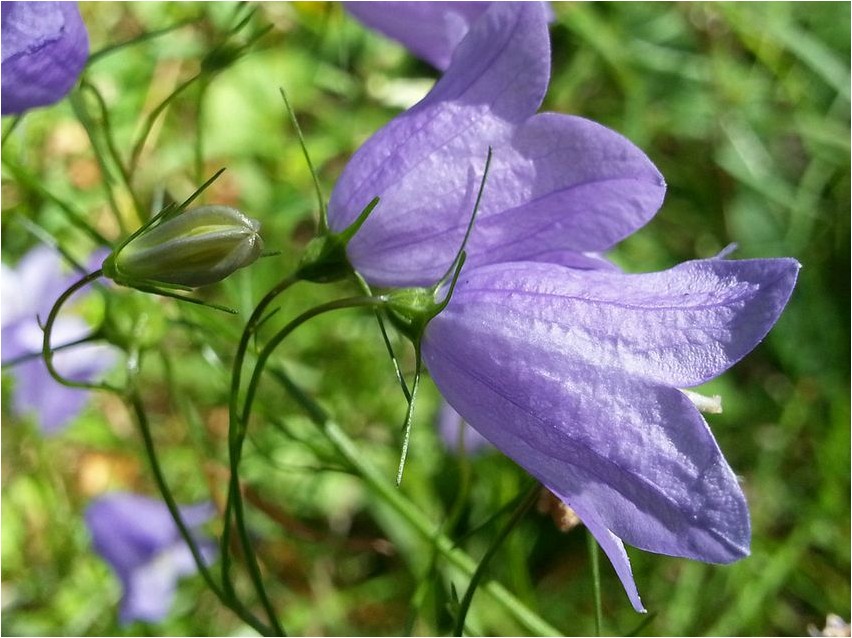
Campanula rotundifolia is one of the plants of the family called bellflowers; in Latin the name of this plant will be as follows: Campanula rotundifolia L.
As for the name of the round-leaved bell family itself, in Latin it will be: Campanulaceae Juss.
Description of Campanula rotundifolia
Campanula rotundifolia is a perennial herbaceous plant whose height will vary between fifteen and forty centimeters. The rhizome of this plant is thin and branched, and it will also creep and form small tufts. The stems of this plant are quite numerous; sometimes, however, they can be single. The basal leaves of Campanula rotundifolia are long-petiolate, kidney-shaped, heart-shaped, ovate, they can be either coarsely toothed or, much less often, almost entire. The stem leaves of this plant will be lanceolate. The flowers are collected in a paniculate and rather spreading inflorescence; such flowers can be either drooping or inclined. The corolla is painted either in blue or light purple tones, and its length will be about twelve to twenty millimeters; such a corolla will be cut shallowly.
The flowering of the round-leaved bell occurs in the period from July to September. Under natural conditions, this plant is found in the Far East, Western and Eastern Siberia. For growth, the plant prefers meadows, bushes and forest edges. It should be noted that the round-leaved bell is an ornamental plant.
Description of the medicinal properties of Campanula rotundifolia
The round-leaved bell is endowed with very valuable healing properties, and it is recommended to use the grass, flowers and roots of this plant for medicinal purposes. The concept of grass includes flowers, leaves and stems.
The presence of such valuable healing properties should be explained by the content of carbohydrates, inulin, sitosterol, pentosans, ursol acid, polyacetylene compounds, alkaloids, as well as nitrogen-containing compounds of betaine and choline in the herb. The herb also contains tannins, flavonoids, esculetin, phenolcarboxylic acids and their derivatives. The stems and leaves of this plant will contain vitamin C.

It should be noted that experiments have shown that both an alcohol extract and a decoction of the herb of Campanula rotundifolia have anticonvulsant properties. In folk medicine, a decoction made from the roots of Campanula rotundifolia is quite common. This root decoction is used for throat tumors. A decoction of the herb has valuable hemostatic properties, and a vodka tincture of the herb is recommended for gargling with sore throat. For epilepsy, an infusion of the flowers of this plant should be taken.
For throat tumors and tumors in the throat cavity, the following remedy based on this plant is recommended: to prepare this remedy, take three tablespoons of crushed roots per two glasses of water. The resulting mixture should be boiled for approximately six to seven minutes, then left to steep for two hours, after which the mixture should be carefully filtered. Take the resulting remedy, made from Campanula rotundifolia, three to four times daily, half a glass or one-third of a glass. To achieve the greatest effect, it is important to strictly follow all the instructions for taking this remedy.





