Davidia
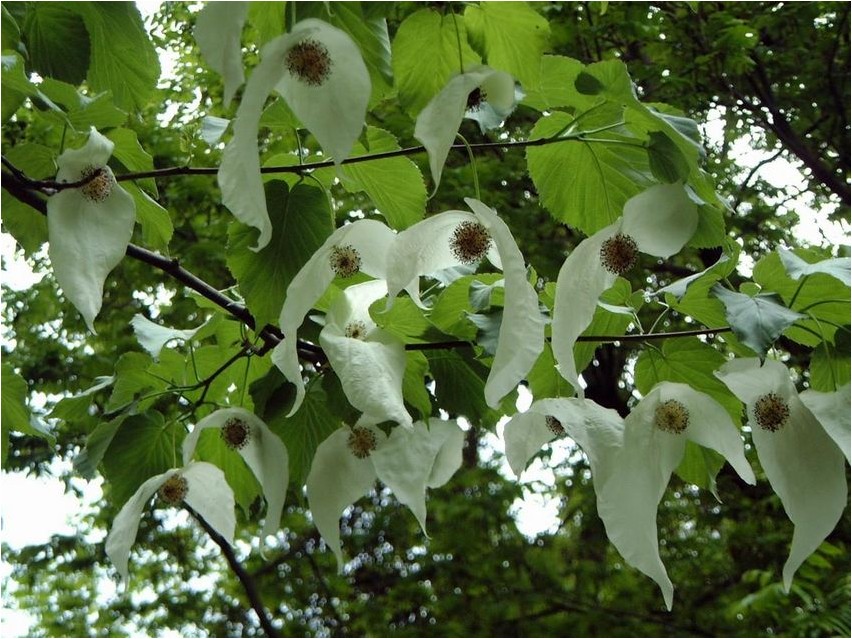
Davidia (lat. Davidia) is a monotypic genus of trees of the Nissa subfamily of the Dogwood family. The only representative of the genus is Davidia involucrata, or Davidia involucrata.
The genus received its name in honor of the French botanist and missionary Armand David. In nature, Davidia is found in the western and central parts of China. Currently cultivated in many parts of the world as a highly ornamental plant.
Characteristics of culture
Davidia is a deciduous tree up to 20-25 m high with a straight strong trunk and a wide pyramidal crown. The bark is grayish-chestnut or light chestnut. The leaves are dark green, simple, heart-shaped or ovate, serrated along the edge. Externally, the leaves of the plants are similar to linden leaves.
The flowers are collected in spherical inflorescences, reaching 2-2. 5 cm in diameter, equipped with two bracts of white or cream color. Flowers form on last year”s shoots. Flowering occurs in May and lasts 20-30 days.
The fruit is a multi-drupe greenish-brown with a pink tint. One fruit contains up to 6 seeds. In Russia, the culture is not particularly popular, although in the southern regions, for example, on the Black Sea coast, it grows without any problems.
Growing conditions

The location is preferably sunny; light shading will not harm the crop. Dense shade will have a detrimental effect on the development of plants. Trees grown in such areas are more often affected by various diseases and practically do not bloom.
Davidia is relatively frost-resistant, but it is recommended to plant it in areas protected from cold winds and the adverse effects of low temperatures. This location will prevent the flower buds from freezing.
Soils are preferably fertile, evenly moist, light with a neutral pH reaction. Heavy clay, highly acidic, swampy and saline soils are not suitable for growing Davidia. The culture does not tolerate waterlogging.
Reproduction
Davidia is propagated by seeds, layering, green cuttings and root suckers. Sowing of seeds is carried out immediately after collection. The first shoots appear at the beginning of next summer. A year later, the seedlings are dug up, separated and grown in greenhouses. Plants are planted in a permanent place after 3-4 years.
Care
Caring for Davidia is practically no different from caring for numerous types of ornamental shrubs and trees. Plants need rare and moderate watering, systematic feeding, and annual sanitary pruning. Pruning is carried out immediately after flowering; this period is the most favorable.
Application
Davidia is a beautifully flowering ornamental plant; it is a wonderful decoration for a garden plot. It is ideal for landscaping parks, alleys and other urban recreation areas. Davidia looks good both in a single copy and in group plantings. The culture is combined with other ornamental shrubs and trees, including conifers.