Carex parvex
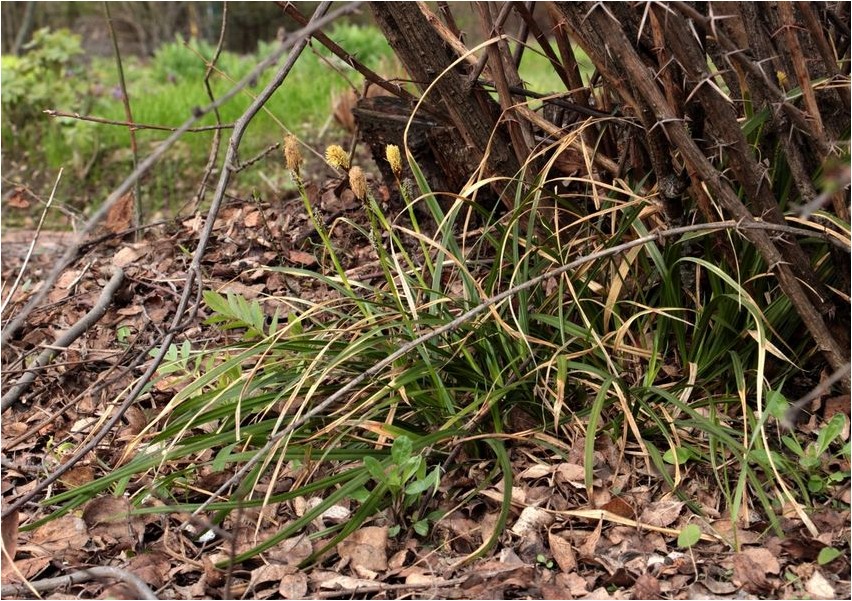
Carex parvex is a member of the Cyperaceae family. Its Latin name is Carex brevicallis Moevch.
The family name of Carex parvex itself is Cyperaceae Juss.
Description of Carex parvex
Carex parvex is a perennial plant with a branched, rigid, horizontal rhizome from which ordered leafy shoots emerge. The lower leaves of this plant are brownish and scale-like, while the central leaves are linear and three to five millimeters wide. The vegetative shoots of this plant are shortened, and the flowers are unisexual, lacking perianths, and are collected in inflorescences. These inflorescences are stripes, which in turn will consist of flowers of one sex. The generative shoots of Carex parva will bear oblong-ovate female spikelets, approximately one and a half to two and a half centimeters long. These generative shoots also bear a single, apical, oblong-club-shaped male spikelet, colored brown.
The fruits of this plant are dry nuts. Flowering occurs from the second half of April to early May. After six weeks, the seeds will ripen and fall. In the wild, this plant is found in Moldova, western and southern Transcaucasia, and the Kharkiv, Khmelnytsky, and Kyiv regions of Ukraine. Generally, it can be found in Western Europe and Asia Minor. Carex parvica prefers gentle slopes of ravines and river valleys, light hornbeam, beech, and oak-hornbeam forests, level areas of watersheds, mountains, meadows, and slopes.
Description of the medicinal properties of Carex parvica
Carex parvica has very valuable medicinal properties, and the leaves and roots of this plant are recommended for medicinal purposes.
The presence of such valuable healing properties should be explained by the content of alkaloids, brevicarin and harmane, in the composition of this plant. It was found that brevicolin has the ability to lower blood pressure, reduce vascular spasms, stimulate respiration and increase contraction of the intestines and uterus, and will also be endowed with ganglion-blocking properties. In addition, such a useful substance will increase uterine contractions, lower blood pressure and completely stop uterine bleeding.

Brevicolin is used in obstetrics and gynecology for weak labor, uterine bleeding in the postpartum period and early discharge of amniotic fluid. Intravenous solutions of this substance are used for bronchial asthma, obliterating endarteritis, left ventricular failure and hypertension.
As for traditional medicine, here preparations based on sedge parva have become very widespread. An infusion and decoction prepared from the herb, leaves or rhizomes of this plant is used as an expectorant for furunculosis, gout, colds, rheumatism, skin and gynecological diseases that will be accompanied by pain.
To prepare this remedy, take two teaspoons of the rhizomes of this plant in two glasses of boiled water at room temperature. The resulting mixture, based on parva sedge, is infused for eight hours and then filtered very carefully. Take this remedy two to three times a day, half a glass.





