Istoda thin-leaved
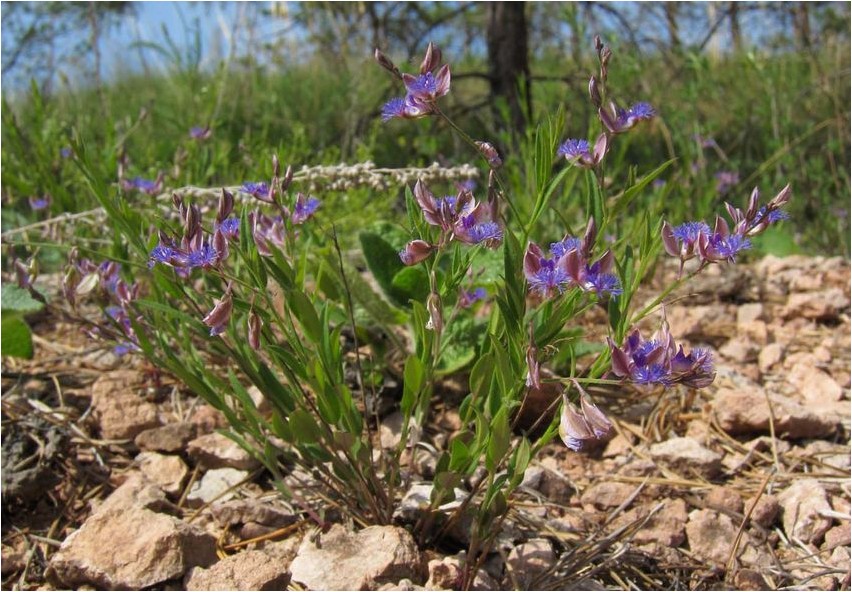
Istoda thin-leaved is one of the plants of the family called istodae; in Latin the name of this plant will be as follows: Polygala tenuifolia Willd.
As for the name of the thin-leaved family itself, in Latin it will be: Polygalaceae R. Br.
Description of thin-leaved spring
Istoda thin-leaved is a perennial herbaceous plant, endowed with an erect stem, as well as narrow lanceolate or elliptical leaves and quite numerous thin stems. The flowers of this plant are very small in shape; they can be colored in both pale blue and blue tones: such flowers are collected in racemose inflorescences. The fruit of Istoda thinifolia is a two-locular, flattened and round-ovoid capsule.
Flowering of the thin-leaved spring occurs in the period from May to July. Under natural conditions, this plant is found in Eastern Siberia, around Lake Baikal and especially in Transbaikalia, as well as in Altai, Novosibirsk, Tomsk and Omsk regions. For growth, the plant prefers steppe areas on rocky slopes, but it is extremely rare to see the plant in pine forests.
Description of the medicinal properties of thin-leaved istoda
Istoda thin-leaved is endowed with very valuable healing properties, and it is recommended to use the roots and rhizomes of this plant for medicinal purposes. Such raw materials should be harvested in the autumn.
The presence of such valuable healing properties is explained by the content of glucose, resins, triterpene saponins, lactones, polyhalite alcohol, fatty and essential oils, as well as other substances in this plant.

The roots of this plant are endowed with wound-healing, emollient, expectorant, choleretic, anti-inflammatory, anti-sclerotic and anti-diabetic effects. It is noteworthy that there is an opinion that preparations based on this plant will promote longevity, and they are also recommended as a tonic, choleretic, antispasmodic and general strengthening agent.
A decoction prepared from the roots of this plant is recommended for use for pneumonia, bronchitis, laryngitis, lung abscesses, and also as part of complex preparations, such decoctions are used for anemia, vascular spasms, neuroses, insomnia and anemia. As for the use of a decoction of the roots as an external remedy, the decoction is used for boils and carbuncles.
An infusion of the leaves of thistle is used for spermatorrhea, and also for eclampsia as a sedative and anticonvulsant. An infusion prepared from the roots of this plant is recommended for use in cases of heart neurosis, diabetes, vasospasms, hypertension, nephritis and vegetative neuroses.
As for traditional medicine, it is recommended to use the healing properties of this plant for hernia and diarrhea, and also as an expectorant and diuretic. It should be noted that the roots and rhizomes of this plant are endowed with a very effective tonic effect.
For diarrhea, it is recommended to use the following remedy based on thin-leaved istoda: to prepare such a remedy, take one tablespoon of the roots of this plant per two glasses of cooled boiled water. The resulting mixture should be infused for four hours, and then this mixture is carefully filtered. Take this remedy one third of a glass three to four times a day. It is important to remember that it is very important to strictly follow all the norms for taking such a remedy based on thin-leaved istoda: only in this case can the greatest effectiveness be achieved.





