Prolomnik northern
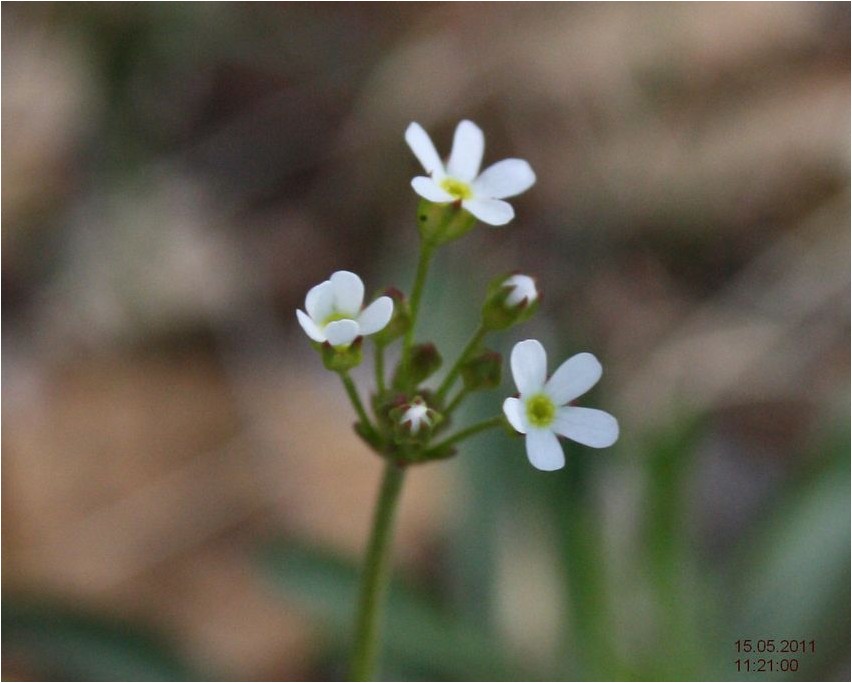
The northern borer is one of the plants of the family called primroses; in Latin the name of this plant will be as follows: Androsace septentrionalis L.
As for the name of the northern borer family itself, in Latin it will be: Primulaceae Vent.
Description of the northern breach
Northern breaker is known by many popular names: heart grass, monthly grass, hernia grass, first grass and re-melting grass. Northern breaker is a small annual winter herbaceous plant, the height of which will fluctuate between two and thirty-five centimeters. The leaves of this plant are collected in rosettes, such leaves are almost sessile, they can be either lanceolate or oblong, and such leaves will be tightly pressed to the ground. The entire plant is covered with sparsely short hairs, which are mostly branched, and in the upper part such hairs are glandular. There are several peduncles of the northern bristlecone, with small white flowers collected in umbrellas. The calyx of this plant will be pentagonal, and up to one third of the calyx will be cut into teeth. The corolla of the northern breaker turns out to be equal to or slightly longer than the calyx itself. The seeds of this plant are enclosed in capsules, and they will be colored in dark brown tones. In the month of July, the ripened seeds of the northern breaker fall off and germinate; in the fall, such seedlings will form a rosette of leaves.
This plant blooms from the second half of May to the month of June. Under natural conditions, the northern breacher is found in Central Asia, the European part of Russia, Belarus, the Caucasus, Ukraine, Western and Eastern Siberia, as well as the following regions of the Far East: Kamchatka and Okhotsk regions, Primorye and Amur region. Under natural conditions, this plant is found in the territory of sparse forests, fallow lands, fallow fields, dry and walled meadows, coastal cliffs, dry rocky slopes, forest edges and clearings.
Description of the medicinal properties of northern breacher
The northern breacher is endowed with very valuable healing properties, and it is recommended to use the herb of this plant for medicinal purposes. The term grass includes stems, flowers and leaves.
The presence of such valuable healing properties should be explained by the content in the herb of this plant of triterpene saponins, cobalt, zinc, iron, vanadium, nickel, chromium, copper, titanium, molybdenum, manganese, titanium, gallium, silver, strontium, zirconium, tannins, flavonoids, coumarins and more than 15 amino acids.

It has been experimentally proven that drugs created on the basis of the northern bronchial plant are endowed with a calming and contraceptive effect.
As for traditional medicine, here this plant is very widespread. An infusion or decoction prepared from the herb of this plant is indicated for oral use for various heart pains, kidney stones, nervous disorders, hernia, fever, goiter, aching joints, and gastralgia. In addition, such healing agents are recommended for use as anticonvulsants for epilepsy, such as diuretics, hemostatic and abortifacients.
Externally, a decoction based on the herb of this plant is used for gonorrhea in men, sore throat and sore throat, and in the form of douching, this remedy is indicated for use in leucorrhoea in women. It should be noted that the use of northern breaker is strictly contraindicated during pregnancy.





