Krachay
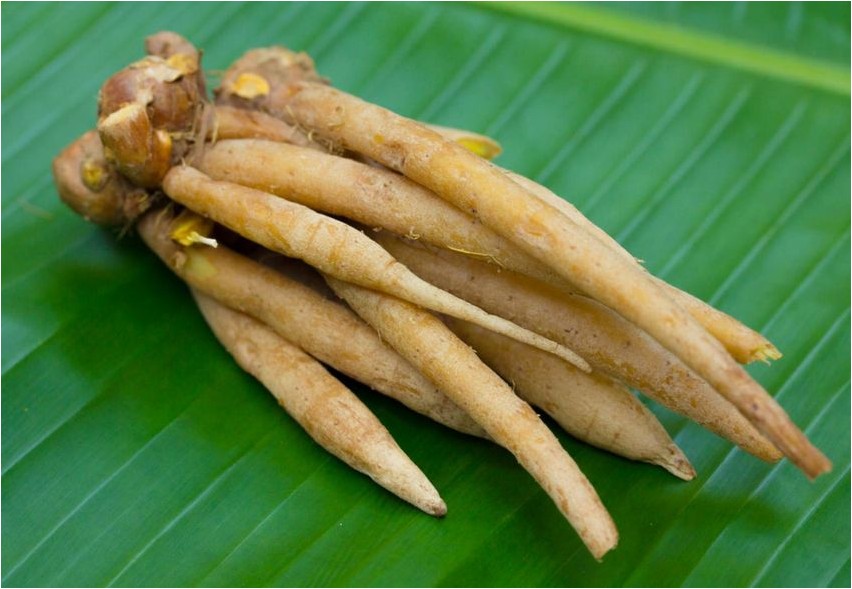
Krachai (lat. Boesenbergia rotunda) is a relative of ginger. It is this fact that determines its second name — Chinese ginger.
Where does it grow
Despite the fact that the birthplace of this useful plant is the Indonesian islands, it is not difficult to meet krachai in Vietnam or Indonesia, as well as in Malaysia and Thailand. You can also find it in Southern China or India — there it grows in lowlands and on dark, damp slopes.
Application
Krachai is most widely used in a very unique Thai cuisine. However, it is used quite often throughout Southeast Asia. Krachai is added to main dishes, soups, salads, snacks and sauces. The characteristic citrus aroma and incredibly soft taste perfectly emphasize the originality of a wide variety of dishes. Krachai goes especially well with seafood and fish dishes. It is also added to the curry mixture. By the way, quite often this plant is ground into a paste or cut into small pieces. Krachai differs from galangal and ordinary ginger in that it is not at all necessary to remove it at the end of cooking a particular dish.
And since krachai has an extremely low calorie content (only 80 kcal), it can be safely consumed even by those who follow a strict diet.
Krachai rhizomes are incredibly rich in calcium, as well as vitamins A and B12. This combination can significantly improve the condition of hair and skin, as well as vision. It also helps regulate metabolism and improve immunity.
Even traditional medicine in many countries of vast Southeast Asia uses krachai for medicinal purposes. With its help, they get rid of stomach pain and improve the functioning of the digestive tract.

The active substances contained in krachai are endowed with anticarcinogenic, antiseptic and anti-inflammatory properties. And a wonderful tonic substance called fingerroot is an integral part of Thai capsules that help strengthen men”s health.
In addition, all kinds of creams and nourishing face masks are made on the basis of krachai.
How to choose
As a rule, krachai sold by weight looks like fresh whole roots, somewhat reminiscent of turmeric. A little less often you can find this spice in the form of packaged chopped straws. It is not difficult to distinguish krachai from ginger — krachai is chopped together with the brownish skin, and ginger is always peeled from it. You can also find ground krachai on sale.
And in specialized stores it will not be difficult to purchase this wonderful product in sets of spices and vegetables for preparing the popular Thai “tom yum” soup.
Storage
To ensure that krachai does not gradually lose its valuable properties, it is important to ensure proper storage. Pickled krachai used as a seasoning should be stored in the refrigerator exclusively in glass or ceramic containers. Its shelf life should not exceed three months. Ground roots are stored in strong sealed containers, and fresh roots are stored for five days in the lower compartment of the refrigerator. If you want to preserve a valuable product for as long as possible, it doesn’t hurt to use the freezer. Before sending it there, the krachai must be properly packaged, and for greater convenience, it is not forbidden to peel it and cut it into small pieces.
Contraindications
There are only two contraindications to the use of krachai — a tendency to allergies and individual intolerance. Everyone else can eat this product without any worries.