Xanthoceras
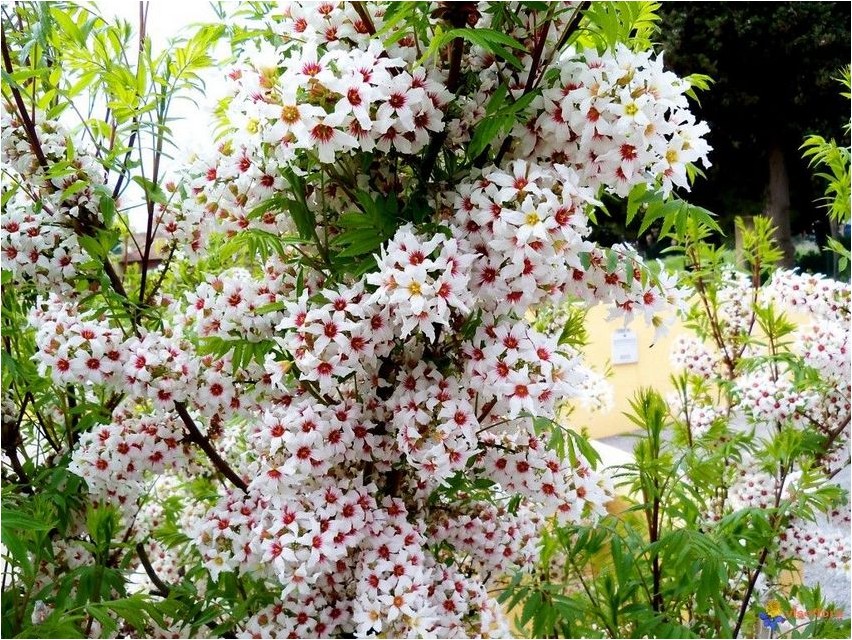
Xanthoceras (lat. Xanthoceras) is a monotypic genus of deciduous trees of the Sapindaceae family. Another name is Chekalkin nut. The only representative of the genus is Xanthoceras sorbifolium.
Natural range: North Korea and Northern China. Today, xanthoceras is cultivated in Moldova, Azerbaijan, Georgia, Central Asia, the European part of Russia and Ukraine.
Characteristics of culture
Xanthoceras, or Chekalkin nut, is a deciduous tree, less often a large shrub up to 8 m high. The crown is pyramidal in shape. The branches are straight, thick, young shoots are covered with soft short hairs over the entire surface. The leaves are dark green, odd-pinnate, alternate, consisting of 9-17 sessile leaflets. The leaves are lanceolate, leathery, sharply serrate, opposite, up to 5 cm long.
The flowers are relatively large, white, regular, sit on short stalks, collected in dense multi-flowered racemes up to 25 cm long, located on shortened lateral branches and at the ends of the shoots. The fruit is an elliptical or triangular-ovoid capsule containing large edible seeds of dark brown or almost black color. When ripe, the fruits crack.
Growing conditions
Xanthoceras develops well and produces high fruit yields on well-moistened, fertile and drained soils without compaction. Loamy soils are optimal. Plants grow without problems on heavily limed soils. The culture does not accept stagnant water, especially for young trees. Xanthoceras is light-loving and tolerates light shade. It is resistant to frost, can withstand frosts down t o-30C.
Reproduction and planting
Xanthoceras are propagated by seeds and root cuttings. Seeds are sown in early spring. It is not recommended to sow in autumn, since the seeds do not have a dormant period and germinate quickly. The crop is sown immediately in a permanent place, since it has a negative attitude towards transplantation, which is directly related to its unique root system. After collection, the seeds are stored in cool rooms in burlap. Seed germination is 50-66%. When some seeds germinate, they form etiolated plants, which die after 30-40 days. The seeding depth is 4-5 cm. Before sowing, the seeds are pre-soaked in warm water.

Root cuttings of xanthoceras are harvested in autumn or early spring. Trenches are dug around an adult tree, then some of the root lashes are cut off with pruning shears, which are subsequently divided into segments 5-10 cm long. During autumn harvesting, root cuttings are stored in boxes with wet sand in a cool room, but before this the material is tied into bundles and the lower and upper ends are marked. In spring, cuttings are planted in the ground so that the end of the root cutting rises 1-1. 5 cm above the soil surface.
Care
Caring for xanthoceras consists of standard procedures for most fruit and ornamental crops, or rather, weeding and loosening of the tree trunk area, watering during drought, fertilizing with mineral and organic fertilizers, preventive treatment against diseases and pests, and sanitary pruning. Young specimens are covered with non-woven material for the winter, and the tree trunk area is mulched with fallen leaves or peat.
Xanthoceras rowan-leaved (Chekalkin nut). Garden plants for gourmets.
Xanthoceras
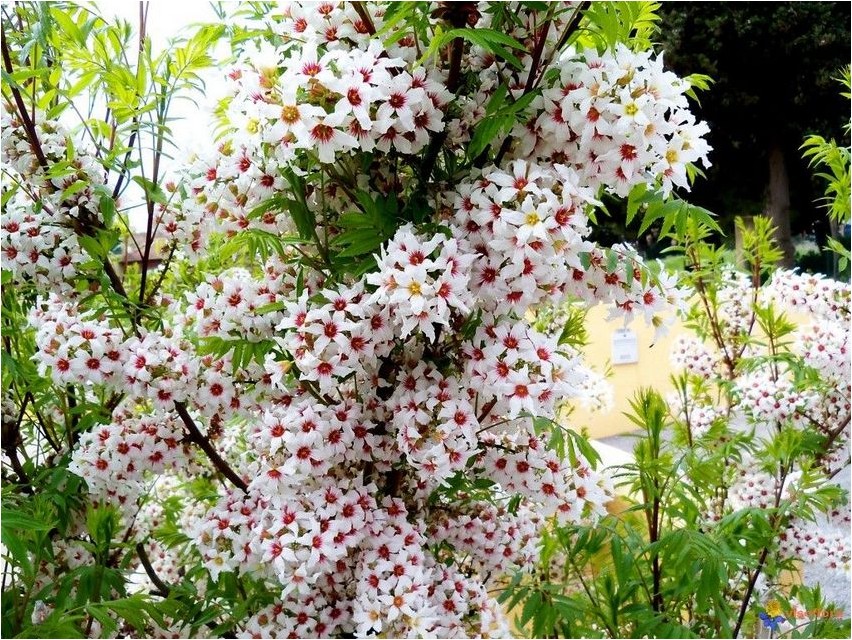
Xanthoceras (lat. Xanthoceras) is a monotypic genus of deciduous trees of the Sapindaceae family. Another name is Chekalkin nut.
The only representative of the genus is Xanthoceras sorbifolium. Natural range: North Korea and Northern China. Today, xanthoceras is cultivated in Moldova, Azerbaijan, Georgia, Central Asia, the European part of Russia and Ukraine.
Characteristics of culture
Xanthoceras, or Chekalkin nut, is a deciduous tree, less often a large shrub up to 8 m high. The crown is pyramidal in shape. The branches are straight, thick, young shoots are covered with soft short hairs over the entire surface. The leaves are dark green, odd-pinnate, alternate, consisting of 9-17 sessile leaflets. The leaves are lanceolate, leathery, sharply serrate, opposite, up to 5 cm long.
The flowers are relatively large, white, regular, sit on short stalks, collected in dense multi-flowered racemes up to 25 cm long, located on shortened lateral branches and at the ends of the shoots. The fruit is an elliptical or triangular-ovoid capsule containing large edible seeds of dark brown or almost black color. When ripe, the fruits crack.
Growing conditions
Xanthoceras develops well and produces high fruit yields on well-moistened, fertile and drained soils without compaction. Loamy soils are optimal. Plants grow without problems on heavily limed soils. The culture does not accept stagnant water, especially for young trees. Xanthoceras is light-loving and tolerates light shade. It is resistant to frost, can withstand frosts down t o-30C.
Reproduction and planting
Xanthoceras are propagated by seeds and root cuttings. Seeds are sown in early spring. It is not recommended to sow in autumn, since the seeds do not have a dormant period and germinate quickly. The crop is sown immediately in a permanent place, since it has a negative attitude towards transplantation, which is directly related to its unique root system. After collection, the seeds are stored in cool rooms in burlap. Seed germination is 50-66%. When some seeds germinate, they form etiolated plants, which die after 30-40 days. The seeding depth is 4-5 cm. Before sowing, the seeds are pre-soaked in warm water.
Root cuttings of xanthoceras are harvested in autumn or early spring. Trenches are dug around an adult tree, then some of the root lashes are cut off with pruning shears, which are subsequently divided into segments 5-10 cm long. During autumn harvesting, root cuttings are stored in boxes with wet sand in a cool room, but before this the material is tied into bundles and the lower and upper ends are marked. In spring, cuttings are planted in the ground so that the end of the root cutting rises 1-1. 5 cm above the soil surface.
Care
Caring for xanthoceras consists of standard procedures for most fruit and ornamental crops, or rather, weeding and loosening of the tree trunk area, watering during drought, fertilizing with mineral and organic fertilizers, preventive treatment against diseases and pests, and sanitary pruning. Young specimens are covered with non-woven material for the winter, and the tree trunk area is mulched with fallen leaves or peat.