Field bindweed
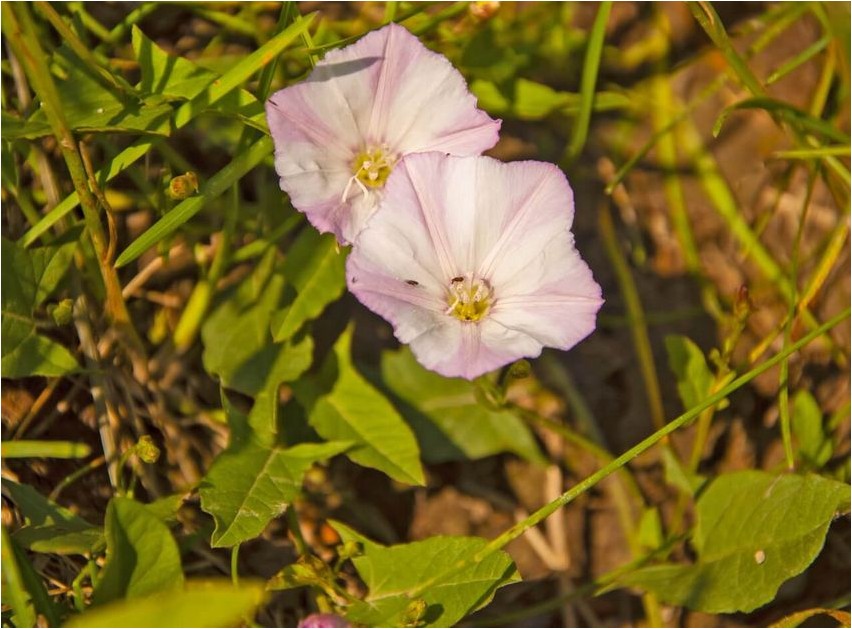
Field bindweed is one of the plants of the family called Convolvulaceae; in Latin the name of this plant will be as follows: Convolvulus arvensis L.
This crop is a perennial herbaceous plant.
Description of field bindweed
The stem of this plant can be either climbing or creeping; this stem is ribbed and its length can reach approximately one meter. The leaves of field bindweed will be regular triangular, they have arrow-spear-shaped bases, as well as a rather long petiole. The flowers of this plant can be colored either white or pink, and they have a very bright aroma. The calyx of field bindweed is five-leaved, and the corolla itself is endowed with a pentagonal bend; there are only five stamens: these stamens are fused with the corolla. Moreover, the pistil of this plant is endowed with two thread-like stigmas and an upper ovary. The fruit of field bindweed is a small, spherical, four-leaf capsule endowed with four black seeds.
The flowering of this plant continues throughout the summer season. Field bindweed is found in the European part of Russia with the exception of the Far North. This plant can also be found in Kazakhstan, the Caucasus, southern Siberia, the Far East and Central Asia. For growth, this plant prefers roads, vacant lots, gardens and vegetable gardens. Actually, this plant can be called one of the most common weeds.
Description of the medicinal properties of field bindweed
It should be noted that field bindweed is endowed with quite valuable healing properties. For medicinal purposes, the grass, roots, flowers and leaves of this plant should be used.
The roots of this plant should be collected either in early spring or in autumn. In this case, leaves, flowers and grass should be collected in June-August. This plant contains the glycoside convolvulin, which has a fairly strong laxative effect. This substance is found in large quantities both in the roots and rhizomes of this plant. The leaves of field bindweed contain carotene and ascorbic acid. The herb of this plant will contain a blood clotting substance and vitamin E, as well as saponins, bitter substances and resinous glycosides. The resin of the roots of field bindweed contains glycosides that are identical to jalapin and convolvulin. The flowers of this plant contain resins, and alkaloids were found in the seeds.

Field bindweed is endowed with wound-healing, laxative, diuretic, antifever, as well as analgesic and antitoxic effects. As for traditional medicine, a decoction and infusion of seeds or roots is widely used as a laxative, and also for enterocolitis and gastritis. In fact, such remedies have also found similar applications in homeopathy and veterinary medicine.
Fresh ground bindweed grass, as well as its juice or dry herb powder, is used as an analgesic or hemostatic agent. Field bindweed grass powder should be sprinkled on wounds and bruises, but fresh crushed leaves are recommended to be applied as an antidote for snake bites. A decoction prepared from the flowers of this plant should be used for fainting or inflammation of the upper respiratory tract. It is noteworthy that the herbal decoction turned out to be very effective in the treatment of diseases of the female genital area.
A decoction of dry leaves or roots of bindweed should be used as an external remedy for lichen, scabies, rashes, as well as for pustular skin diseases. Traditional medicine also recommends the use of rhizome powder for insomnia.





