Halesia
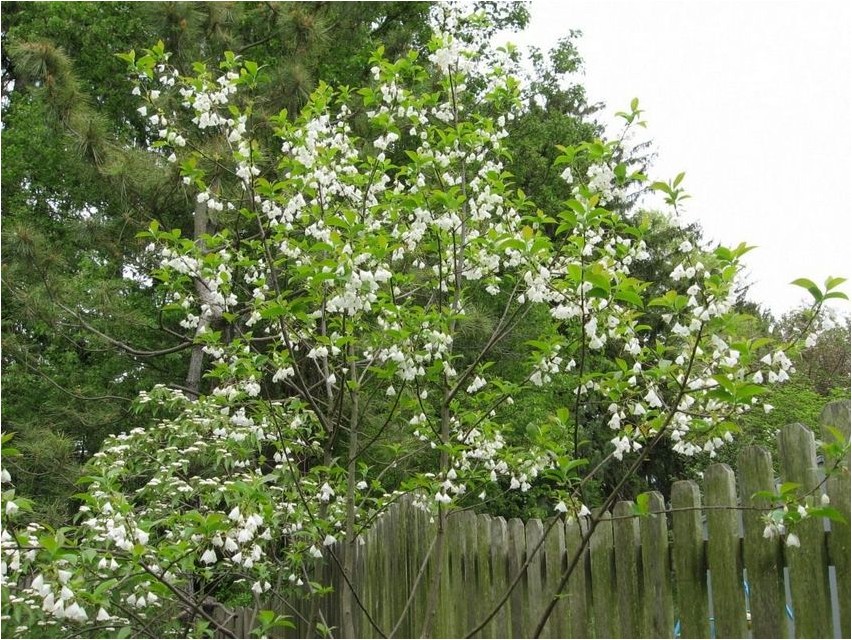
Halesia (Latin: Halesia) is a genus of beautifully flowering ornamental shrubs in the Styrax family. The plant is often called the lily-of-the-valley tree, snowdrop tree, and silverbell tree.
These names derive from its large, bell-shaped flowers. The genus includes four species, three of which are native to North America and China. Halesia is not particularly popular in Russia, but is grown by amateur gardeners in private gardens, parks, and squares in the Krasnodar Territory.
Common Species and Their Characteristics
*Halesia caroliniana (Latin: Halesia caroliniana) is a shrub with thick, straight trunks up to 3 meters tall, covered with bright brown, bumpy bark. The leaves are light green, alternate, elliptical, with a pointed tip, up to 10-12 cm long. The flowers are white or pale pink, bell-shaped, four-petaled, and borne on thin peduncles in clusters. Halesia carolinica blooms for 10-15 days, typically beginning in late May or early June. The fruits are large, ribbed, up to 3. 5 cm long. The seeds are winged. The fruits ripen in late August. Halesia carolinica is native to North America, growing on riverbanks and mountain slopes.
*Halesia monticola (Latin: Halesia monticola) is a species of deciduous shrubs and trees up to 25 m tall with a broad, conical crown. Young shoots are smooth and gray-brown, turning gray-black with age, with deep scales. The leaves are oblong or elliptical, alternate, with serrated edges. The flowers are white, bell-shaped, up to 2. 5 cm long. The fruit is brown, with wing-like ribs. Galesia montana is currently grown in southern Russia, as well as in Moldova and Ukraine.
Growing Conditions
Galesia prefers a sunny location, although light shade is possible. Protection from cold winds is essential. Fertile, moist, well-drained, and loose soils without compaction are desirable. Galesia does not tolerate waterlogged, highly acidic, or saline soils. The presence of lime in the soil is also contraindicated.

Galesia is relatively frost-hardy, but cold winters can damage flower buds. Therefore, abundant flowering should not be expected after cold winters. The crop can be grown under the canopy of large trees, which creates a more favorable microclimate that mitigates frost.
Propagation and planting
Galesia is propagated by seeds, layering and cuttings. In the middle zone, cuttings are preferable. Cuttings are taken from semi-lignified shoots. Before planting, the cuttings are soaked in a solution of indolylbutyric acid. In this case, the rooting percentage is 68%. In the southern regions, the crop is propagated by seeds; their germination rate is low, only 60-62%.
Most gardeners grow galemsia as biennial seedlings. Before planting, the container with the seedling is immersed in warm water for 20-25 minutes. The substrate must be completely saturated with water. The diameter of the planting hole should be about 50 cm, the depth — 60 cm. A layer of gravel or crushed stone is placed at the bottom of the hole, a soil mixture consisting of fertile soil and humus is poured, and the seedling is lowered. The roots are straightened, and the voids are filled with earth and compacted.
After planting, the tree trunk area is watered and mulched. It is recommended to use peat or wood chips as mulch. The root collar of the seedling should be located at the level of the soil surface or a couple of centimeters higher. At first, the seedlings should be shaded from the bright sun.
Care
Mandatory procedures for caring for crops include fertilizing and watering. Feed plants in early spring and before flowering. Watering is systematic; the volume of water is increased during drought and before preparing plants for winter. Sanitary pruning is carried out in spring and autumn. Formative pruning of galesia is not necessary, but is not prohibited.