Blackberry
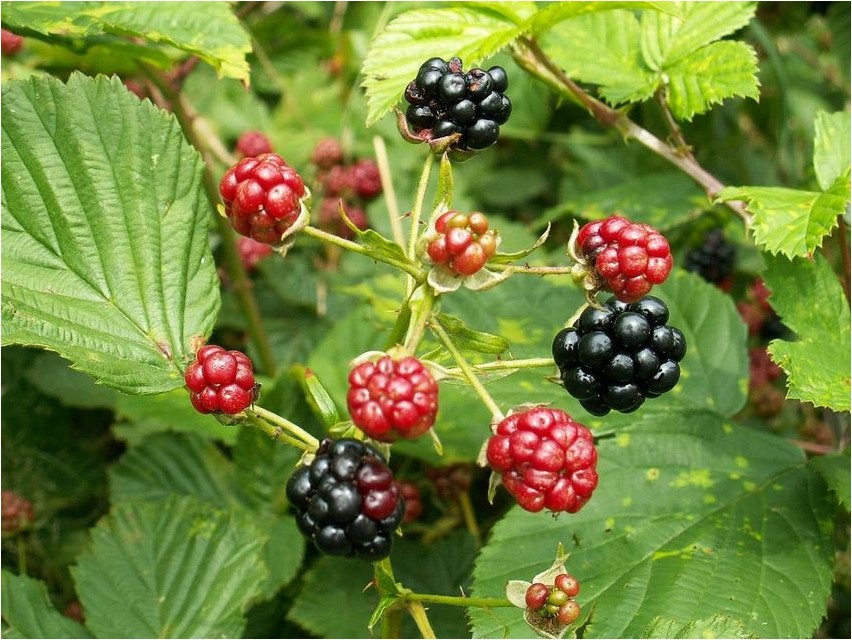
Blackberry (lat. Rubus) — belongs to the category of berry crops; is a genus belonging to the Rosaceae family. It is found wild in the Russian Federation, the USA and China.
Description
Blackberries are represented by subshrubs up to 100 cm high, equipped with erect, less often creeping stems bearing complex, palmate or trifoliate green foliage located on long petioles. The shoots are strewn with prickly thorns. The flowers, depending on the type and variety, can be white or light pink; they are small, collected in branched shields.
The fruits are in the form of black or reddish-black complex drupes. The fruits may have a bluish coating. They are usually aromatic, sweet or sweet and sour, and watery in texture. A distinctive feature of the crop in question is its long flowering period; often both flowers and fruits are found on the plant at the same time.
Subtleties of cultivation
Blackberries are classified as light-loving crops; they thrive in intensely lit areas. Wind protection is preferred. In shaded areas, blackberries develop with a lag and flowering is rare. In addition, the shade helps to stretch the shoots in length.
Soils for blackberries are preferable to moist, loose, light, nutritious, well-drained, neutral. Sandy loam soils are optimal. Blackberry is a moisture-loving plant, but it does not tolerate close water. Blackberries are not friendly with heavy, acidic, damp, poor and saline soils.
Features of reproduction
The crop is propagated by seed and vegetatively (by cuttings, dividing the bush, etc.). Sow seed seeds in September. It is important to provide the crops with good cover with peat or fallen leaves. Sowing in spring is not prohibited. The seeds are planted to a depth of 1 cm. The plants are transplanted to the place where cultivation is planned in the phase of five true leaves. A crop grown in this way begins to bear fruit in its fifth year.

Blackberries can be propagated by layering. This is the simplest and most effective way. Layers are placed in previously prepared grooves, pinned and covered with earth. This method of reproduction is carried out in the third ten days of July. In the spring of next year, cuttings are cut from the bush and planted in a designated area.
The crop in question is cut in July. Cuttings are taken from annual shoots; each cutting must have a bud. Before planting for rooting, it is recommended to dip the cuttings in a solution of indolylbutyric acid. The cuttings are planted in containers filled with a nutrient mixture.
Care
Caring for blackberries is not difficult; it is important to regularly carry out watering, loosening and other procedures. The first pruning is carried out after a year. Sanitary pruning involves removing old and damaged shoots. Blackberries also need support. It is advisable to use fan-shaped structures. Despite the fact that the crop is drought-resistant, it requires systematic watering. The soil in the stem zone should not dry out. Blackberries respond positively to mineral and organic fertilizers. They are paid annually. With the onset of cold weather, the bushes are bent to the ground and covered with lutrasil or spruce branches.





