Hemanthus
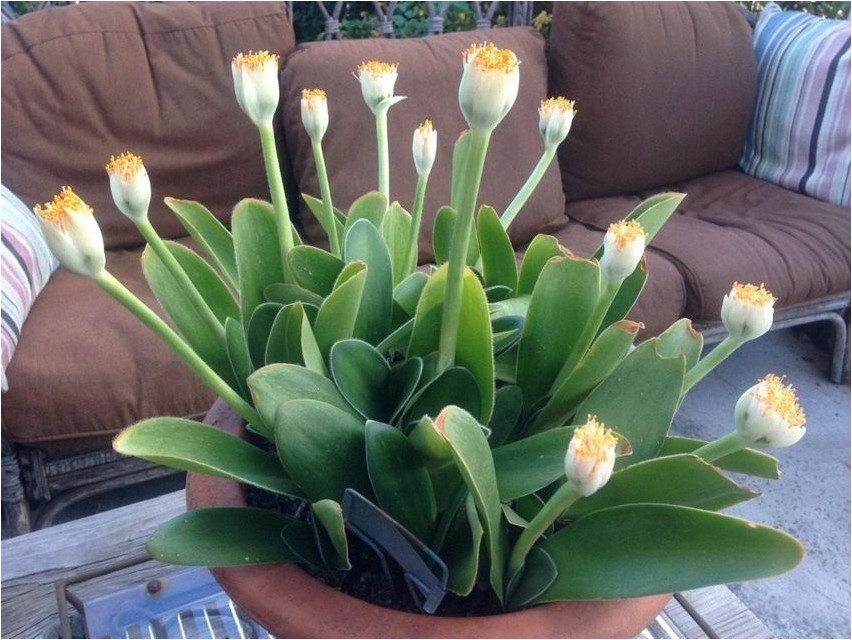
Hemanthus (lat. Haemanthus) is a genus of bulbous plants of the Amaryllidaceae family (lat. Amaryllidaceae).
The plants are distinguished by a small number of leaves, evergreen or periodically falling, and an unusual inflorescence, similar to a paint brush or artist’s brush. The inflorescence is protected from drying out by stipules, painted by nature in the same color as the numerous original flowers. In Russian climatic conditions, plants of the Hemanthus genus are grown as indoor plants or in warm greenhouses.
What’s in your name
The Latin name of the genus of original plants is based on two Greek words. Their literal translation into Russian violates all the life principles of plants through whose vessels blood has never flowed. After all, these two words are “blood” and “flower”.
This incomparable combination of words is explained by the bright red color (resembling the color of human blood) of the stipules and flowers of two species of the genus, which were the first to decorate European gardens. It was these two species that Carl Linnaeus saw, who gave the name to the entire genus. Although later it turned out that there are species with pure white stipules and white flowers, which are more familiar to Russian gardeners today.
Such contrasting colors of flowers of plants of the genus Hemanthus haunted botanists for a long time, each of whom tried to attach different species of this genus to completely different genera and give them different names. Therefore, different classifications of plants include different numbers of species in the genus Hemanthus, misleading both botanists and ordinary flower growers. The range in the number of species of the genus Hemanthus ranges from 6 to 22. This can be partly explained by the fact that plants of this genus grow only in South Africa, which not every botanist could and can reach in person.
Description
The main part of plants of the Hemanthus genus is the relatively large bulb. This is a real storehouse in which the plant stores nutrients and moisture, allowing the plant to remain in an inactive state underground during unfavorable dry periods of the year. In addition, it is also a reproductive organ, bringing new small bulbs into the world.

The bulb is formed by fleshy basal leaves and looks like a two-row tunic. Three types of plants that have evergreen leaves leave part of the bulb on the soil surface, which, when positioned in this way, acquires a bright green color. In arid habitats, plants hide their bulbs quite deep in the soil.
Leaves appear from the bulb simultaneously with the peduncle, or even later than the peduncles, the number of which varies from one to six pieces. In different species of plants of the genus, the appearance of the leaves can differ radically. These can be narrow leaves that creep along the surface of the ground, or wide and erect leaves. The surface of the leaves is leathery, from smooth to very hairy, or even sticky. The leaves can be evergreen or fall off during an unfavorable period of life.
Compared to other plants of the Amaryllidaceae family, Hemanthus has particularly small flowers. However, when gathered in large groups, they form attractive raceme-shaped inflorescences and have large reserves of pollen and nectar, which bees successfully collect. Although the smell of flowering is not very attractive to humans.
The flowers are protected from drying out and damage by four (or more) bracts, which can be filmy or fleshy. The color of the bracts, as a rule, matches the color of the flowers, creating a single monochromatic compositional group, white, pink, orange, red.
The fruits of Hemanthus seem more fragrant to humans. They are typically spherical in shape and come in colors ranging from bright red to orange, pink and white.
Usage
In South Africa, Hemanthus species choose a wide variety of habitats, located on gravel plains and swamps, coastal dunes, and mountain peaks.
In other parts of our planet, they prefer to grow in greenhouses or in residential premises.