Norichnik shadow
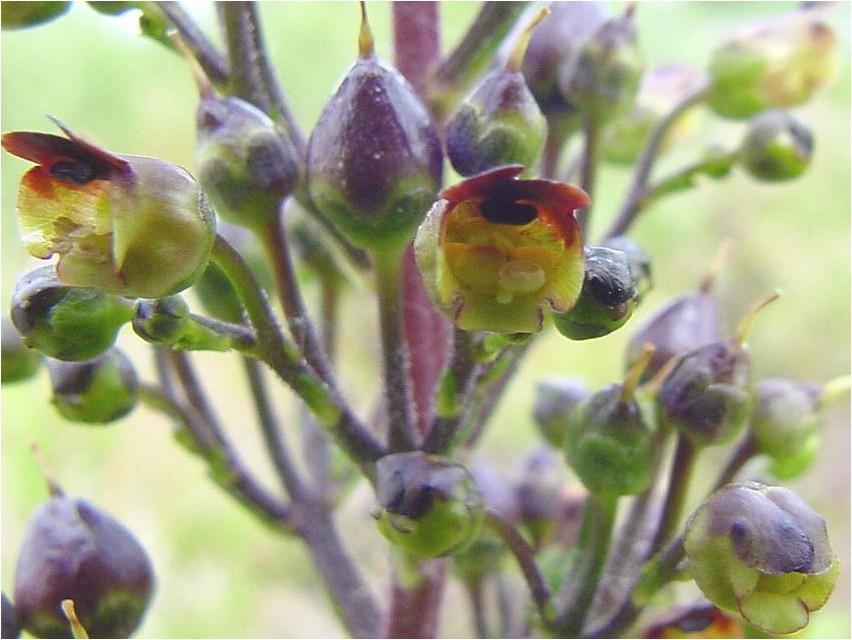
Scrophularia umbrosa Dumort. (S. alata Gilib., S. aquatica auct.).
As for the name of the family of the shady nocturnus itself, in Latin it will be like this: Scrophulariaceae Juss.
Description of the shadow minnow
Norichnik shady is a perennial herbaceous plant, the height of which will fluctuate between forty and one hundred and twenty centimeters. Such a plant is naked, it will be endowed with fibrous roots. The stem of this plant will be tetrahedral, the leaves are oblong-ovate in shape, their length is seven to nine centimeters, and the width is about three and a half to four centimeters, while the length of the petioles will be equal to one centimeter. The length of the lower leaves of the shady grass is ten to sixteen centimeters, and the width will be about four and a half to seven and a half centimeters; sometimes such leaves can be heart-shaped. The bracts of this plant are lanceolate. The flowers of the shady orchids will be on glandular-pubescent pedicels, three in half-umbrellas. Such flowers are collected in a paniculate inflorescence, the length of which is sixteen to twenty-six centimeters, and the width is about five to nine centimeters. The corolla of this plant is colored in greenish-red-brown tones, its length is four to six millimeters, the capsule will be round-ovate or almost spherical. The seeds of the shadow burrow are colored in dark brown tones, they will be elliptical, their length will not reach one millimeter, and their width will be equal to half a millimeter.
The flowering of the shady nocary occurs during the period from July to September. Under natural conditions, this plant is found in Central Asia, the European part of Russia, the Caucasus, Crimea, Western and Eastern Siberia, as well as in the Carpathians and the Dnieper region of Ukraine. For growth, this plant prefers river banks, swamps, meadows, springs, ditches, coniferous and mixed forests from the lowlands to the upper mountain zone. It is noteworthy that this plant is also poisonous.
Description of the medicinal properties of norichnik shadow
Scrophula acuminata possesses valuable medicinal properties, and its rhizomes and herb are recommended for medicinal purposes. The herb includes the leaves, flowers, and stems. The herb and leaves of this plant should be collected between May and August, while the rhizomes are harvested in late autumn.
The plant’s valuable medicinal properties are attributed to its content of saponins, iridoids, carbohydrates, and phenolic acids. The herb contains steroids, iridoids, carbohydrates, phenolic acids and their derivatives, as well as the following fatty acids: linoleic, linolenic, oleic, and palmitic. The stems of Scrophula aetiflora contain saponins, iridoids, tannins, phenolic acids, and their derivatives. The flowers contain saponins and iridoids, and the fruits contain harpagide, aucubin, tannins, and harpagide acetate.

This plant has bactericidal, diaphoretic, anti-allergic, and anti-inflammatory properties. An infusion made from Scrophula aetiflora herb promotes faster wound healing and softens infiltrates. Infusions of the herb and root decoctions are widely used in folk medicine: these remedies are used for various skin conditions, goiter, infectious diseases, and are also a highly effective antitumor agent.





