Arktous
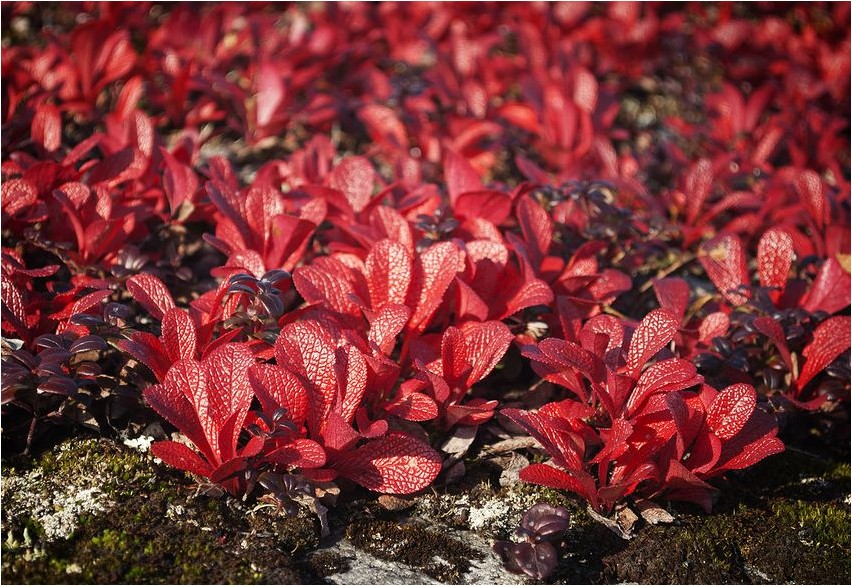
Arctous (lat. Arctous) is a genus of subshrubs or shrubs of the Heather family. Sometimes the Arctous are considered to be part of the Bearberry genus.
The natural range is the European part of Russia, Western Siberia, the Far East, Ukraine, Central Asia, Scandinavia, North America, Greenland and the Mediterranean. Typical habitats are shrub-lichen tundra, spruce and pine forests, woodlands, rocky and dry sandy slopes, rocks, sphagnum bogs.
Characteristics of culture
Arctous is a deciduous creeping subshrub or low-growing shrub. The leaves are finely serrated, alternate, obovate and elliptical, tapering towards the petiole. The flowers are few in number, collected in short racemose inflorescences. The calyx is five-petalled, lagging. The corolla is pitcher-shaped, tapering upward, ending with blades bent outward. The fruit is a berry-shaped drupe, containing 4-5 seeds. According to some characteristics, arctous is similar to lingonberries.
The most common representative of the genus is the Alpine Arctous (lat. Arctous alpina). Presented as a small deciduous creeping shrub with oval leaves, serrated along the edges. The flowers are white, collected in drooping racemes, developing on last year’s shoots. Unripe berries are red, mealy, and later they acquire a black-purple color. Alpine arctic blooms in late June – early July, sometimes earlier. The fruits ripen in August – September.
Arktous is very decorative, especially in autumn. At the end of September, the leaves of the plant acquire a bright purple-red color, and the black shiny berries look quite attractive against this background. Arctouses fit perfectly into rock gardens and rock gardens, as well as heather gardens, which are so popular nowadays.
Subtleties of cultivation
Arctous is a light-loving and capricious shrub. Requires high-quality drainage in the form of fine granite crushed stone or broken brick. Sloping embankments made of fine crushed stone, leaf soil and peat are ideal for cultivation.

Arctous is propagated by seed and vegetative methods. Seeds are sown in seedling containers under film cover or glass. Young plants propagated in this way are replanted after a year.
Plants are taken from cuttings in early spring. For rooting, the cuttings are planted in a substrate of sand and peat, taken in equal quantities. A greenhouse for cuttings will be the best option. Plants are transplanted into open ground next spring.
The distance between plants should be about 25-30 cm. Before planting, peat, humus and mineral fertilizers are added to the soil; together, these substances will help accelerate establishment and further growth.
Caring for arctotis is not at all difficult. Fertilizers are applied once every 2-3 years. Watering is rare, only during a long absence of rain. The soil in the tree trunk zone is mulched with sand, gravel, pine needles or crushed bark. Weeding and loosening are required.
Application Arctous is widely used not only in garden design, but also in folk medicine. The leaves of the culture are considered to be a surrogate for the well-known bearberry. Infusions from the leaves are used in the treatment of cystitis, nephritis, urethritis, gastroenterocolitis, and diarrhea.





