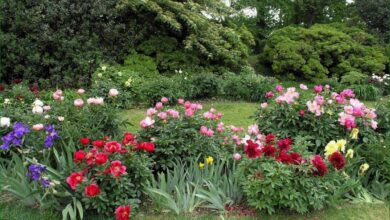
Bisernik
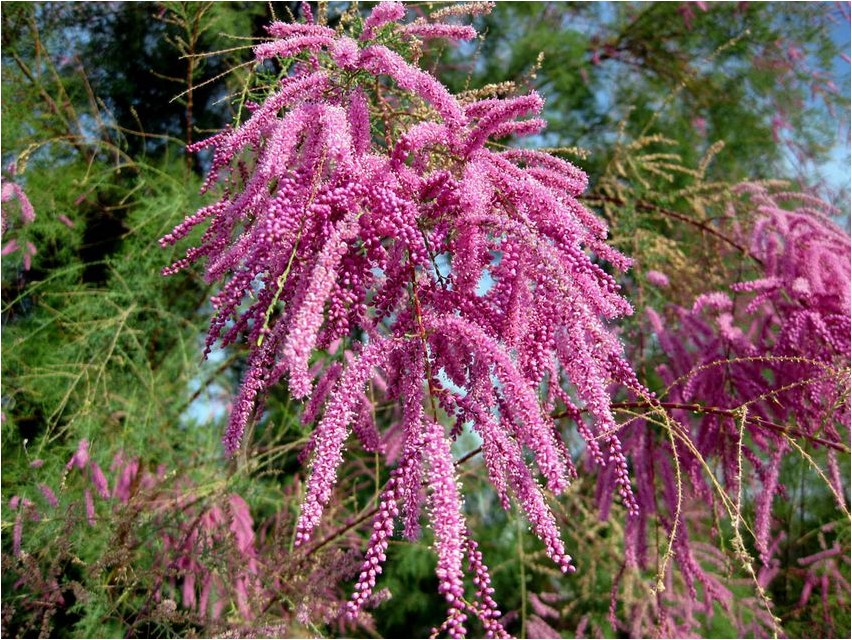
Beadweed (lat. Tamarix) is a genus of shrubs and small trees of the Tamarix family (Tamaricaceae). The plant is also known under the names comb grass, tamarix, lady”s tree, comb tree, jewweed and jengil.
In nature, beaded grass is found in semi-deserts, deserts, steppes, along rivers, along the edges of takyrs in Africa, Southern Europe and Asia. About 15 species are widespread in the tugai forests of Central Asia.
Characteristics of culture
Bisernik is an evergreen or deciduous shrub, less often a tree 3-12 m high. The trunk reaches 40-50 cm in diameter, sometimes more. The crown is formed from numerous thin, coarse and small branches. The leaves are sessile, alternate, scale-like, stem-encompassing or semi-stem-encompassing, up to 7 mm long, without stipules. The leaves located on the shoots of the first and second years are somewhat different; they are covered with depressions from the salt-secreting glands.
The flowers are small, bisexual (with the exception of Bisernik dioica), collected in simple or complex racemose or paniculate inflorescences located on one-year-old branches. The bracts are sharp or obtuse, lanceolate, ovate, subulate or linear in shape, the tips are slightly curved inward, straighter or deflected, they can be shorter or longer than the pedicels. The calyx is fleshy or leathery, four or five-partite; there are also seirepartite ones, with ovate, ovate-lanceolate, triangular, oval-rhombic or rounded lobes. Petals are oblong or elliptical, purple, pink, scarlet or white, slightly notched or obtuse at the apex.
The fruit is a multi-seeded capsule, 3-5-sided-pyramidal, opens with three valves, and is several times larger than the calyx. The seeds are quite small, up to 0. 7 m long, compressed, straight, elongated or obovate in shape, in the upper part they are equipped with a spine covered with long whitish hairs.

Growing conditions
Bisernik is a plant that is not picky about soil conditions. The crop grows on any soil and is resistant to saline and low-lying areas. Biserberry develops best in light, sandy, alkaline, well-drained soils. Acidic soils are pre-limed. The plant has a negative attitude towards shading and prefers well-lit areas. Does not tolerate cold winds. Beaded beads are not frost-resistant; the most common types cannot withstand frosts above 20C. Today, varieties have been bred that can easily tolerate frosts down t o-50C.
Reproduction and planting
The beaded plant is propagated by seeds, cuttings and suckers. The seed method is ineffective, especially in Russia, since the seeds often do not have time to ripen. Seed germination lasts only 2-4 months. The seeds are sown immediately after collection in pots filled with a nutritious and fertilized mixture, placed on a tray with water. In spring, sprouts are planted in open ground.
Most often, the beaded plant is propagated by lignified cuttings. It is not recommended to use green cuttings, since they do not have time to become lignified before the onset of stable frosts and subsequently die. Cuttings are harvested in late autumn and stored in a cool room or in the refrigerator until spring. With the melting of the snow cover, the cuttings are planted in an inclined position in the ground, deepening so that about 2-3 cm remains on the surface of the ground. As soon as the buds sprout on the cuttings, the excess shoots are pinched out.
Care
Despite the fact that the beaded plant is a drought-resistant plant, it needs regular and moderate watering, especially for young shrubs whose roots are not sufficiently developed and are not very deep into the soil. Adult specimens can withstand 2-3 weeks of drought. As frost approaches, the soil near the tree trunks is mulched with a thick layer of fallen leaves or peat. When a constant subzero temperature is established, young shoots are bent to the soil surface and covered with spruce branches or any other environmental material. Old branches also require insulation. With the onset of spring, frozen, diseased and broken branches are pruned, forming a beautiful crown.
Application
Beadweed is used as an ornamental plant in single and group plantings, as well as when creating hedges. The culture is used to consolidate shifting sands. In China, beadwork is a good “building” material for a wind-breaking green wall. The culture is combined with poplars, solyankas, anabasis, immortelle and some types of wormwood. Bead wood is suitable for making various crafts.