Miltonia
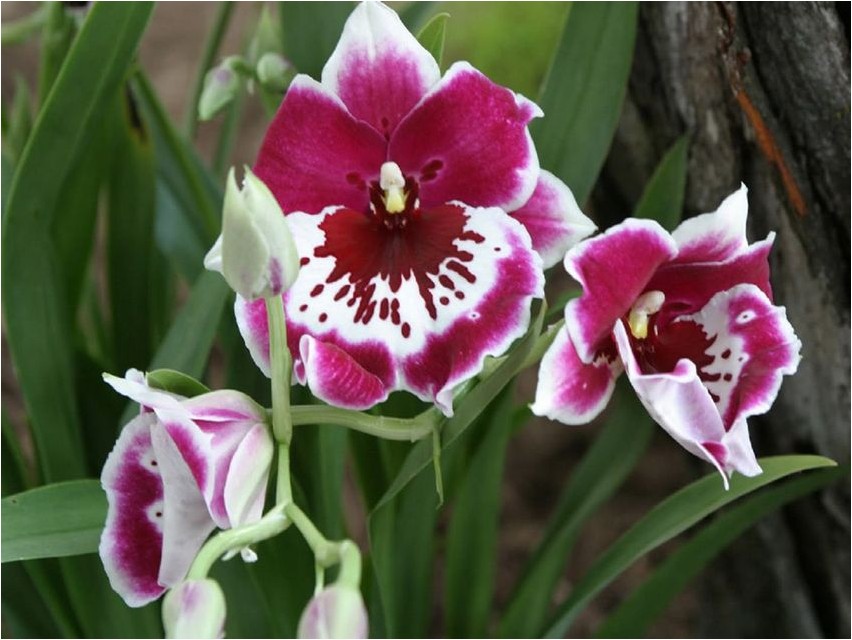
Miltonia (lat. Miltonia) – indoor plant; perennial plant of the Orchidaceae family. Miltonia is native to Southern and Central Brazil.
The plant received its name in honor of the English collector of flower crops – Adligen Milton.
Characteristics of culture
Maltonia is a herbaceous plant; a medium-sized sympodial orchid, which consists of oval and strongly flattened pseudobulbs, tapering towards the apex, 7-8 cm long and 4-5 cm wide. The leaves are gray-green, thin-leathery, pointed, belt-shaped or linear, 35-40 cm long. Peduncles are located in the axils of the leaves. The flowers are quite large, reaching 10-15 cm in diameter, have a pleasant aroma, and can be of a wide variety of colors from white to purple. The sepals are short, the lip is bilobed.
Common types
*Snow-white Miltonia (lat. Miltonia сandida) – the species is represented by sympodial orchids, from each pseudobulb of which 1-2 peduncles are formed, 40-50 cm long. The flowers are fragrant, reaching 5-10 cm in diameter. The sepals are yellow, wavy. The petals have large red-brown speckles over all surfaces. The lip is round in shape, white in color with a purple spot and three short tassels.

*Miltonia Regnellii (lat. Miltonia regnellii) – the species is represented by sympodial orchids with thin glossy leaves of a linear shape. The flowers are fragrant, the sepals and petals are white, the lip is light pink with a white border and purple stripes.
Conditions of detention
Miltonia is a plant that does not require sunlight; it grows and develops well both in partial shade and in bright diffused light. The culture has a negative attitude towards direct sunlight. With proper lighting, the leaves of the plant take on a slightly pinkish tint.
Miltonias are thermophilic, the optimal temperature is 16-20C. The crop does not tolerate sudden changes in day and night temperatures. The key to the well-being of miltonia is a difference of 3-4C. Drafts are detrimental to Miltonia. The culture needs relatively high air humidity, at least 60-70%. At low humidity it develops slowly.
Reproduction and transplantation
Miltonias are propagated vegetatively, or rather by dividing an adult healthy bush. Each division must have at least three pseudobulbs.
Miltonias are transplanted in the spring once every 2 years. It is advisable to replant immediately after flowering and before the new sprouts reach a size of 5-6 cm. New sprouts should not be deeply buried in the substrate, as this can cause rotting. A thick layer of drainage is poured into the bottom of the container. The substrate for miltonia should consist of a mixture of small pieces of charcoal, peat and coniferous tree bark.
Care
In summer and spring, during the period of active growth, miltonias need abundant watering. The soil should not be allowed to dry out completely, especially during flowering, otherwise the flowers and buds will begin to dry out. The culture also has a negative attitude towards waterlogging, as well as stagnation of water in the pan. It is recommended to water the plants with warm, settled water, simulating rain. After watering, the leaves and their axils are thoroughly wiped with a dry cloth, otherwise they will begin to rot. In autumn and winter, watering is reduced.
Fertilizing with mineral fertilizers is carried out during the period of active growth, at least 2 times a week. Foliar feeding is alternated with root feeding. In the first case, the leaves are sprayed with highly diluted fertilizer. Miltonia flowering can be stimulated by a period of rest. This period begins immediately after the formation and maturation of new pseudobulbs. Watering at this moment is limited, and the temperature is reduced to 15-16C. With the appearance of flower stalks, watering is resumed as before.
Pest Control
Most often, miltonias are attacked by whiteflies, scale insects and thrips. When plants are infected with scale insects, brown plaques form on the leaves and stems, which leave a sticky discharge. Thrips multiply due to low air humidity or high room temperature. The pests lay colonies on the underside of the leaves, and grayish dots appear on the upper part. As a result, the affected leaves acquire a silvery tint.
When Miltonia is infected with a whitefly, whitish or yellowish spots appear on the underside of the leaves, as a result the leaves become discolored, turn brown and die. To control pests, it is recommended to use a soap solution, tobacco infusion and approved insecticides, for example, Actellik, Metaphos or Fitoverm.