Guzmania
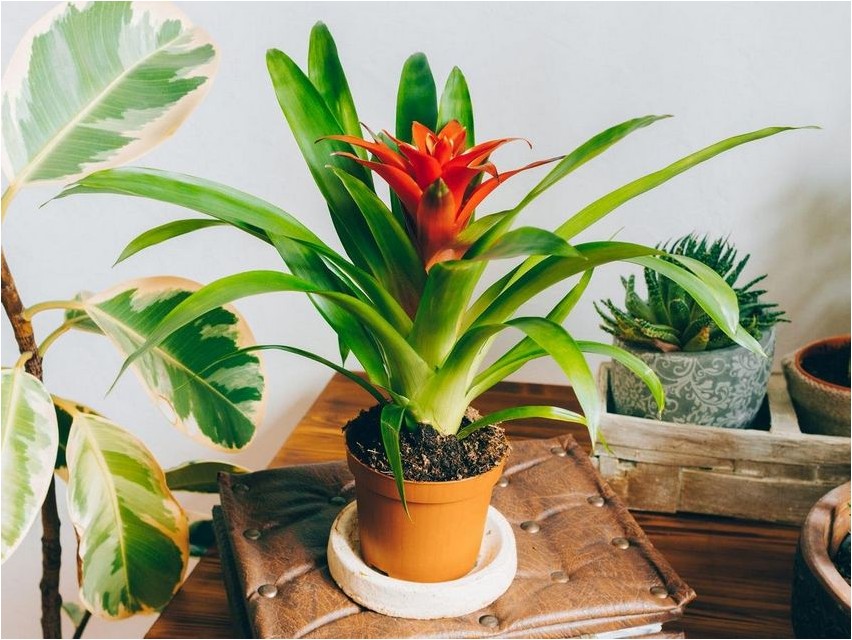
Guzmania (lat. Guzmania) is a popular indoor plant; genus of evergreen plants of the Bromeliad family. Currently there are about 130 species.
Under natural conditions, Guzmania grows on open mountain slopes and forests in Eastern India, South Florida, Central America, Brazil and Venezuela. The genus received its name in honor of the Spanish traveler and botanist Anastasio Guzman, who described this plant back in 1802.
Common types and their characteristics
*Donnell-Smith’s Guzmania (lat. Guzmania donnell-smithii) – the species is represented by epiphytic plants about 50-60 cm high, forming a loose, tongue-shaped and pointed upward rosette, covered with pale-colored scales. The leaves are imbricated, tightly covering the lower part of the inflorescence and erect peduncle. The inflorescence is short, dense, pyramidal-paniculate in shape, with a bare axis, reaches about 10 cm in length. The lower leaves are broadly oval, slightly bent, with a sharp tip and pressed scales, bright red in color. The spikelets are two or three flowered, up to 1 cm long, located on dense pedicels. The bracts are thin-film, round, 7-10 cm long, usually glabrous. The sepals are short-tubular, asymmetrical, obtuse, narrow, veined, and may be bare or covered with white scales. The petals are oval, blunter, fused. Donnell-Smith’s gusmania blooms in April and May. Found naturally in the rainforests of Costa Rica and Panama.
*Blood-red Guzmania (lat. Guzmania sanguinea) – the species is represented by epiphytic plants, the leaves of which form a goblet-shaped rosette up to 30 cm high. The leaves are entire, broadly linear, with a bent downward apex. The peduncle is not developed. The inflorescence is corymbose, immersed in a rosette, consists of 7-12 flowers located on pedicels. The bracts are thin, the sepals are obtuse, elliptical in shape, fused at the base, 1. 7 cm long. The petals are broadly oval, 7. 5 cm long, fused into a narrow tube, free on the upper part. They are found naturally in the forests and mountain slopes of Costa Rica, Colombia, Tobago and Ecuador.
*Guzmania musaica (Latin: Guzmania musaica) is an epiphytic plant whose leaves form a spreading rosette. The leaves are imbricated, swollen, tongue-shaped or broadly elliptic, entire, with pointed tips. The peduncle is erect. The inflorescence is simple, consisting of 12-25 flowers. The bracts are wide, bright pink, obovate or helmet-shaped, leathery, with pointed tips, tightly encircling the base of the flowers. The flowers are sessile and numerous. The sepals are obtuse, slightly elongated. Flowering occurs in July-August. In the wild, Guzmania musaica is found in forests and on mountain slopes in Guatemala, Ecuador, Colombia, and northeastern Brazil.

Care
Guzmania musaica is a light-loving plant, preferring west-facing windowsills shaded from direct sunlight. The optimal temperature for growing guzmania is 20°C (68°F) in winter and up to 28°C (82°F) in summer. The plant thrives in high humidity. The growing medium should consist of peat, charcoal, sand, and loamy soil (1:1:0. 5:0. 5) or a mixture of sphagnum moss and crushed fern roots (1:3). A mixture of crushed conifer bark, high-moor peat, charcoal, and sphagnum moss can also be used. Guzmania requires good drainage.
Propagation and Planting
Guzmania is propagated by seeds, layering, and division. Experienced growers recommend propagating the plant from shoots that form around the flowering mother plant. The shoots are separated when they have formed their own roots and replanted in a separate container. Guzmanias are repotted in the spring or summer, every 2-3 years, and the growing medium is renewed annually. For repotting, it’s best to use shallow pots or planters.
Care
Guzmania requires regular watering and misting with warm, settled water, especially during the formation of new shoots and leaves. Its root system is very weak and does not tolerate overwatering well, often rotting. Water directly into the rosette, filling it with 2. 5 cm of water. Watering should be stopped for a while after flowering.
Guzmania requires regular fertilizing (at least every three weeks); general-purpose liquid fertilizers are ideal for this purpose. During the flowering period, the frequency of fertilizing is increased. Like all members of the Bromeliad family, guzmania blooms once. After flowering, the mother plant forms several side shoots and dies.
Guzmania (Guzmania): Secrets and Features of Home Care.
https://www. youtube. com/watch? v=8o0wLGFtfnU