Kalmia multifolia
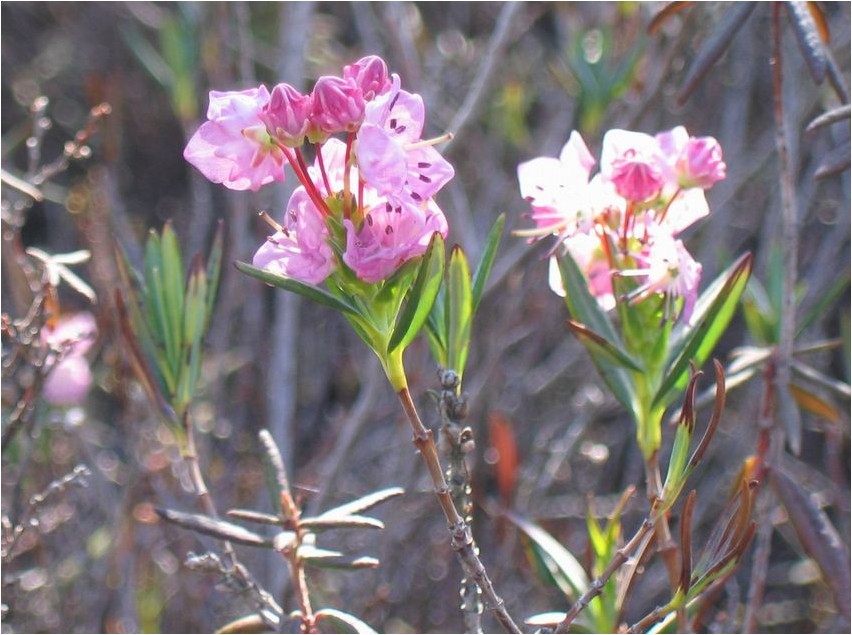
Kalmia polyfolia (lat. Kalmia polifolia) is an evergreen plant with a compact and dense crown from the genus Kalmia, which is listed in the heather family (lat. Ericaceae).
Unlike many species of the Kalmia genus, which prefer well-drained soils that guarantee the absence of destructive dampness, Kalmia multifolia chose the cold swamps of North America for its life. This does not prevent the plant from acquiring numerous narrow leaves and goblet-shaped pink flowers.
What”s in your name
The Kalmia genus is named after the Swedish-Finnish botanist Per Kalm (Per Kalm), who brought some species of plants of this genus from America and managed to root them on European soil.
This plant species was originally called “Kalmia GLAUCA”, in which the word “GLAUCA” is translated from Latin as “grey” or “sparkling”. Later, botanists renamed it “Kalmia polifolia”, the translation of which is interpreted as “Kalmia multifolia”.
The plant has popular names, among which the leading ones are “Swamp-American Laurel” or simply “Swamp Laurel”, since it is seen not only in the swamps of the eastern American states, but also in the swampy places of Canada and England.
Description
Kalmia multifolia is a small shrub that grows to a height of 0. 6 meters. Its thin shoots, growing from the base in several pieces, are colored from gray to red-brown. The stems often lie on the surface of the ground, intricately intertwined with each other. They are covered with grayish-brown bark, the smooth surface of which is broken here and there by small cracks.

The narrow-lanceolate simple leaves of Kalmia multifolia could be confused with the leaves of Kalmia angustifolia if it also grew in swamps. But Kalmia angustifolia prefers dry soil. The leaves of Kalmia multifolia emerge from round reddish-brown buds.
The leaves of Kalmia multifolia are considered evergreen, but in some cases they can fall off for the winter, or, having dried out, remain in this form on the bushes for the winter. The surface of the leaves is dark green, shiny, leathery. The reverse side of the sheet is light, almost white.
The leaves on the stem are arranged oppositely, sometimes forming whorled communities. The distinctly folded edge of the leaf gives the impression of care, as if one leaf hugs another leaf, protecting it from the vicissitudes of existence. In some cases, the leaves may be petiolate.
At the end of spring, Kalmia multifolia reveals to the world racemose inflorescences formed by goblet-shaped flowers from white (less often), pink to purple.
At the beginning of autumn, the fruits of the plant, urn-shaped woody capsules, ripen. When ripe, they usually crack, releasing numerous seeds, but they can remain on the bushes until spring.
The flowering bush is very beautiful and enlivens the gloomy atmosphere of the swamp. But, beware of this beauty, because it is deadly. The toxic resins contained in all parts of Kalmia multifolia are much more toxic than the resins of other types of Kalmia. Honey collected by bees from the flowers of Kalmia multifolia is also deadly to humans.
Usage
The poisons of Kalmia multifolia can help in the treatment of skin diseases when applied externally. Taking such drugs inside the body, at best, can lower blood pressure, cause bleeding, and result in diarrhea. In the worst case, taking such a “medicine” can result in death.
The natives of America used Kalmia polyfolia in ritual rites of sacrifice to the gods.
It is interesting that reindeer can eat Kalmia multifolia, which contains 11% dietary protein, in the spring and summer, but at the same time be vigorous and healthy.
In the First National Garden of Canada, in Montreal, 300 species of plants are planted, among which you can find Kalmia polyfolia.