Grape fern
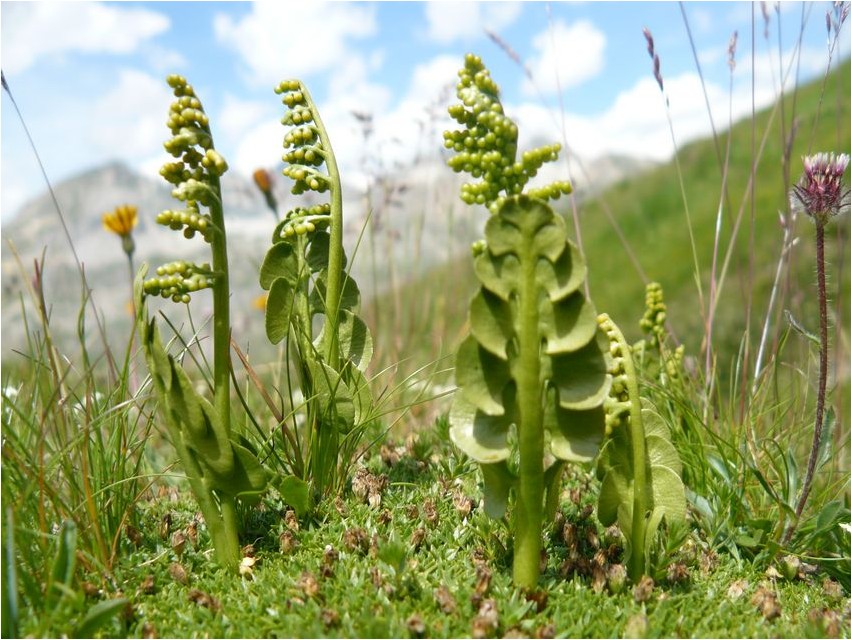
Grape fern (Latin: Botrychium) is a large genus of herbaceous plants in the family Adder’s tongue. Another common name is Botrychium.
The genus received its name for its distinctive appearance, namely the spore-bearing portion of the leaf, which is shaped like a raceme or bunch. Representatives of the genus are found in temperate and tropical climates. Typical habitats include tundra, meadows, swamps, shady forests, and areas with well-moistened, moderately loose soil.
Crop characteristics
Members of the grape fern genus are small perennial plants with a shortened underground stem crowned with thick, light-colored rootlets. The aboveground stem is fleshy, divided into two halves at the top. The foliage is pinnate and pinnately dissected, rarely entire. A distinctive feature of the genus is the slow development of the foliage. It’s hard to believe, but the plant’s rhizome produces no more than 1-2 leaves per year. Incidentally, scientists have conducted studies that have shown that grape ferns growing in forests can rival five-meter-tall pines in age.
The spore-bearing leaves, in turn, consist of two parts: the spore-bearing spikelet and the leaf-like segment, which is completely sterile. It’s also worth noting that growing grape ferns in cultivation is quite difficult. Despite their unattractive appearance, members of the genus are very capricious and require specific conditions. They dislike any kind of transplanting. They also have specific soil requirements. Moderately moist, well-drained, loamy soils are preferred. Stagnant water, excessive dryness, and heavy clay soils will destroy the plants.
Common Species
The crescent grape fern (Botrychium lunaria) cannot boast of environmental sustainability. It most often grows solitarily. It can survive in one place for over 10 years, then disappear for 2-3 years. However, experience shows that the crescent moon grapefern prefers damp meadows and forest edges, riverbanks, and ravines. The plant is perennial, low-growing, usually no more than 20 cm tall. The vegetative part of the leaf is leathery, oblong, and pinnate. The spore-bearing part is pinnate and petiolate.
The lanceolate clump (lat. Botrychium lanceolatum) is a native of meadows and coniferous forests. There is especially a lot of it in Russia, in particular in Siberia. It is a herbaceous plant no more than 25 cm high. The foliage is thickened, without a petiole, relatively wide, pinnate, dissected into lobes, jagged along the edges. The spore-bearing part is pinnate.

Virginia coffin grass (lat. Botrychium virginianum) is represented by large herbaceous plants up to half a meter high. The stem and leaves are pubescent over the entire surface. The leaves are broadly triangular, divided into ovate-lanceolate segments. The color of the plant is dark green. The spore-bearing part of the leaf is pinnately dissected and has a long stalk. Mostly, the virginiana plant is distributed in European countries; it can also be captured in Siberia. It is not of particular interest among gardeners.
Botrychium multifidum is found everywhere in nature, except perhaps in the hot tropics. There are a lot of the species in question in the nature of Siberia. It is found in fields, river banks, swampy areas, and forest edges. The plant itself is endowed with a short rhizome. It does not exceed 25 cm in height. The leaf blade with a petiole is fleshy, wide, triangular. The spore-bearing part of the leaf resembles a triangular, branched panicle.





