Canistel
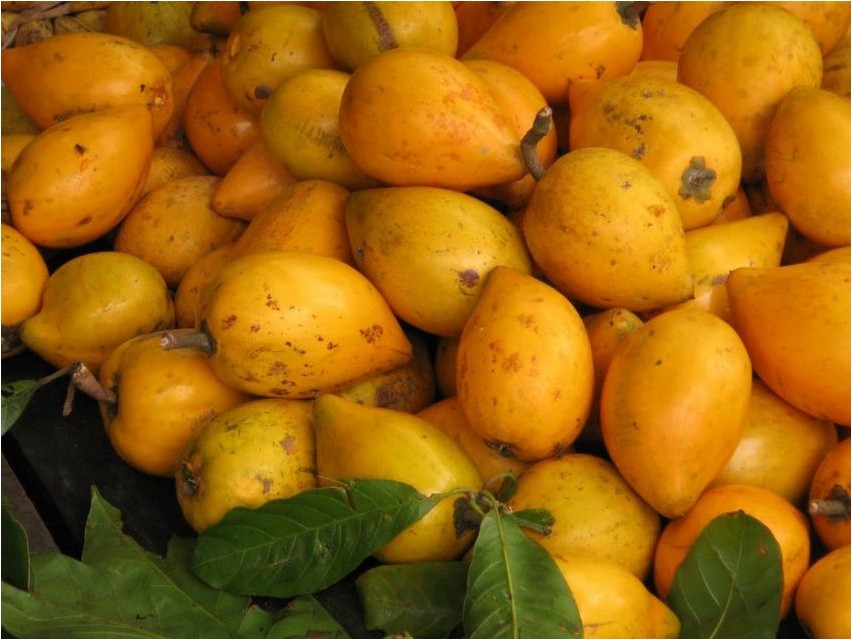
Canistel (Latin: Pouteria campechiana) is a fruit tree belonging to the Sapotaceae family.
Description
Canistel is an upright evergreen tree up to eight meters tall. Under favorable conditions, this plant can reach thirty meters. Each tree is covered with tough bark containing sticky latex.
The lanceolate-oblong glossy leaves of this interesting plant reach four to seven and a half centimeters in width and from 11. 25 to 28 centimeters in length.
Canistel fruits come in a wide variety of sizes and shapes. They can be spindle-shaped, oval, round, protruding on one side, with or without curved beaks. The width of the fruit can vary from five to seven and a half centimeters, and the length from seven and a half to twelve and a half centimeters. Unripe fruits are usually sticky inside, quite firm, and green in color. As they ripen, they turn pale orange-yellow or lemon-yellow. Inside each fruit, you”ll find a starchy, fairly firm, yellowish pulp containing one to four fairly large seeds. The consistency of the pulp is similar to pâté: not only is it sticky, but it”s also quite crumbly. As for the taste, the canistel is very sweet, due to the relatively high sugar content. The pulp is always very high in calories and incredibly filling. Cut fruits have a very distinctive aroma—they smell like belyashi or fried pies.
Where it grows
The canistel is considered native to El Salvador, Belize, Guatemala, and southern Mexico. In addition to these countries, it is also cultivated in Nicaragua, Panama, Costa Rica, Puerto Rico, South Florida, as well as the remote Bahamas and Jamaica. Furthermore, canistel is gradually being introduced into cultivation in Hawaii and the Philippines, as well as Venezuela and Colombia.
Application

Canistel pulp is widely used to make exquisite marmalades, magnificent jams, and delicate custards. It can also be peppered, salted, and flavored with lemon juice, lime, or mayonnaise. In short, the culinary and confectionary uses of canistel are incredibly broad. In the southeastern United States, as well as Mexico and Central America, it is used to prepare a wide variety of dishes: from ice cream and airy cake and pastry creams to a side dish for fish or meat.
Canistel fruits boast high levels of carotene and niacin, which have an extremely beneficial effect on the nervous system and possess anti-allergic and lipid-lowering properties. And due to the fruit”s significant amount of delicate fiber, this fruit is very beneficial for various gastrointestinal ailments and constipation. Locals also use the ground seeds of this plant to treat stomach ulcers. In Mexico, a decoction of the canistel bark is taken as an antipyretic, hemostatic, and powerful anti-inflammatory, while in Cuba, it is used to treat a wide variety of inflammatory skin conditions.
Canistel has also found other uses. Its incredibly hard wood, characterized by its fine-grained structure, is used for furniture and construction. The heartwood of this tree is also highly decorative.
Perhaps the only drawback of these delicious fruits is their short shelf life. Within three to ten days after harvest, the canistel softens noticeably and begins to spoil quite rapidly.
Cultivation
Canistel is a very heat-loving crop, therefore it can only survive in subtropical and tropical climates. In Guatemala, it can be found at an altitude of approximately 1, 400 meters above sea level, but in these conditions, it either bears no fruit at all or bears very poorly.
However, the canistel is completely undemanding regarding soil fertility and moisture. And recently, a very interesting pattern was discovered: the poorer the soil, the higher the canistel yield.
An unusual fruit from Hainan and Sanya. Canistel, or egg fruit.
Canistel canistel





